
Starting a coworking space business requires more than just renting an empty office and adding desks. Whether you’re an entrepreneur exploring the flexible workspace industry or an investor evaluating new opportunities, understanding the real costs behind launching a profitable coworking space is essential before signing any lease.
Many aspiring operators ask, “How much does it cost to run a coworking space?” before they fully grasp what it takes to open one. The reality is that your coworking space expenses list spans far beyond furniture and rent. You are essentially funding two businesses simultaneously: a real estate operation and a hospitality service.
According to 2025 industry data, startup costs for coworking spaces average around $88,000 to $210,000, though this range can swing dramatically based on your location, size, and business model. Some operators have launched barebones spaces for under $15,000, while premium urban locations can demand over $500,000 in initial capital.
This guide breaks down exactly where your money goes, what hidden expenses catch first-time operators off guard, and how to structure your coworking space budgeting to reach profitability faster.
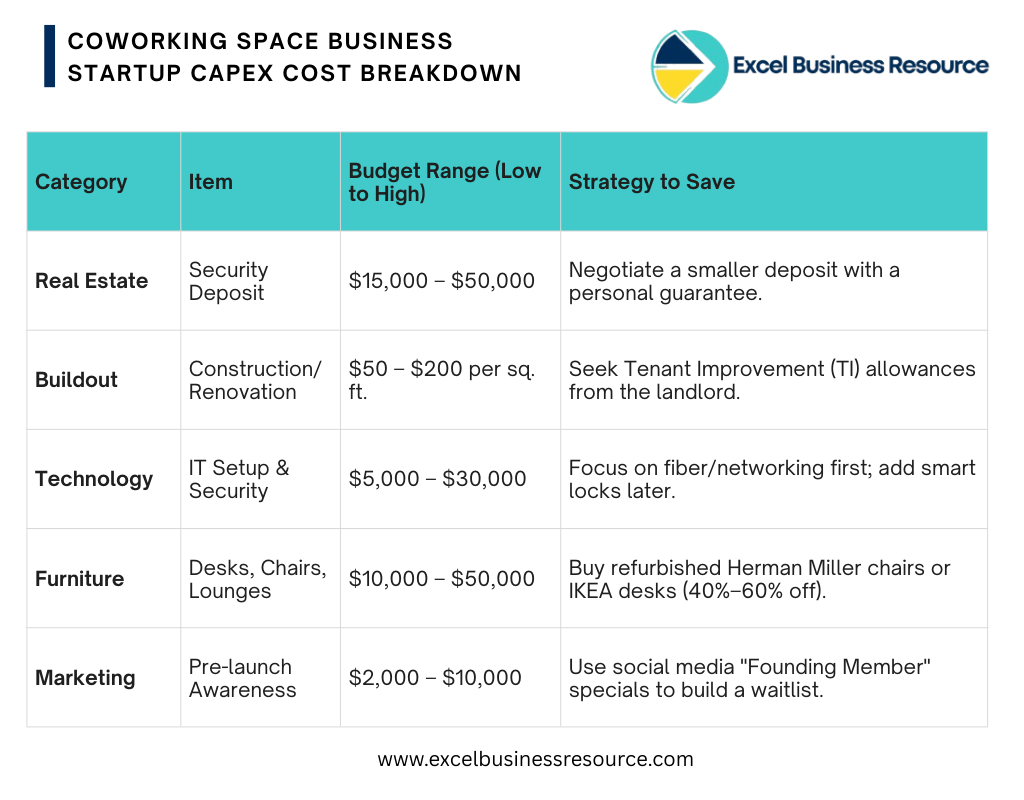
Cost Breakdown of Coworking space Startup by Category
The Physical Space: Your Largest Fixed Cost
Location drives everything. In premier urban centers like San Francisco, office listing prices hit $63 per square foot annually, while secondary markets like Detroit average closer to $22 per square foot. For a 3,000-square-foot space, this translates to roughly $8,250 monthly in rent plus a security deposit that could reach $24,750.
Your decision to lease versus buy fundamentally changes your capital structure. Leasing requires less upfront cash but demands strong credit and personal guarantees. Buying gives you asset appreciation and control but ties up significant capital that could otherwise fund operations. Most first-time operators lease initially, often negotiating Tenant Improvement (TI) allowances of $20-$60 per square foot from landlords to offset buildout costs.
Buildout and Design: Creating the Right Environment:
Construction costs vary wildly by market tier. Expect $150-200 per square foot in tier-one cities versus $80-150 in secondary markets. For a 10,000-square-foot space, this difference alone can mean $700,000 or more in variance.
Your coworking space budget template excel should account for:
- Open work areas and hot desk zones
- Private offices and phone booths
- Meeting rooms of varying sizes
- Kitchenettes and lounge areas
- Lighting, flooring, and aesthetic touches
Basic renovations including painting, flooring, and minor updates typically run $50-$100 per square foot, while full custom buildouts can exceed $150 per square foot.
Technology Infrastructure: The Non-Negotiable Foundation:
Poor internet connectivity is the fastest way to kill a coworking business. Members will tolerate mediocre coffee. They will not tolerate dropped video calls.
Budget $5,000-$30,000 for initial tech setup, including:
- Dedicated fiber internet installation ($500+/month ongoing plus ~$4,000 one-time setup)
- Enterprise-grade networking hardware and cabling
- Access control systems ($3,000+ for multi-door setups)
- Coworking management software ($200+/month)
- Security systems ($2,000 for professional installation)
Furniture, Fixtures, and Equipment (FF&E):
Ergonomic chairs run $200-$400 each, while commercial-grade desks cost $150-$300 per unit. For a space housing 50 members, furniture alone can reach $25,000-$50,000 if buying new.
Smart operators mix new purchases with budget-friendly sourcing. IKEA, Craigslist finds, and refurbished commercial furniture can cut this budget by 40-60% without sacrificing functionality.
Operating Expenses: The Ongoing Reality
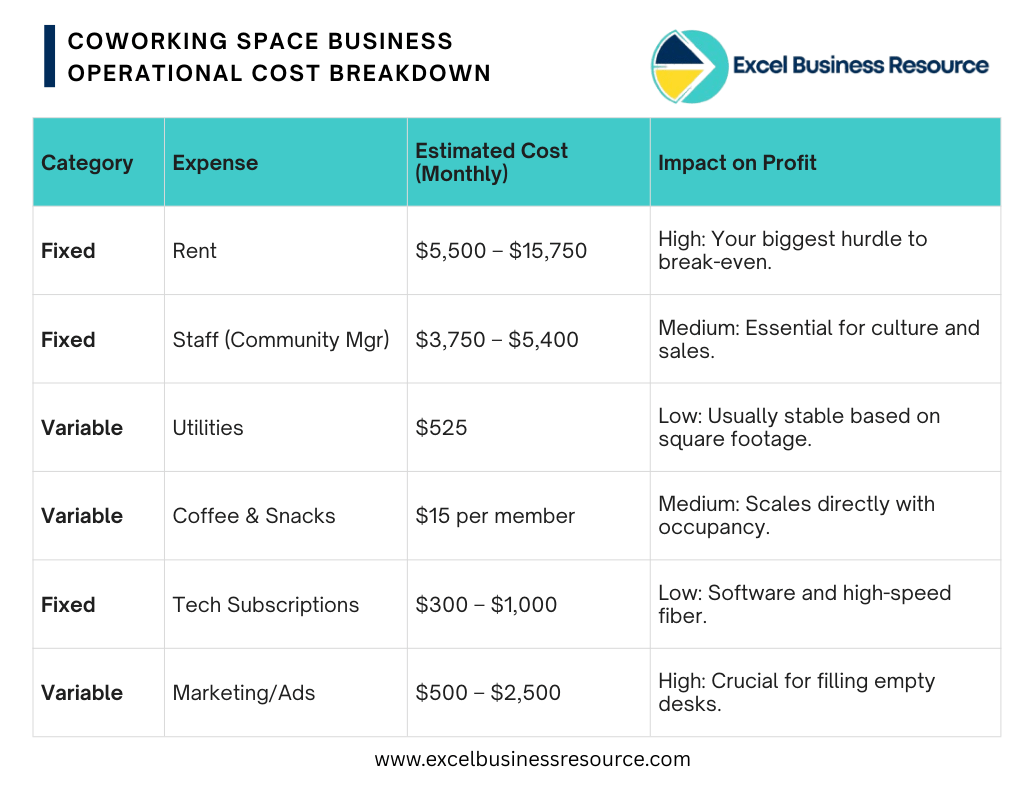
Understanding how to make a coworking space profitable requires modeling your monthly burn rate accurately. Fixed costs dominate your P&L, making occupancy your most critical metric.
Fixed Monthly Costs:
- Rent or mortgage: $3,000-$30,000+ depending on market and size
- Insurance: $500-$1,000 annually for property coverage, plus specialized coworking liability starting at $25/month
- Salaried staff: Community managers earn $45,000-$65,000 annually
- Software subscriptions: Management platforms, accounting tools, marketing systems
Variable Costs That Scale with Usage:
- Utilities: Average $2.10 per square foot annually in commercial spaces, or roughly $6,300 monthly for a 3,000-square-foot location
- Cleaning services: Tied to daily occupancy and foot traffic
- Coffee, tea, and snacks: Budget $15 per member monthly for quality coffee alone
- Printing and office supplies: $25-$50 monthly basics, plus potential revenue from paid printing services
- Marketing and advertising: $1,000-$5,000 monthly to maintain pipeline
Asset-Light Models: Reducing Your Coworking Capital Barrier
Not every successful coworking space requires half a million in startup capital. Asset-light operating models allow you to launch with significantly less risk.
In this structure, you partner with building owners under a management agreement rather than a traditional lease. The owner funds the buildout and holds the real estate risk. You operate the space, build the community, and share revenue or profits. This model reduces your coworking space startup costs to primarily technology, marketing, and initial working capital sometimes under $50,000 total.
The trade-off is lower margins and less control, but for operators focused on unit economics and community building rather than real estate ownership, this path offers faster scaling with reduced personal exposure.
Profitability Timeline and Financial Planning Of Coworking Space
The profit timeline of coworking space business typically follows a predictable pattern. Most spaces require 9-18 months to reach stabilization, defined as consistent 70%+ occupancy. During this ramp-up period, you will burn through working capital while refining your offering and building word-of-mouth.
Research from Deskmag indicates that 52% of coworking spaces are profitable, with another 27% breaking even. The remaining 21% are either pre-revenue startups or struggling with location or model issues.
To model your specific path to profitability, you need a financial projection model for coworking space that accounts for:
- Gradual occupancy ramp (typically 5-10% monthly growth early on)
- Churn rates and member retention curves
- Seasonal fluctuations in demand
- Pricing elasticity in your local market
For example, a 150-desk space with $300 average monthly membership rates and $30,000 in monthly fixed costs loses $36,000 annually at 60% occupancy but generates $46,800 profit at 75% occupancy. This sensitivity to occupancy rate is why working capital reserves matter so heavily in your first year.
Building Your Business Plan and Financial Model
A business plan for coworking space business must go beyond generic templates. Your plan needs to demonstrate deep understanding of local market dynamics, competitive positioning, and realistic financial projections based on actual comparable data.
Key components should include:
- Market analysis: Survey at least 50 potential members about needs and willingness to pay
- Competitive mapping: Analyze three direct competitors through platforms like Coworker.com, noting their pricing tiers and amenity packages
- Revenue model: Mix of hot desks ($150-$300/month), dedicated desks ($300-$600/month), private offices ($700+/person), day passes ($25-$50), and meeting room rentals (50− hour)
- KPIs of coworking space: Track occupancy rate, revenue per available desk (RevPAD), member churn, and net promoter score
- Working capital forecasting: Model 6-12 months of operating reserves based on your specific fixed cost structure.
If you are seeking funding, lenders and investors will scrutinize your burn rate analysis and path to break-even. SBA 7(a) loans are popular for coworking ventures, offering $50,000-$350,000 with rates typically between 8-11%, but they require solid personal credit and detailed financial documentation.

Tools to Accelerate Your Launch
Creating accurate financial projections from scratch is time-consuming and risky for first-time operators. Small errors in occupancy ramp assumptions or variable cost scaling can distort your entire capital requirement calculation.
At Excel Business Resource, we have supported 100+ startups in data analysis, FP&A, and financial modeling services. Our custom built Financial Model Template for Coworking Space provides a complete framework for:
- Budgeting template for coworking space with categorized expense tracking
- Coworking space financial forecasting model with 3-5 year projections
- DCF valuation capabilities for investor presentations or loan applications
- Revenue drivers of coworking space business modeling including membership tiers and ancillary income
- Startup valuation methods tailored to asset-light and traditional models
Our templates are built specifically for flexible workspace operators, incorporating industry-specific metrics like desk utilization rates, meeting room booking patterns, and community event ROI that generic startup financial model templates simply cannot capture.
Key Takeaways for Coworking Space Owner’s:
Launching a coworking space is capital-intensive but potentially rewarding for operators who combine hospitality instincts with rigorous financial discipline. Your success hinges on three factors: choosing the right location for your target demographic, maintaining adequate working capital through the 12-18 month stabilization period, and building genuine community that drives retention and word-of-mouth growth.
Before committing capital, validate demand through direct market research, analyze comparable spaces in your target market, and build detailed financial models that stress-test various occupancy scenarios. The difference between a struggling space and a thriving community hub often comes down to preparation depth in the pre-launch phase.
For entrepreneurs ready to move forward, investing in a professional coworking space financial model template and budgeting template for coworking space pays dividends in lender confidence, investor clarity, and your own operational peace of mind.
Founder's Ask Questions (FAQs)
Startup costs typically range from $88,000 to $210,000. Basic spaces in secondary cities can launch for $50,000, while premium urban locations often exceed $500,000. Costs vary based on location size, market tier, and whether you choose an asset-light or traditional lease model. Use a financial projection model for coworking space to calculate your specific capital needs before committing.
Most spaces reach profitability in 9 to 18 months. Break-even occurs at 65-75% occupancy, with reliable profits emerging at 70-85%. The key is maintaining 6-12 months of working capital reserves to avoid desperate pricing decisions during the ramp-up phase.
Four costs often surprise first-time operators: tenant improvement overruns (20-30% above estimates), technology infrastructure ($30,000+ for fiber, access control, and software), specialized insurance requirements, and community building expenses essential for retention. A detailed coworking space expenses list template helps you budget for these overlooked items.
Build your model around three components: revenue drivers (membership tiers, meeting rooms, events), realistic occupancy ramp (5-10% monthly growth), and sensitivity analysis for pricing and timing scenarios. Include burn rate analysis, unit economics per desk, and DCF valuation for investors. Our financial model template for coworking space provides these frameworks pre-built with industry-validated metrics.
Coworking generates 2-3x revenue per square foot versus traditional office leases but requires active hospitality management . Asset-light models offer faster returns with lower risk, while owner-operators capture higher upside but tie up more capital. Evaluate opportunities using a valuation template of coworking space that assesses both cash flows and community brand value.