
Why Your Battery Startup Needs a Battle-Tested Plan
Let’s be real for a second. You’re not just starting another tech company you’re diving into one of the most capital-intensive, technically complex industries on the planet. The battery manufacturing sector is exploding with opportunity, but it’s also where great ideas go to die when founders underestimate what they’re getting into.
You’ve probably read the headlines about the EV revolution and trillion-dollar market opportunities. But here’s what those articles don’t tell you: most battery startups fail not because their chemistry doesn’t work, but because they run out of cash six months before their yield rates hit viable levels. The gap between working prototype and profitable production is a graveyard littered with companies that had brilliant engineers but naive financial projections.
At Excel Business Resource, we’ve lived through this with over 100 startups. We’ve seen founders burn six months trying to model depreciation curves for equipment that hasn’t been invented yet, or guess cash flow timing for dry room construction delays. That’s exactly why we built investor-ready business plan templates and detailed ready to use financial forecasting models for 30+ industries including battery manufacturing that actually account for yield ramp curves, scrap rates during production ramp-up, and the brutal reality of gigafactory economics.
Whether you need a complete business plan for battery manufacturing or a customizable financial plan for battery manufacturing, we’ve done the heavy lifting on the financial architecture so you can focus on what you do best: building better batteries. Let’s create a plan that survives due diligence and gets you to production ready without running out of runway.
Is Battery Manufacturing Actually Profitable for Startups?
The short answer: yes, but only if you understand the economics.
Battery manufacturing profitability hinges on two brutal metrics: throughput (how many cells you actually produce) and yield (the percentage that pass quality control). Even tier-one manufacturers took four years from production start to reach profitability at major facilities. Think about that four years of burning cash while you figure out how to make cells that don’t short-circuit or overheat.
For context, a 10-gigawatt-hour factory costs approximately $2 billion to build. Dry room construction alone runs $1,000-$1,500 per square foot. Industry experts peg minimum viable scale for profitability at 18-22 gigawatt-hours annually.
But here’s the founder opportunity: small scale battery manufacturing business models can be profitable much sooner if you avoid the temptation to manufacture cells from scratch. Focus on assembly operations for niche applications e-bike batteries, power tools, marine storage, or stationary energy systems where you’re importing cells and integrating them into application-specific packs. These operations require significantly lower capital (often under $500,000 versus $46M+ for full cell production) and can reach profitability within 12-18 months.
In short, If you’re asking is battery manufacturing profitable, understand that the answer depends entirely on your scale, whether you’re making cells or assembling packs, and how realistic your financial model is about the 2-3 year ramp-up period where your yields might start at 50% and slowly crawl toward 90%.
Essential Components of an Investor-Ready Battery Manufacturing Business Plan
A generic business plan template will get you laughed out of investor meetings. An investor ready battery manufacturing business plan template needs these specialized, industry-specific sections:
Executive Summary: Your 60-Second Survival Pitch
Business Introduction: Define your niche immediately. Are you producing lithium-ion cells from scratch (capital intensive, high risk), or assembling battery packs for specific applications like eVTOLs, marine storage, or industrial equipment (lower capital, faster to market)? Clarity here signals you understand the difference between these models and have chosen strategically.
Market Opportunity: The global battery market is racing toward a planetary-scale transition, but avoid generic Total Addressable Market (TAM) figures that mean nothing. Instead, cite specific demand signals: Two in five energy utilities are integrating batteries with renewable systems, creating immediate demand for stationary storage or The e-bike market alone is growing 11% annually with chronic battery supply shortages.
Products and Services: Detail your form factor (cylindrical, prismatic, pouch) and chemistry (NMC, LFP, solid-state). If you’re developing next-generation technology like solid-state batteries, acknowledge the manufacturability challenges defectivity in thin-film solid electrolytes can short-circuit entire batches, and you’ll need specialized equipment that costs 3x standard lithium-ion lines.
Marketing & Sales Strategy: Battery sales are B2B and relationship-driven. You don’t just list your product on Amazon and wait for orders. Outline your customer acquisition strategy for EV OEMs, energy storage integrators, or consumer electronics brands. Note that 69% of energy companies now offer Battery-as-a-Service models could this recurring revenue model work for your startup instead of one-time hardware sales?
Financial Highlights: Be brutally honest about the ramp. Show year-by-year throughput projections, yield improvement curves, and break-even analysis. Smart investors want to see you understand it takes 18-36 months to reach positive cash flow in this industry.
Call to Action: Specific funding ask with clear use-of-funds breakdown (typically 40% equipment, 30% working capital, 30% R&D).
Market Analysis: Beyond the Hype
Analyze your competition not just by company names, but by geography and specialization. China currently dominates lithium-ion production, so explain your leapfrog strategy perhaps focusing on applications where current tech falls short, like extreme-weather storage, aerospace applications, or rapid-charging solutions for commercial fleets.
Operations Plan: The Devil is in the Dry Room
Detail your facility requirements with specifics that show you’ve actually toured a battery plant:
- Environmental controls: Ultra-low humidity (dew points below -40°C) and clean room classifications
- Production flow: Electrode fabrication → Cell assembly → Formation and aging → Testing and grading
- Quality protocols: Inline process control systems to detect dendrite growth or separator defects before they cause thermal runaway
Management Team: Why You Won’t Quit When Yields Hit 30%
The most important factor in battery manufacturing success is determination. You’ll be in a factory where everyone is stressed because the yield is terrible, equipment is breaking, and investors are asking why you’re behind schedule. You need a team that’s been through manufacturing ramp-ups before. Highlight operators who’ve scaled physical products, not just software engineers who’ve read about batteries.
Risk Analysis: Mapping the Valley of Death
Address the challenges in battery manufacturing business head-on:
- Technology risk: Will your chemistry actually scale from lab to production line?
- Supply chain risk: Lithium price volatility and geopolitical concentration (most processing happens in China)
- Talent scarcity: 60% of battery manufacturers face severe skills shortages in manufacturing engineering
- Regulatory risk: BIS certification, environmental clearances, Factory Act compliance
Licenses, Compliance, and Regulatory Reality
Regulatory navigation is where business plan for battery manufacturing credibility gets tested. You’ll need:
General Business Licenses:
- Company registration and GST
- MSME registration for government benefits
- Factory license under the Factories Act (requires detailed site plans, hazard waste disclosures, and labor commissioner approval)
Industry-Specific Certifications:
- BIS Certification: Mandatory sample testing at BIS-recognized labs for safety standards
- Environmental Clearances: Authorization for hazardous waste management (you’ll be dealing with toxic solvents and heavy metals)
- Fire Safety: Specialized NOCs given the thermal runaway risks battery fires can’t be put out with water
- Import Licenses: If sourcing lithium, cobalt, or specialized equipment from international markets
Documentation Requirements:
- Detailed layout/site plans showing dry room specifications and ventilation systems
- Machinery lists and manufacturing process descriptions
- Raw material safety data sheets
- Test reports from accredited laboratories showing your cells meet safety standards
Navigating the Challenges in Battery Manufacturing Business
The challenges in battery manufacturing business aren’t just technical they’re existential. Here’s how successful founders address them:
- The Talent Gap There simply aren’t enough experienced battery manufacturing engineers in the market. Your plan should mention recruitment from adjacent industries (pharmaceuticals, semiconductor manufacturing, food processing) and partnerships with technical universities to build a talent pipeline.
- Supply Chain Volatility Lithium prices fluctuated 400% between 2021-2023. Your financial plan for battery manufacturing must include scenario analysis for raw material cost spikes and show secured offtake agreements with suppliers.
- Technology Obsolescence With solid-state and sodium-ion batteries emerging, committing to today’s lithium-ion equipment carries stranded asset risk. Mention modular production lines that can adapt to new chemistries as technology evolves.
- Yield Management Poor quality control doesn’t just hurt margins it creates safety liabilities. One major recall cost an OEM $1.9 billion. Your plan must describe inline inspection systems, statistical process control, and traceability systems that track every cell back to its raw material batch.
Small Scale vs. Large Scale: Choosing Your Path
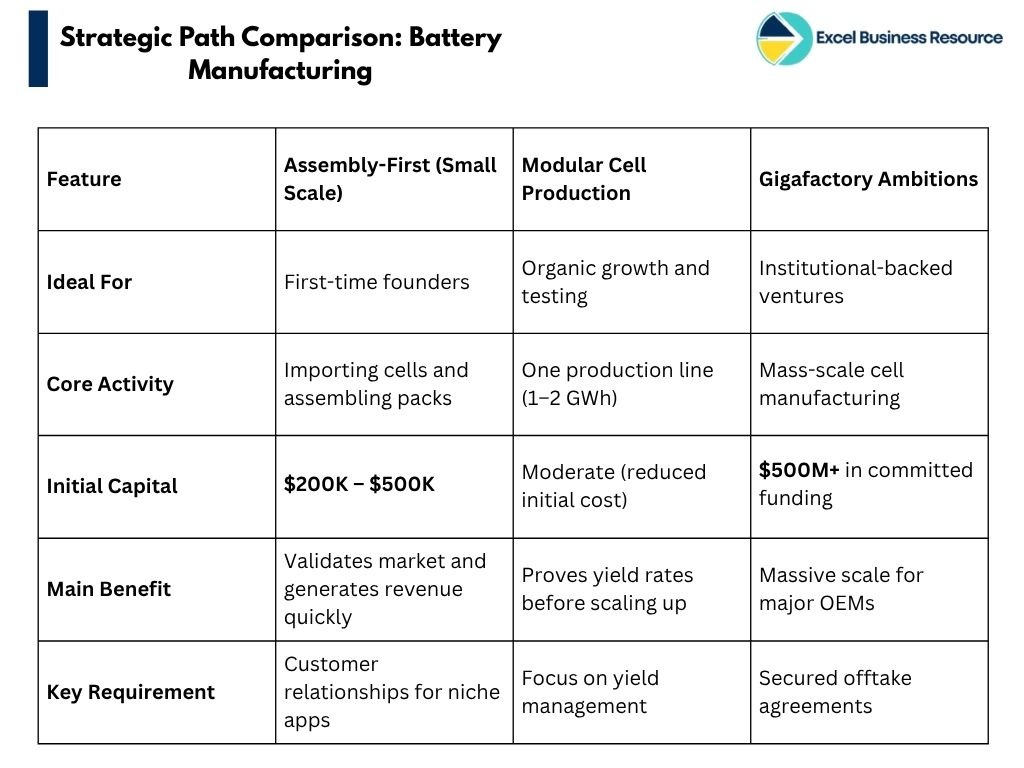
Not every founder needs to build a gigafactory. Consider these strategic paths:
Assembly-First Approach (Recommended for First-Time Founders): Start with a small-scale battery manufacturing business importing cells and assembling packs for specific applications. This validates your market understanding with $200K-$500K investment versus $46M+, lets you build customer relationships, and generates revenue while you perfect your technology.
Modular Cell Production: Begin with one production line (1-2 GWh capacity) and expand organically. This reduces initial cost to start battery manufacturing plant while proving your yield rates before committing to massive scale.
Gigafactory Ambitions: Only pursue this if you have secured offtake agreements with major OEMs and $500M+ in committed funding. The capital intensity and 3–4-year timelines require institutional backing and a team that’s done this before.
Conclusion
The transition to electrified transportation and renewable energy storage isn’t coming it’s here. But unlike SaaS startups, startup battery manufacturing business ventures require industrial-grade patience, institutional capital, and operational excellence. Your battery manufacturing business plan isn’t just a fundraising document; it’s a survival roadmap through what industry insiders call the valley of death.
Whether you’re drafting a financial model for battery manufacturing for a modest assembly operation or pitching a gigafactory to institutional investors, success hinges on brutal honesty about timelines, yields, and capital requirements. The founders who win in this space aren’t necessarily the ones with the best chemistry they’re the ones who built financial models that anticipated the 3 AM production line failures, the lithium price spikes, and the 18-month yield ramp.
The battery revolution needs founders who understand both ions and income statements. It needs builders who can survive the grind of manufacturing scale-up while keeping investors confident during the inevitable delays. Build your plan with eyes wide open to the challenges, staffed with a team that’s been through the fire before, and capitalized to survive the long ramp to profitability.
The future of energy is being written in factories, not just laboratories. Make sure your business plan gets you from prototype to production without becoming another cautionary tale.

Ready to stop wrestling with spreadsheets? Visit Excel Business Resource to explore our battery manufacturing business plan template, financial model for battery manufacturing startup tools, and industry-specific resources that have helped 100+ founders turn technical visions into investor-ready realities. From battery manufacturing business plan sample structures to fully customizable battery manufacturing financial model Excel template files, we provide the financial infrastructure so you can focus on building the future of energy.