

As the founder of Excel Business Resource, I have spent the last several years working alongside more than 100 startups across dozens of industries. During this time, I have seen a recurring pattern that would surprise most scientists and entrepreneurs. About 80% of the biotech business plans that land on an investor’s desk are rejected almost immediately. It is not because the science is bad or the team is unqualified. Instead, the specific factor that leads to failure is a lack of commercial de-risking.
Most founders focus entirely on the lab results while ignoring the roadmap to market. In this guide, I am sharing the exact framework we use for our premium clients at Excel Business Resource to help you move from the lab bench to a successful Series A or B round.
What Investors Really Look for in a Biotech Business Plan
Before you start typing, you need to understand the mind of a biotech investor. Unlike a tech investor who looks for rapid user growth, a biotech investor is looking for a clear path through a long, expensive, and regulated journey. They want to see that you understand the “Value Inflection Points.” These are the specific milestones, like finishing a Phase I trial or securing a patent, that significantly increase the value of your company.
Investors are also looking for a “Moat.” In this industry, that means your Intellectual Property (IP) strategy. If you cannot prove that you own your discovery and can protect it for the next twenty years, the most brilliant science in the world won’t get funded. They want to know that you are not just building a product, but a sustainable business that can survive the ten-year window it often takes to reach a commercial exit.
Also Track: Top 10 Biotech Startup KPIs Investors Care About
Essential Steps to Build Your Investor ready Biotech Business Plan
To make your plan stand out, you need to follow a structure that answers an investor’s questions before they even ask them. Each section serves as a building block for your credibility.
- The Executive Summary
The executive summary is the first thing investors read, and often the only thing they read if it does not grab them. It should be no longer than two pages and must answer three questions right away: What problem are you solving? What is your solution? And why is your team the right one to execute?
Keep the science simple here. Save the deep technical language for the appendix. The executive summary is not about impressing investors with jargon. It is about making them want to read the rest of the document.
Founder Tip: Avoid getting bogged down in the chemistry here. Focus on the “Unmet Medical Need.” If your drug or device can save the healthcare system money or improve patient lives better than anything currently available, lead with that.
Problem and Opportunity
This section explains the medical or scientific problem you are solving and frames it as a market opportunity. Start with the patient. How many people are affected? What does their current treatment look like? What is failing them?
Then move to the market. Industry research suggests that unmet medical needs in rare diseases, oncology, and metabolic disorders represent massive opportunities for companies with novel approaches. The key is specificity. Do not say your market is worth billions. Tell investors what percentage of a clearly defined patient population you are targeting and what your revenue per patient looks like at scale.
Pro tip: Use published clinical literature and epidemiological data to support your patient population numbers. Investors will fact-check your numbers, and sourced claims always hold more weight than estimates.
Product or Technology Overview
This is where you explain your science, but in a way that a non-scientist investor can follow. Use visuals where possible. A mechanism of action diagram, a clinical development timeline, or a comparison table showing how your approach differs from existing therapies can make a complex story much easier to follow.
Cover the following: What is the product? What stage of development is it in? What data do you already have from preclinical or early clinical work? What are the key technical risks and how are you planning to manage them?
Pro tip: Be honest about the risks here. Investors know that Biotech is a high-risk space. What they want to see is that you understand the risks clearly and have a plan for managing them. Founders who pretend there are no risks come across as either naive or dishonest, and neither impression helps.
Regulatory Strategy
This is the section that most founders underestimate, and this is exactly why 80% of Biotech business plans get rejected.
Your regulatory strategy must include your target indication, your proposed FDA pathway, any conversations or pre-submission meetings you have already had with regulators, and a realistic timeline from your current stage to approval. If you are pursuing accelerated approval, breakthrough therapy designation, or fast track status, explain why you qualify.
If your product is being developed for multiple markets, such as the US and EU, address both regulatory pathways separately.
Pro tip: If you have not yet had a pre-IND or pre-submission meeting with the FDA, schedule one. Even if your product is early-stage, that conversation gives you data points that investors trust. It shows seriousness and regulatory maturity.
Clinical Development Plan
Walk investors through your clinical roadmap step by step. Show the phases, the expected timelines, the patient enrollment targets, and the endpoints you will use to measure success.
Be clear about what happens at each go or no-go decision point. What data will you need to advance to the next phase? What will it cost? How long will it take?
This section should also address your manufacturing strategy for clinical supplies. Are you outsourcing to a contract manufacturing organization? Do you have a GMP-compliant facility? These logistics matter to investors who have seen well-funded programs stall because of manufacturing failures.
Pro tip: Build your clinical timelines conservatively. Investors have seen enough Biotech plans to know that timelines almost always slip. If you present an aggressive timeline and then miss it, you lose credibility. If you present a conservative one and beat it, you build trust.
Intellectual Property
Detail your patent portfolio, including filing dates, expiration dates, and the specific claims that protect your product. If you have licensed technology from a university or research institution, explain the terms of that license, including any milestone payments or royalty obligations.
Also address freedom to operate. Have you conducted an FTO analysis? Are there any third-party patents that could block your path to commercialization?
Pro tip: If your IP is still in provisional status, say so. And tell investors what your filing strategy is going forward. A clear IP strategy is a sign of a sophisticated founding team.
Learn: How Biotech Startups Make Money: A Deep Dive into Revenue Drivers
Financial Plan and Projections
The Biotech financial plan is where many founders struggle most. Unlike a SaaS company, you cannot project revenues from year one. Your financial model needs to capture the full cost of your clinical program, your expected milestones, and the funding you will need at each stage before any revenue appears.
A well-structured Biotech financial model includes:
- Operating expenses broken down by clinical, regulatory, manufacturing, and G&A
- Milestone-based fundraising rounds tied to clinical outcomes
- Cash runway analysis showing how long each round lasts
- Scenario modeling for faster or slower clinical progression
- Revenue projections only after regulatory approval, with clear assumptions
If you need a starting point, a Biotech financial model Excel template can help you structure this properly without starting from scratch. At Excel Business Resource, our financial model for Biotech startups is built specifically to handle milestone-based funding cycles and clinical burn rates, which are quite different from traditional startup financial Model.
Pro tip: Show investors at least three scenarios: a base case, an optimistic case, and a stress case. The stress case is what separates a thoughtful team from an overconfident one. Investors almost always ask what happens if something goes wrong, and your model should already have the answer.
Estimate your R&D and launch budget with this Biotech Financial Blueprint.

Team and Advisors
List your founding team with bios that highlight relevant scientific, clinical, and commercial experience. Include your scientific advisory board and explain why each member was chosen.
If you have gaps in your leadership, such as no chief medical officer yet, acknowledge them and describe your plan to fill them. Trying to hide a gap is never a good idea. Investors will notice, and they will appreciate you more if you address it directly.
Pro tip: If your team has published research, hold patents, or has previously taken a company through an exit, make that visible. In Biotech, track record matters even more than it does in consumer startups.
Master your projections with this Data-Driven Guide to Biotech Revenue Forecasting
Common Pitfalls: Why Do Biotech Founders Make These Mistakes?
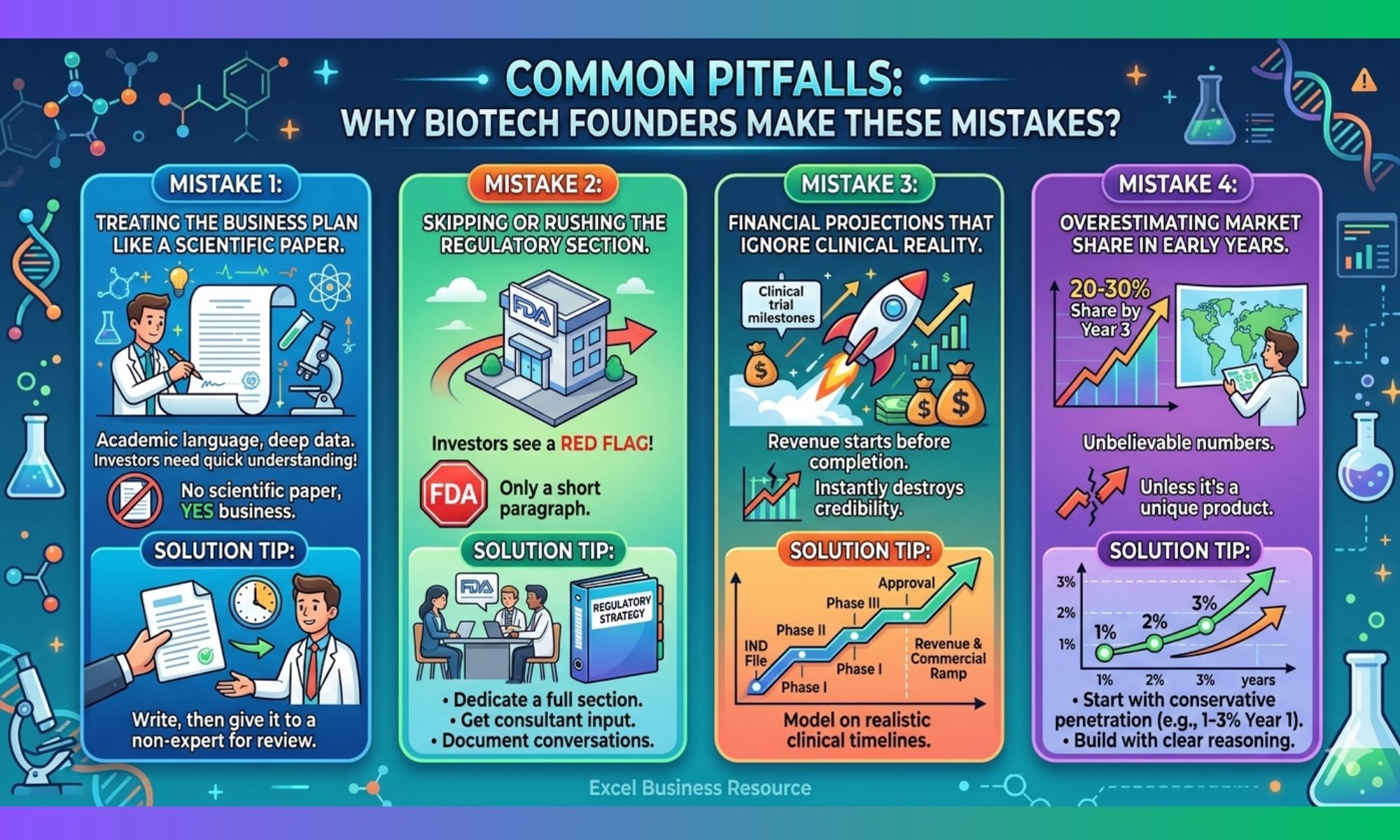
Even the smartest founders fall into traps that can stall their fundraising efforts. Over my years at Excel Business Resource, I have seen these three mistakes more than any others.
- Mistake 1: Treating the business plan like a scientific paper. Many Biotech founders have strong research backgrounds and naturally write in academic language. The problem is that investors are not reviewing your paper for a journal. They need to understand your business opportunity quickly. Keep the language clear. Move the deep technical data to an appendix.
How to fix it: Write your first draft, then give it to someone outside your field. If they cannot understand your opportunity in 10 minutes, rewrite it.
- Mistake 2: Skipping or rushing the regulatory section. This is the biggest one. Founders often write one paragraph about the FDA and move on. Investors see this as a red flag. It signals that the team has not thought through one of the most important risks in the entire business.
How to fix it: Dedicate a full section to regulatory strategy. Get input from a regulatory consultant if needed, and document any early conversations with the FDA.
- Mistake 3: Financial projections that ignore clinical reality. I regularly see Biotech plans where revenue starts in Year 2, before any clinical trial could possibly be completed. These projections immediately destroy credibility.
How to fix it: Model your financials based on realistic clinical timelines. Show when you expect to file the IND, complete Phase I, complete Phase II, and so on. Revenue should only appear after approval, and even then, a commercial ramp-up period should be modeled.
- Mistake 4: Overestimating market share in the early years. Founders often project capturing 20% to 30% of the market within three years of launch. Unless you have a sole-source product with no competition, these numbers are not believable.
How to fix it: Start with a conservative market penetration assumption in Year 1, perhaps 1% to 3%, and build from there with clear reasoning behind each growth assumption.
Conclusion
Writing an investor-ready Biotech business plan comes down to one core insight: investors are not just evaluating your science, they are evaluating your judgment. Every section of your plan, from the regulatory pathway to the financial projections, is a test of whether you understand the real challenges of building a Biotech company and whether you have the discipline to navigate them. The founders who succeed are not necessarily the ones with the most groundbreaking molecules. They are the ones who can communicate their vision clearly, plan their milestones honestly, and show investors that they have thought carefully about both the upside and the risks. If you are working on your Biotech business plan right now, take your time with it. A well-built plan is not just a fundraising document. It is a strategic tool that will guide your company through years of development, and when it is done right, it can open doors that no pitch deck alone ever could.
Frequently Asked Questions
A complete Biotech business plan should include an executive summary, problem and opportunity analysis, product or technology overview, regulatory strategy, clinical development plan, intellectual property summary, financial plan with projections, and a team section. The regulatory and clinical sections are especially important for investor readiness.
Most investor-ready Biotech business plans are between 25 and 40 pages, not counting appendices. The goal is to be thorough without being overwhelming. Investors should be able to read the core document in about an hour.
The cost to start a Biotech business varies significantly depending on the type of product and stage of development. Early-stage Biotech startups focused on preclinical work may need anywhere from $500,000 to $5 million to reach an IND filing. Companies moving through clinical trials require tens of millions. Industry research suggests that the average cost to bring a drug from discovery to approval exceeds $1 billion when you account for the full clinical program and regulatory costs.
Biotech investors look for a validated scientific concept, a clear regulatory strategy, a defensible IP position, a strong team with relevant experience, a realistic clinical development plan, and a financial model that reflects the true cost and timeline of getting to market.
A Biotech financial model should be milestone-based rather than revenue-based in the early years. It should capture clinical development costs, manufacturing costs, regulatory costs, G&A, and round-by-round fundraising tied to specific milestones. A pre-built Biotech financial model Excel template can save you significant time and ensure your model follows the structure that investors expect.
Biotech can be extremely profitable, but it takes a long time and significant capital. Most Biotech companies do not generate revenue for many years while their products are in development. Profitability depends on whether the product successfully clears clinical trials and receives regulatory approval. Companies that reach commercialization with a differentiated product can generate substantial returns, which is why sophisticated investors are willing to fund the long development journey.
A Biotech business plan template is a pre-structured document that gives you the framework, section headings, and guidance you need to write a professional plan without starting from a blank page. A good template is customizable to your specific company and product, and includes guidance on what to include in each section, particularly the regulatory and clinical sections that are unique to Biotech.
The biggest challenges in a Biotech business include the high cost and long timeline of clinical development, regulatory uncertainty, the difficulty of recruiting and retaining scientific talent, managing intellectual property, and raising enough capital to reach meaningful milestones. Many Biotech startups fail not because the science was wrong but because they ran out of money before reaching a value-creating milestone.
Start with a clear understanding of what Biotech investors care about: regulatory strategy, clinical milestones, IP, team, and realistic financials. Write in plain language that a non-scientist investor can follow. Include data to support every key claim. Be honest about risks and show how you plan to manage them. And make sure your financial projections reflect the real cost and timeline of your clinical program.
Biotech financial forecasting should include a detailed operating expense forecast by department and clinical phase, a milestone-based fundraising timeline, cash runway projections for each funding round, and revenue projections that only begin after regulatory approval. Scenario analysis showing base, optimistic, and stress cases adds significant credibility to your plan.