

If you’re a startup founder, you’ve likely hit “The Wall.” It’s that moment when your basic bookkeeping—which worked fine during the “move fast and break things” phase—suddenly feels like a liability. Your investors are asking for detailed projections, your burn rate is keeping you up at night, and you realize that a simple bank balance doesn’t tell you the real story of your business.
At this stage, you know you need help. But the terminology is a maze. Do you need a Chief Financial Officer (CFO)? Should you go for a Fractional CFO? Or is Financial Planning & Analysis (FP&A) the actual engine you’re missing?
The truth is, many founders hire a CFO when they actually need a financial architect. Others hire a bookkeeper when they need a strategist. Getting this wrong leads to expensive mistakes and “flying blind.”
In this guide, we’ll strip away the jargon and explain exactly who does what, and more importantly, when you should hire them.
The Core Difference: Strategy vs. Execution
To understand the difference, think of your startup as a ship.
- The CFO is the navigator. They look at the horizon, worry about the weather (market conditions), and talk to the fleet owners (investors).
- FP&A is the engine room. They monitor the fuel levels (cash), calculate how much power is needed to reach the next port (forecasting), and ensure the ship is running efficiently (Unit Economics).
What is a CFO (and the Fractional version)?
A CFO is a high-level executive. In a large corporation, they manage hundreds of people. In a startup, a Fractional CFO provides that same high-level brainpower on a part-time basis.
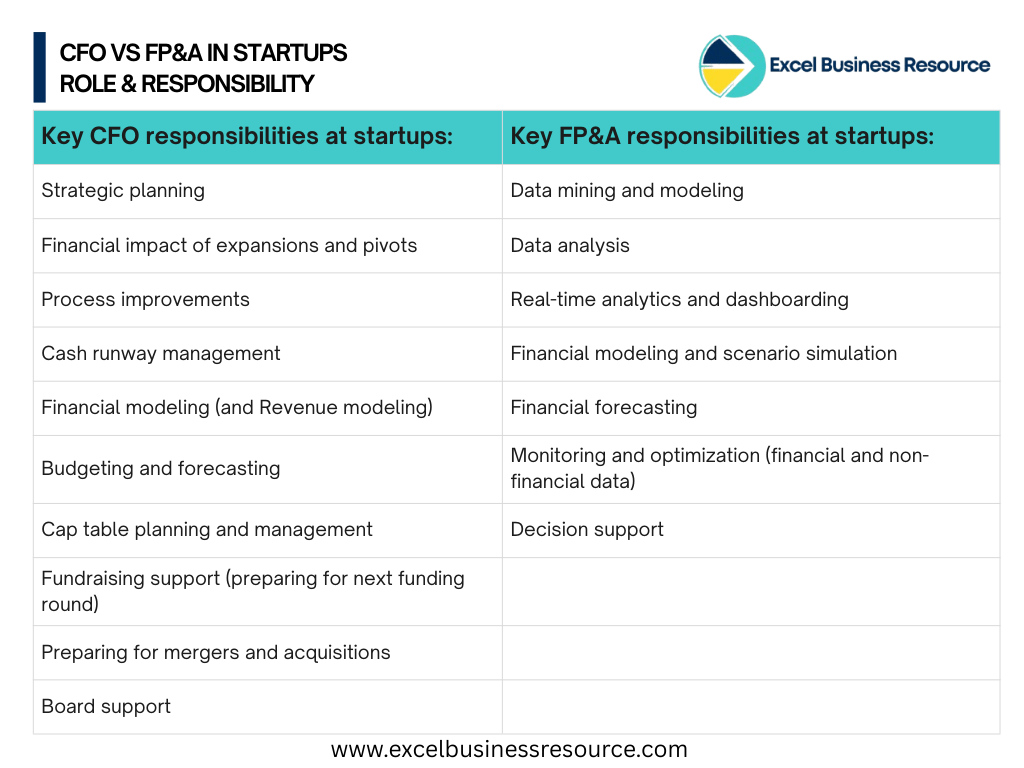
Their job is Strategic Advisory. They help you with:
- Fundraising: Structuring your Series A or B, talking to VCs, and managing your cap table.
- Governance: Reporting to the Board of Directors and ensuring you don’t get sued or audited for the wrong reasons.
- M&A: If you’re looking to buy another company or get acquired yourself.
What is FP&A for Startups?
Financial Planning & Analysis (FP&A) is about the “how.” It’s a specialized function focused on Data Analysis and decision support.
An FP&A expert or a Financial Modeling Consultant isn’t just looking at the past; they are building the future. They take the CEO’s vision and turn it into a Financial Forecasting Model. They tell you exactly how many customers you need to acquire to break even and whether your current Startup Valuation is backed by real numbers or just wishful thinking.
When to Hire: The Startup Finance Roadmap
The biggest mistake founders make is hiring “out of order.” Here is a typical, healthy progression for a scaling startup:
Phase 1: The Historian (Bookkeeper)
When: Day 1 to $500k ARR.
The Need: You just need to know where the money went. A bookkeeper keeps your transactions clean and ensures taxes are paid. This is the foundation, but it’s not strategic.
Phase 2: The Architect (FP&A / Financial Modeling)
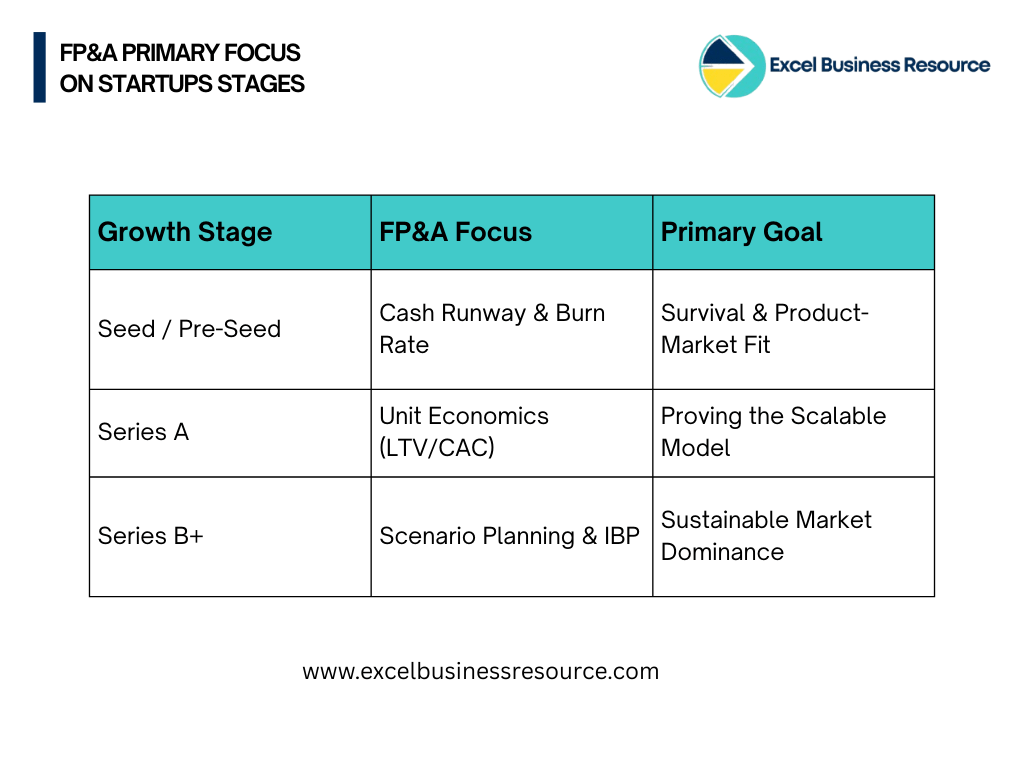
When: Pre-seed to Series A (or when your revenue models get complex).
The Need: This is often the most overlooked step. Before you hire an expensive CFO, you need a Startup Financial Model Template that works. You need someone to dive into your Unit Economics (CAC, LTV, Payback Periods).
Why now? Because a CFO cannot be strategic without a reliable Financial Modeling and Scenario Simulation tool. FP&A builds the “Source of Truth” that the rest of the leadership team uses to make decisions.
Phase 3: The Navigator (Fractional CFO)
When: Preparing for a major fundraise or managing $2M+ in ARR.
The Need: Now that you have data (thanks to FP&A), you need a Startup Advisory Service to help you use that data to win over investors. A Fractional CFO uses the models built by FP&A to tell a story to the Board.
Phase 4: The General (Full-Time CFO)
When: Post-Series B or $10M+ Revenue.
The Need: At this point, the complexity of managing a large team, multiple entities, and international tax laws requires a dedicated, full-time executive.
Why "Fractional" is the New Standard
Ten years ago, you either had a full-time CFO or you had nothing. Today, the “Fractional” model has changed the game.
A Fractional CFO or a Financial Modeling Consultant allows you to access $300k-a-year talent for a fraction of the cost. They might work with you 4–10 hours a week, giving you the high-level oversight you need without the “C-Suite” price tag or equity dilution.
The Power of the "Scenario"
If you are only looking at your “actuals” (what happened last month), you are driving a car by only looking in the rearview mirror.
Modern FP&A for Startups is about Financial Modeling and Scenario Simulation. This allows a founder to ask “What if?” questions:
- “What if we pivot to a seat-based pricing model?”
- “What if our churn rate increases by 0.5% next quarter?”
- “What if we double our marketing spend—how does that impact our runway?”
Using a robust Financial Model Template for Startups, an FP&A specialist can simulate these outcomes in seconds, giving the founder the confidence to move fast without the fear of running out of cash.
Common Myths: CFO vs. FP&A
Myth #1: “My CFO will build my models.”
Reality: Most high-level CFOs are great at strategy, but they haven’t touched an Excel formula in years. They analyze models; they don’t usually build them from scratch. This is why you often need Financial Modeling Services to build the engine that the CFO then operates.
Myth #2: “I just need a Business Plan Template to get funded.”
Reality: A static Business Plan Template is a ghost of the past. Investors today want to see a dynamic Financial Forecasting Model where they can see the underlying assumptions of your business. They want to see that you understand your Unit Economics at a granular level.
Myth #3: “Financial modeling is just for big companies.”
Reality: Big companies can afford to be slightly inefficient. Startups cannot. For a startup, a $10k error in a forecast can be the difference between a successful bridge round and closing your doors.
How Excel Business Resource Helps
At Excel Business Resource, we believe every founder deserves a “CFO-level” view of their business without the “CFO-level” expense. We bridge the gap between simple bookkeeping and high-level strategy.
We provide the tools and expertise that modern startups need to scale:
- Startup Financial Model Templates: Customized, dynamic models that grow with you.
- FP&A Support: Ongoing Data Analysis and monthly reporting to keep you on track.
- Startup Advisory Services: Helping you understand your Startup Valuation and prepare for your next big milestone.
Summary: Which one do you need?
- If you need to raise $5M+ and manage a Board, hire a Fractional CFO.
- If you need to know your runway, understand your profit margins, and forecast your growth, hire an FP&A Specialist or Financial Modeling Consultant.
- If you are pitching to investors for the first time, get a professional Financial Model Template for Startups and a solid Business Plan Template.
Don’t let your finance function be an afterthought. In the startup world, the best product doesn’t always win—the best-managed business does.
Would you like a clear look at your company’s future? [Click here to explore our Financial Modeling Services] and let’s build a roadmap that actually works for your startup.
Founder Ask Questions
Think of it as a timeline: Bookkeeping looks backward to ensure your past transactions are accurate and tax-compliant. Financial Planning & Analysis (FP&A) looks forward, using that data to build a Financial Forecasting Model and track Unit Economics. A CFO (or Fractional CFO) uses the insights from both to make high-level strategic decisions, like leading a fundraise or managing board relations.
At Excel Business Resource, we specialize in the “Forward-Looking” piece building the models and analysis that turn raw data into a strategic roadmap.
You should upgrade as soon as you have more than one “driver” for your revenue or when you are preparing for your first significant fundraise. A basic spreadsheet often misses the interconnectedness of the Three Statements (Income, Balance, and Cash Flow).
Our Startup Financial Model Template is designed to be dynamic; when you change a hiring assumption or a customer acquisition cost, your cash runway updates automatically, giving you a professional-grade tool that investors trust.
Most early-stage investors prioritize a defensible model over an expensive executive hire. They want to see that you understand your Unit Economics and have performed Financial Modeling and Scenario Simulation to prove your business can scale.
Often, hiring a Financial Modeling Consultant to build a robust model and provide Startup Advisory Services is more cost-effective and provides exactly what VCs are looking for during due diligence.
Data Analysis isn’t just about pretty charts; it’s about survival. By diving deep into your data, we can calculate your “Magic Number” (efficiency), LTV (Lifetime Value), and CAC (Customer Acquisition Cost).
If your Unit Economics are broken, more marketing spend will only make you lose money faster. Our Financial Modeling Services help you identify which customer segments are actually profitable so you can scale with confidence.
A generic Business Plan Template is a great starting point for your narrative, but its financial sections are usually too static for a modern startup. Investors want to see “What-If” capabilities.
We provide customized Financial Modeling and Scenario Simulation that allows you to test different futures. Whether you need to model a pivot, a new product launch, or a 10% cut in expenses, our tools are built to handle the “messiness” of real-world startup growth.