
Ask ten founders what a financial statement is and most will say it is something their accountant sends them. That answer is close, but it misses why the document matters. A financial statement is a formal report that shows how much a business earned, what it owns, what it owes and where its cash went during a set period. Banks read it before they lend. Investors read it before they send money. You should read it before you hire, raise prices or sign a lease.
At Excel Business Resource we have worked with more than 100 startups on FP&A and financial modeling, and one pattern repeats. Founders who can read their own numbers make steadier decisions. This guide explains the three core reports in plain language, shows how to read them, and works through one small example with real figures.
What Is a Financial Statement? Definition and Purpose
A financial statement summarizes a company’s activity for a reporting period, such as a month, a quarter or a fiscal year. Accountants build it from the general ledger, the master record of every transaction. Most businesses use accrual accounting, so a sale counts when you earn it, even if the customer pays next month.
Different readers want different answers. Owners ask whether the business makes money and can afford to grow. Lenders ask whether you can repay. Investors ask how risky the business is and what it could be worth. Tax authorities ask whether the numbers are consistent. Good records also leave an audit trail, so anyone can trace a figure back to the entry behind it. That traceability makes due diligence faster and compliance checks easier.
Financial statements answer three simple questions:
- Is the business making money?
- Does it have enough cash to keep running?
- What does the business actually own and owe?
What Are the 3 Main Financial Statements?
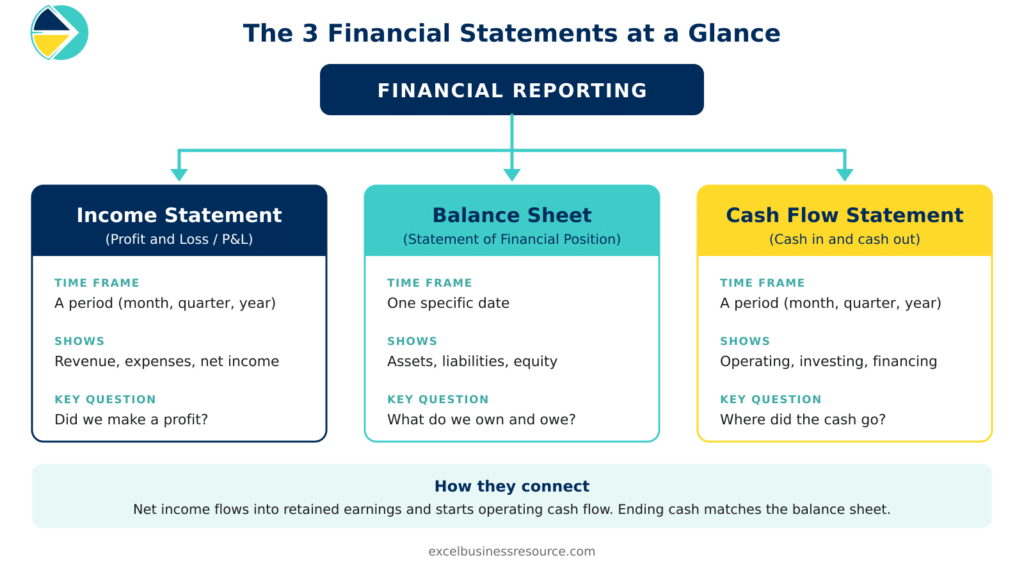
The three core statements are the balance sheet, the income statement and the cash flow statement. Each answers a separate question, and you need all three to judge a business fairly. Many companies also publish a fourth, the statement of shareholders’ equity (or owner’s equity), which shows how ownership value changed during the period.
Balance Sheet (Statement of Financial Position)
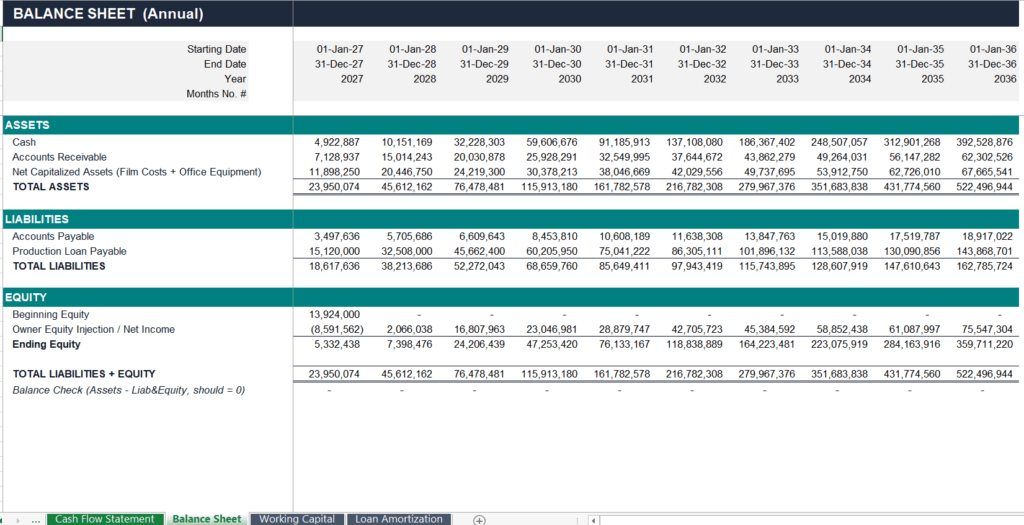
The balance sheet, also called the statement of financial position, is a picture of the business on one date. It lists assets such as cash, receivables, inventory and equipment. Next come liabilities such as supplier bills and loans. The rest is equity, the part that belongs to the owners. Both sides must always match:
Assets = Liabilities + Equity
Assets (what the business owns):
- Current Assets: Cash, accounts receivable, inventory (things that can turn into cash within a year)
- Non-Current Assets: Equipment, property, long-term investments
Liabilities (what the business owes):
- Current Liabilities: Bills, short-term loans, and other amounts due within a year
- Non-Current Liabilities: Long-term loans and other long-term obligations
Equity:
- Owner’s capital plus retained earnings (profits kept in the business)
The balance sheet helps you see whether the business is financially stable and can pay its short-term bills. If they do not match, something is recorded wrongly.
Income Statement (Profit and Loss / P&L)
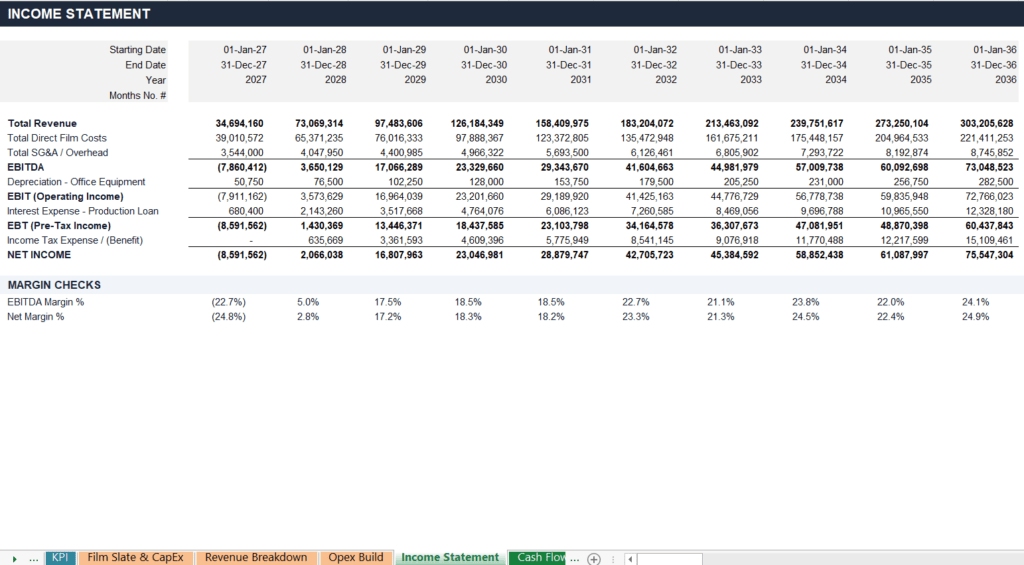
The income statement, or profit and loss statement, covers a period instead of a date. It starts with revenue, removes the direct cost of what you sold, then operating expenses, interest and tax. What remains is net income. If you want a layout to copy.
Here are the main parts, in order:
Revenue
Total money earned from selling products or services.Cost of Goods Sold (COGS)
Direct costs of producing what you sold (materials, direct labor, etc.).Gross Profit
Revenue minus COGS. This shows how profitable your core product or service is.Operating Expenses
Day-to-day costs of running the business (rent, salaries, marketing, software, etc.).Operating Income
Gross profit minus operating expenses. This shows profit from core operations.Net Income
The final profit (or loss) after interest and taxes. This is the “bottom line.”
A rising revenue with stable or improving margins is usually a healthy sign.
Our small business profit and loss statement template shows each line in order.
Cash Flow Statement
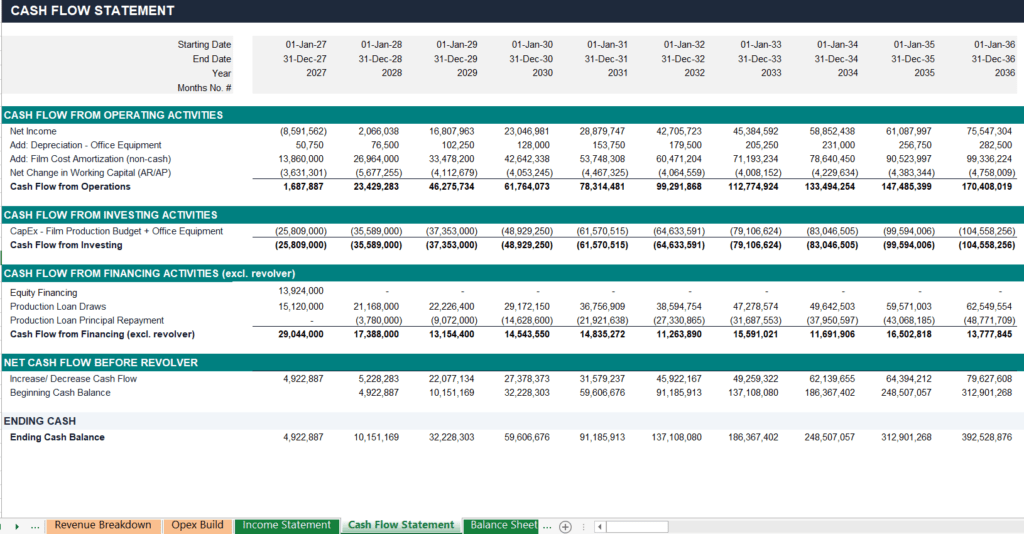
This report surprises new founders the most. A business can show a profit and still hold too little cash, because customers pay late or stock absorbs money. The cash flow statement tracks real movement in three groups;
The cash flow statement tracks real cash moving in and out of the business. It is divided into three parts:
Operating Activities
Cash from day-to-day business operations (sales collected, bills paid, salaries, etc.).Investing Activities
Cash spent on or received from long-term assets (buying or selling equipment, for example).Financing Activities
Cash from loans, owner investments, loan repayments, or dividends.
A business can show a profit on the income statement but still run short of cash. That is why this statement is so important, it shows the real cash position.
When cash feels tight, use this cash runway template to calculate & analyze how many months you have left.
How to Read Financial Statements (Step by Step)
Check the reporting period and the notes first, because the notes explain the accounting choices behind the numbers. Then read in this order:
Start with the income statement
Check if revenue is growing and if margins are stable.Move to the balance sheet
See if the business can pay its short-term bills. Compare current assets (cash + receivables + inventory) with current liabilities.Check the cash flow statement
Confirm that the business is generating cash from its operations, not just from loans or new investment.Look at trends
One period is not enough. Compare at least two or three periods to see the direction.
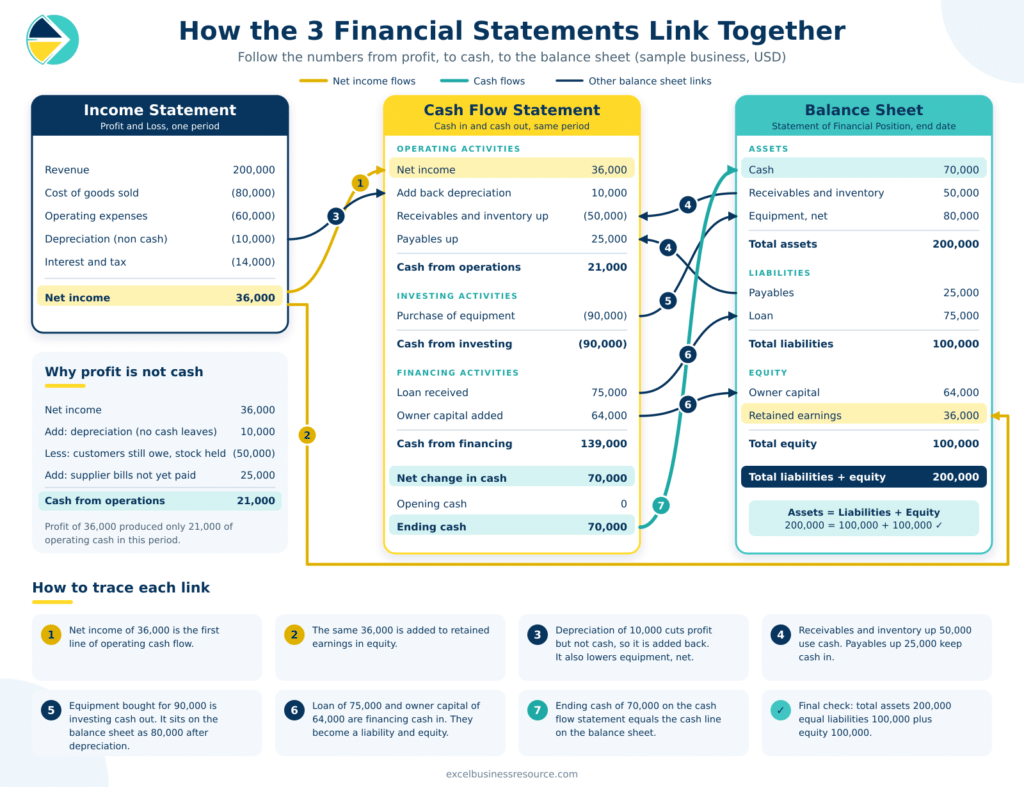
How the Three Statements Link Together
The three statements work together as one system:
- Net income from the income statement goes into retained earnings on the balance sheet.
- That same net income is the starting point of the cash flow statement.
- Depreciation reduces profit but does not use cash, so the cash flow statement adds it back.
- When you buy equipment, it shows up as an asset on the balance sheet and as a cash outflow under investing activities.
- The final cash number on the cash flow statement must match the cash line on the balance sheet.
If these links do not match, there is usually an error in the books.
Common Mistakes When Reading Financial Statements
Many founders make the same mistakes when they look at their financial statements:
Looking only at profit
A business can show a profit and still run out of cash. Always check the cash flow statement as well.Ignoring the notes
The notes explain important accounting choices. Skipping them can lead to wrong conclusions.Checking only one period
One month or one year does not show the real trend. Compare at least two or three periods.Focusing only on revenue growth
Growing sales means little if margins are falling or cash is getting tighter.Not linking the three statements
If net income, equity, and cash do not connect properly, something is usually wrong in the numbers.Trying to handle everything alone
If you are a startup or a growing business, it is usually better to get your financial statements, budgeting model, and valuation prepared by a professional. Clean and connected numbers build more trust with investors and lenders.
Hire a professional FP&A & financial model consultant to help you prepare detailed financial statements, prepare a clean financial books (bookkeeping services)
How Pre-Revenue Startups Should Show Financials to Investors or VCs
Pre-revenue startups do not have sales yet, so traditional profit and loss statements look empty. Investors still expect clear financial information. Here’s what usually works:
Show your cash position clearly
How much cash you have now and how many months it will last (cash runway).Share your monthly burn rate
How much money you spend each month and where it goes (salaries, product, marketing, etc.).Present a simple financial projection
Show expected revenue, costs, and cash flow for the next 12–24 months under realistic assumptions.Highlight unit economics (if possible)
Even without revenue, show early signals like customer acquisition cost, conversion rates, or pilot results.Keep the three statements connected
Even if revenue is zero, investors like to see a clean Balance Sheet and Cash Flow Statement that match each other.
One practical way is to download an investor-ready startup financial model for your niche. These templates let you set detailed assumptions and instantly create a full three-statement model in Excel. You can then share the complete file with investors including clear assumptions, financials, summary, valuation, KPIs, and analysis. The same file also works well for your own internal decision-making and investment presentations.
Why Accurate Financial Statements Matter for Growth and Valuation
Accurate financial statements help in four practical ways:
- Investors trust your numbers more during fundraising.
- Valuation becomes clearer and more credible.
- Banks are more willing to lend.
- You make better decisions about hiring, pricing, and spending
Investors price a startup from its numbers, and they notice quickly when the reports do not connect. One mismatch makes them doubt the forecast, then the founder. Connected, investor-ready statements do the opposite. They shorten due diligence and support a stronger valuation. If you are planning a raise, our guide to bootstrapped and funded fundraising strategy shows what investors check first. Revenue, margin and burn feed straight into a startup valuation, while unit economics show whether growth deserves funding. Equity changes should also match your cap table.
If you are building your first plan, start with our free financial plan template for startups. For a full model where all three statements update together,
Frequently Asked Questions (FAQs)
What is a financial statement in simple words?
A financial statement is a report that shows how much a business earned, what it owns and owes, and how its cash moved during a specific period. It helps owners, lenders and investors understand the real financial health of the company.
What are the 3 main financial statements?
The three main financial statements are:
- Income Statement – shows profit or loss over a period
- Balance Sheet – shows what the business owns and owes on a specific date
- Cash Flow Statement – shows how cash actually moved in and out of the business
What is the difference between a balance sheet and an income statement?
The balance sheet shows the financial position of a business on one specific date (what it owns and owes). The income statement shows performance over a period of time (how much profit or loss was made). One is a snapshot, the other is a video of performance.
What is the most important financial statement?
There is no single most important financial statement. All three are needed for a complete picture. However, many investors and lenders pay closest attention to the Cash Flow Statement because it shows real cash movement, which is harder to manipulate than profit figures.
How often should financial statements be prepared?
Most businesses should prepare financial statements monthly for internal decision-making. Quarterly and annual statements are usually prepared for investors, lenders, and tax purposes.