
Thinking about turning your passion for padel into a profitable business? You’re not alone. Padel is currently the world’s fastest-growing racket sport, with over 30 million players across 130 countries and more than 63,000 courts in operation globally as of early 2026. In the United States alone, the market is exploding surging from 227 courts in 2023 to over 650 in 2025, representing a 51.5% year-over-year growth in clubs.
But here is the reality that many aspiring padel entrepreneurs overlook: building a successful padel court business requires significant capital, strategic financial planning, and a deep mastery of unit economics. Having worked with over 100+ startups in data analysis, FP&A, and financial modeling at Excel Business Resource, we’ve seen firsthand how a rock-solid Business Plan for Padel Court operations separates thriving clubs from failed investments.
This 1,500+ word guide breaks down the real-world costs of starting a padel court business, provides verified industry benchmarks, and shows you how to build a Padel Court Business Financial Model that attracts investors and ensures long-term ROI.
Understanding the Total Investment Required
Starting a padel business isn’t just about installing glass walls; it’s about infrastructure, technology, and surviving the initial “ramp-up” phase. Based on 2025-2026 market data, your total investment for a professional facility typically ranges from $500,000 to $1.5 million.
Capital Expenditure (CapEx) Breakdown
The type of court you choose dictates your initial budget. While you can find “budget” options, professional-grade equipment is a non-negotiable for longevity and player safety.
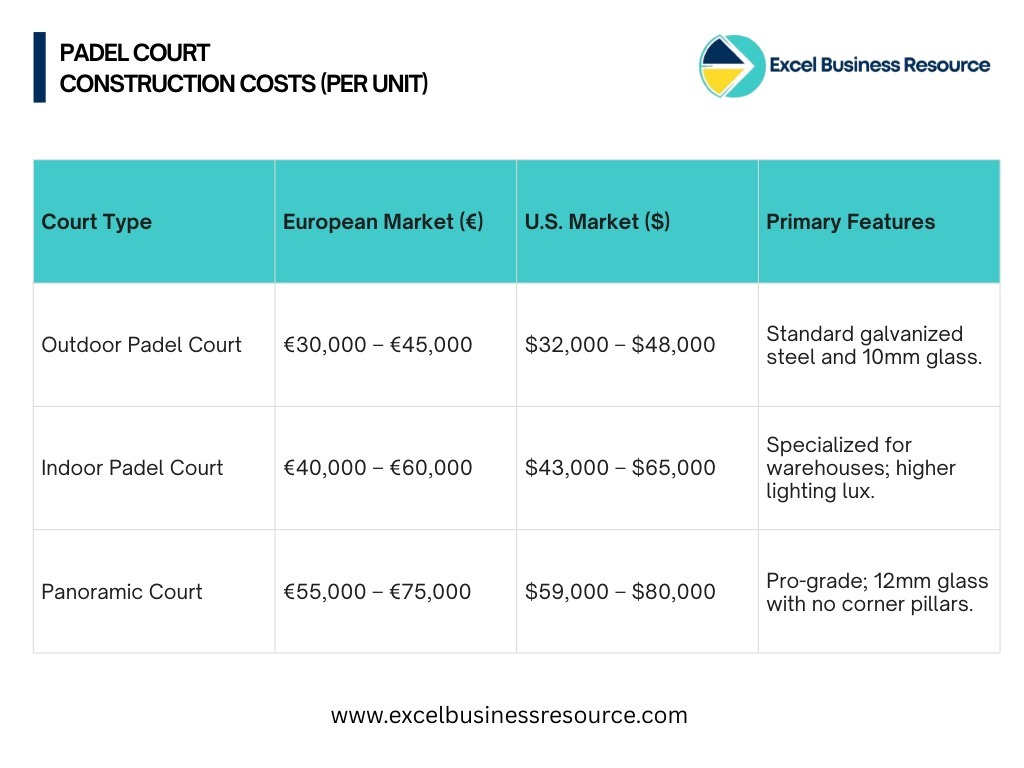
In the U.S. market, while a court structure itself might start at $24,000, the total project cost—including site preparation, shipping, and specialized installation typically extends from $43,000 to $96,100 per court.
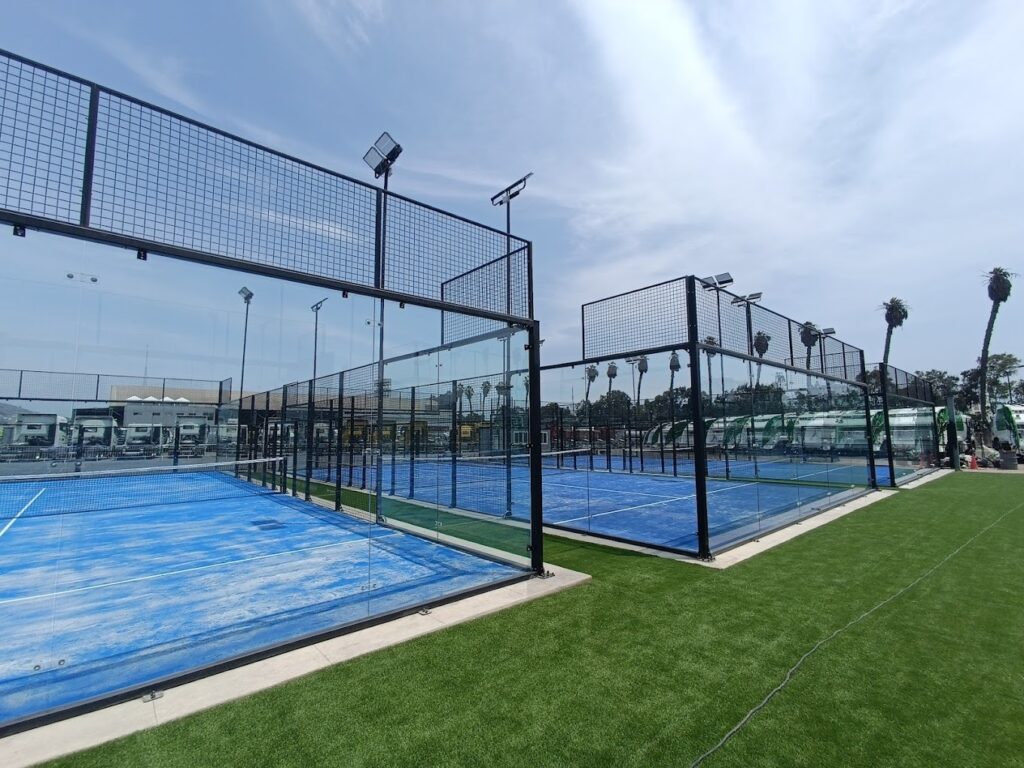
Multi-Court Club Setup (3-6 Courts)
To achieve true profitability through economies of scale, most investors aim for a 3-to-6 court facility. Here is a baseline budget for a 4-court setup:
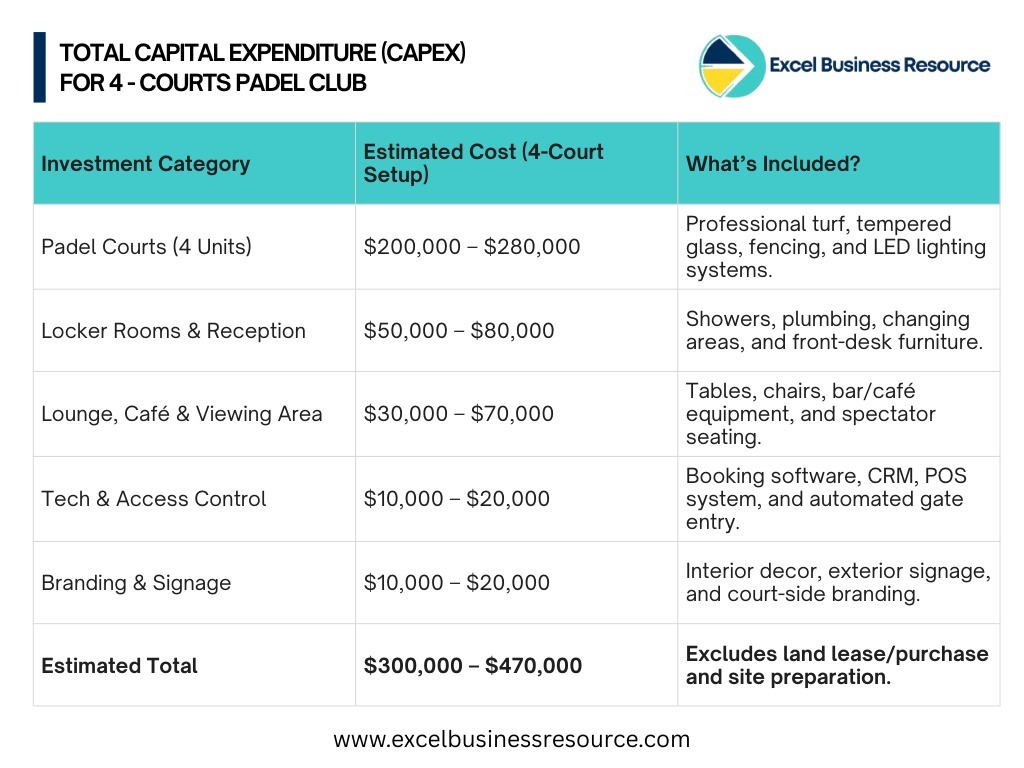
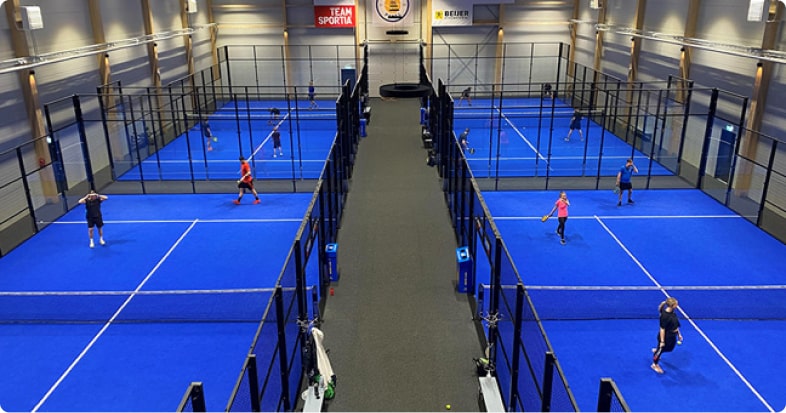
Total Estimated CapEx: $250,000 – $490,000 for outdoor/basic setups. Indoor padel facilities often exceed $600,000 to $1,000,000 due to HVAC systems, insulation, and the structural requirements of the building.
Breaking down your budget helps you identify where to optimize and where to invest for quality. As a financial analyst, I always tell clients: “The most expensive court is the one you have to fix twice.”
Foundation and Site Preparation (40% of Total Cost)
The foundation is your most variable expense and often where hidden costs reside. A standard 6-inch reinforced concrete slab with proper drainage costs $25,000 – $35,000 per court location.
- Geotechnical Studies: $1,000 – $3,000. Never skip this; knowing your soil conditions prevents costly structural failures or “floating” courts.
- Excavation and Drainage: Can add $5,000+ depending on the slope of your land.
Steel and Glass Structure (30% of Total Cost)
The core of your court. High-quality steel columns (80x80x3.0mm) and 12mm tempered glass ensure safety. This component typically runs $22,500 – $38,300 in the U.S. market.
Note on Glass: 12mm glass is the gold standard. 10mm glass is cheaper but has a higher breakage rate during high-intensity play, which can lead to facility downtime.
Playing Surface & Lighting
Professional artificial turf (such as the MONDO curled turf used in the World Padel Tour) costs between $5,600 and $13,500. This includes proper silica sand infill and expert installation.
Additionally, high-quality LED sports lighting ($2,800 – $10,000) is essential. Quality lighting isn’t just for visibility; it directly impacts your revenue potential by extending playable hours into the late evening.
Operating Expenses (OPEX) & The Critical Cash Buffer
Beyond construction, you need a “cash buffer” to stay afloat until the business becomes self-sustaining. Industry data suggests maintaining a minimum cash buffer of $353,000 to navigate the critical first 14 months of operation.
Annual Operating Costs (4-Court Indoor Club Example):
Operating a Padel Club involves high fixed costs. Your Financial Forecasting Model For Padel Court must account for:
- Staff Wages (Manager, Coaches, Front Desk): $390,000 – $445,000.
- Lease/Property Costs: $125,000 – $160,000 (Average $15,000/month).
- Utilities (HVAC & Lighting): $105,000 – $125,000.
- Booking Software, CRM, & POS: $20,000 – $30,000.
- Marketing & Member Engagement: $40,000 – $60,000.
- Court Maintenance & Resurfacing: $30,000 – $50,000 (budgeting for the 5-7 year turf replacement cycle).
Total Annual OPEX: $710,000 – $870,000 for a mid-sized club.
Revenue Potential Of 4 Padel Courts
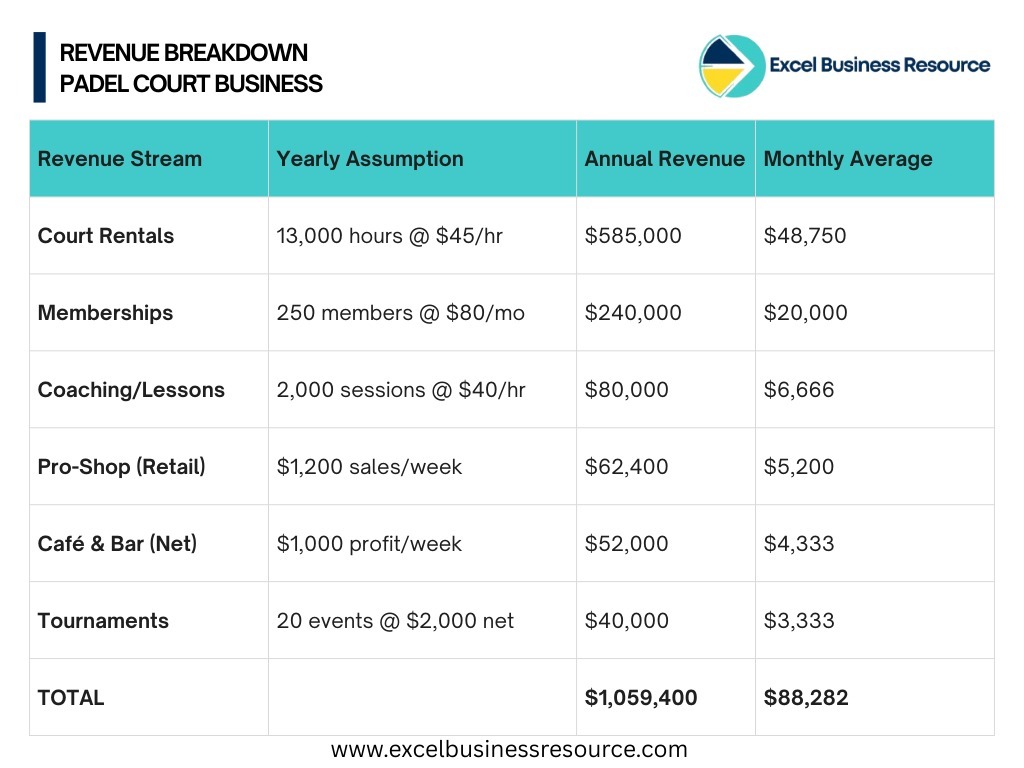
Investors want to see the math under the hood. Here is how we calculated the annual revenue for a standard 4-court facility operating 14 hours a day (8AM to 10 PM).
The Capacity & Utilization Math
- Total Available Hours: 4 courts × 14 hours/day × 365 days = 20,440 total hours per year.
- Target Utilization Rate: ~63% (This means out of every 10 hours the club is open, 6.3 hours are booked).
- Note: Established clubs aim for 70-85% during peak times and 30-40% during off-peak (mornings/afternoons).
- Actual Booked Hours: 20,440 hours × 63.6% = 13,000 hours per year.
Annual Revenue Breakdown (Detailed)
This table clarifies that these are Yearly Totals and shows the monthly average for your cash flow planning.
Understanding Utilization Rate (The Occupancy Rate)
Utilization is the most important metric for a Padel club. It is calculated as:

Why 63%?
In our model, we use a blended rate of 63%. Here is why that is a “Safe” and “Realistic” number for a 2026 business plan:
- Peak Hours (5 PM – 10 PM): Usually 90-100% utilization.
- Off-Peak (8 AM – 4 PM): Usually 30-40% utilization.
- Weekends: Usually 70-80% all day.
Pro-Tip: If you can push your off-peak utilization (through senior programs or school clinics) from 30% to 50%, you add roughly $100,000 in pure profit to your bottom line without building a single new court.
Profitability Metrics & Timeline
- Average Revenue Per Court: Well-managed clubs see roughly $61,000+ per court annually.
- Operational Breakeven: Usually achieved within 14–18 months.
- Full ROI (Payback Period): Between 2 to 4 years for optimized facilities.
- Owner Income: Once stabilized, owners typically earn $100,000 – $250,000 annually through salary and distributions, with EBITDA margins reaching 30-35%.
To reach these numbers, you must track Key Performance Indicators (KPIs) like Court Utilization Rate and Average Revenue Per Booking. For a deep dive into these metrics, read our detailed guide on Padel Club KPIs.
Creating Your Financial Model and Business Plan For Padel Business
Developing a Business Plan For Padel Court operations requires more than just listing expenses. You need an investor-ready framework that includes:
- 5-Year Financial Projections: Including Income Statements, Cash Flow, and Balance Sheets.
- Sensitivity Analysis: What happens if utilization is 40% vs. 70%? How does a $5 price increase impact the bottom line?
- Break-even Analysis: Identifying exactly when monthly revenue covers fixed costs.
- Unit Economics: Calculating the lifetime value of a member vs. the cost to acquire them (CAC).
- Padel Club Valuation: Using DCF (Discounted Cash Flow) and comparable transaction models for potential exit strategies or investor buy-ins.
At Excel Business Resource, we have developed a specialized Padel Club Financial Model Excel Template. Built by FMVA-certified financial modeling experts, this template provides everything you need to transform a vision into a bankable asset.
Financing Your Padel Court Investment
Given the $500k – $1.5M price tag, most entrepreneurs combine multiple funding sources. Your financial model is the key to unlocking these:
- Traditional Bank Loans: Banks require 3-5 years of projections and a rock-solid Padel Court Business Plan Template.
- Private Investors: Often seek equity in exchange for capital. They will look closely at your Padel Club Valuation and your plan for the 14-month ramp-up.
- Equipment Financing: Some suppliers allow you to lease the court structures, which significantly reduces the initial cash required but adds to monthly OPEX.
- Crowdfunding: Because Padel is community-centric, “founding memberships” can be sold in advance to raise initial working capital.
Risk Mitigation and Success Factors of Padel Business
Based on our experience with 100+ startup financial models, here are the critical success factors for Padel operations in 2026:
Location Strategy
Urban and high-foot-traffic suburban areas perform best. Your Startup Financial Model Template should account for local demographics. Visibility and parking are non-negotiable—if players can’t find you or park easily, they won’t return.
Revenue Diversification
Clubs that rely only on court rentals are vulnerable to seasonal shifts. Successful operators layer in coaching programs (which can command high margins), corporate team-building events, and high-margin retail sales.
Technology Integration
Automated booking systems and dynamic pricing algorithms (charging more for peak 6 PM slots) reduce administrative overhead while maximizing court utilization.
Community Building
Padel’s social nature is its greatest strength. Leagues, ladders, and social mixer events drive the high membership retention rates that make a Padel Court Business Financial Model actually work.
Conclusion: Is a Padel Court Business Right for You?
Starting a padel business requires significant upfront capital—typically between $500,000 and $1.5 million for a multi-court facility with proper amenities. However, the Unit Economics are some of the most compelling in the sports industry today.
With EBITDA margins of 30-35% and a payback period often under 4 years, the ROI is undeniable—but only if you plan with precision. The key is starting with a financial foundation that accounts for the 14-month ramp-up, seasonal fluctuations, and the high OPEX of indoor facilities.
Ready to build your Padel empire? Don’t start without the right tools. Download our comprehensive Padel Club Financial Model Template to create investor-ready projections and track the KPIs that matter most.
For guidance on structuring your business narrative, read our companion article on How to Write a Business Plan for Padel Club.
Founder Ask Questions
Yes. We provide a fully integrated Padel Court Business Financial Model that includes revenue forecasting per court, utilization assumptions, memberships, operating costs, cash flow, breakeven analysis, valuation, and sensitivity analysis. The model is designed for investor presentations, bank financing, and internal decision-making.
Absolutely. Our Padel Club Financial Model Excel Template is built to be investor-ready, covering unit economics, EBITDA margins, payback period, and valuation metrics that investors expect. It supports scenario analysis (base, upside, downside) to help founders clearly explain growth and risk.
A well-managed padel club achieves operational breakeven within 12-18 months and full investment recovery in 2-4 years. Successful 4-court facilities generate $1.0M–$1.5M in annual revenue with 30-35% EBITDA margins by year five. Owner-operators typically earn $100,000–$250,000 annually through salary and profit distributions. Profitability depends heavily on achieving 50-70% court utilization during peak hours and diversifying revenue through memberships, coaching, and F&B sales. A comprehensive Padel Court Business Financial Model helps you stress-test these assumptions and optimize pricing strategies before launch.
A professional Financial Model Template for Padel Court includes: 5-year financial projections (P&L, cash flow, balance sheet), detailed CAPEX scheduling for court construction and facilities, multi-revenue stream modeling (court rentals, memberships, coaching, retail, F&B), sensitivity analysis for utilization rates and pricing scenarios, break-even analysis, KPI dashboards tracking utilization and ARPU, payroll planning for coaches and staff, and investor-ready valuation models. At Excel Business Resource, our Padel Club Financial Model is specifically built for the sport's unique economics—unlike generic gym or restaurant templates—incorporating seasonal demand patterns, turf replacement cycles, and dynamic pricing capabilities.
Yes. We offer custom Business Plan services for Padel Court and Padel Club startups, covering market analysis, pricing strategy, operations, KPIs, financial projections, and growth roadmap. We also provide a Padel Court Business Plan Template for founders who want a structured, cost-effective solution.
Our forecasts are based on real operating drivers, such as court utilization rates, peak vs off-peak pricing, memberships, and coaching revenue. With experience across 100+ startups, our Financial Forecasting Model for Padel Court focuses on realistic assumptions rather than inflated projections.
Yes. We customize the Padel Court Business Financial Model based on location, indoor or outdoor courts, local pricing, staffing costs, energy costs, and tax structures. This ensures the model reflects actual unit economics and realistic padel club valuation for your specific market.
For Padel Club Valuation, investors and lenders focus on: Court Utilization Rate (target 50%+ overall, 70%+ peak), Average Revenue Per User (ARPU) from all revenue streams, Membership Retention Rate (80%+ monthly indicates healthy community), Ancillary Revenue Percentage (15-20% of total shows diversification), and EBITDA Margin (30-35% at maturity indicates operational efficiency) . These metrics feed into valuation multiples typically ranging from 4-6x EBITDA for established clubs. A professional Startup Financial Model Template tracks these KPIs automatically, helping you optimize operations and present compelling unit economics to potential buyers or investors.