
In the fast-paced world of artificial intelligence, launching a venture without a blueprint isn’t just risky it’s a gamble most founders lose. To capture a share of the trillion-dollar Generative and Agentic AI markets, you need a business plan that speaks the language of venture capitalists and anticipates the unique technical and ethical hurdles of the industry.
Building this from scratch is a massive undertaking. Between researching volatile market trends and calculating complex GPU/compute costs, founders often sink hundreds of hours into “paperwork” rather than “product.” Traditional business templates often fail to account for the nuances of AI startups, such as:
Scalability Economics: The high initial cost of model training vs. the long-term ROI.
Infrastructure Requirements: Detailing the compute power and data pipelines necessary for success.
Regulatory Compliance: Addressing data privacy and AI ethics in a way that satisfies VC scrutiny.
This is where Excel Business Resource becomes your strategic growth partner. As leading financial modeling and FP&A experts, we help you skip the 100+ hours of tedious research and formatting. Our ready-made financial models and customized business plans are tailored specifically for the AI ecosystem. By letting our experts handle the heavy lifting of financial forecasting and strategic documentation, you gain a competitive edge and the freedom to focus on what matters most: innovating and scaling your business.
What is a Generative AI Business Plan?
A business plan for a generative AI startup is a formal document that describes how your company will use “creative” AI the kind that writes text, makes images, or writes code to solve a specific problem and make a profit. Unlike a regular business plan, it must explain how you handle massive amounts of data and the high costs of running AI models.
Why do you need a specialized plan for Gen AI Startups?
The “AI gold rush” has matured. In recent years, the investor manifesto has undergone a fundamental shift: venture capitalists are no longer dazzled by the mere mention of “AI” or “GPT.” They’ve moved past the hype and are now hunting for demonstrable ROI and sustainable unit economics.
To secure funding today, your plan must prove you can bridge the gap between cutting-edge tech and a profitable bottom line. A specialized roadmap shows VCs that you have mastered both sides of the coin:
The Technical Architecture: You aren’t just using a wrapper; you understand model orchestration, latency optimization, and infrastructure scaling.
The Business Engine: You have a clear strategy for managing high compute costs while maintaining a healthy Customer Acquisition Cost (CAC) to Lifetime Value (LTV) ratio.
The Bottom Line: Investors aren’t just buying your code; they’re buying your path to revenue.
A generic template won’t survive the scrutiny of a modern-day pitch meeting—a specialized AI strategy is your only ticket to the table.
How to Structure Your AI Business Plan for Success?
To stand out from competitors, your plan must be more than a document, it must be a high-performance roadmap. Here is the architecture VCs expect to see:
1. Executive Summary: The Strategic Hook
This is your “Elevator Pitch” on paper. Keep it under two pages and focus on three “North Star” questions:
The Critical Friction: What specific bottleneck or “pain point” are you eliminating?
The AI Edge: How does your Generative or Agentic solution outperform traditional software or human effort by at least 10x?
The Defensible Moat: Why can’t Big Tech (Google, Meta, OpenAI) replicate your success overnight? Is it your proprietary data, your community, or a unique workflow integration?
2. Market Analysis: The Era of Vertical AI
In the current market, the trend has shifted from “Horizontal AI” (tools for everyone) to “Vertical AI” (tools for specialists). Investors want to see a “Niche-First” strategy:
Total Addressable Market (TAM): The global potential for your specific industry (e.g., AI for precision agriculture or forensic accounting).
Serviceable Obtainable Market (SOM): Your realistic capture within the first 24 months. Focus on “beachhead” customers who are desperate for your solution.
3. The Tech Stack: Scaling with Precision
You don’t need to be a developer to explain your architecture, but you must demonstrate Inference Economics. Focus on:
The Foundation: Are you fine-tuning a Large Language Model (LLM) or deploying an efficient Small Language Model (SLM)?
Data Integrity & RAG: Where is your training data coming from? Are you using Retrieval-Augmented Generation (RAG) to ensure accuracy and data privacy?
User Interface (UI): Is it a seamless browser extension, a mobile-first app, or an autonomous Agentic worker that operates in the background?
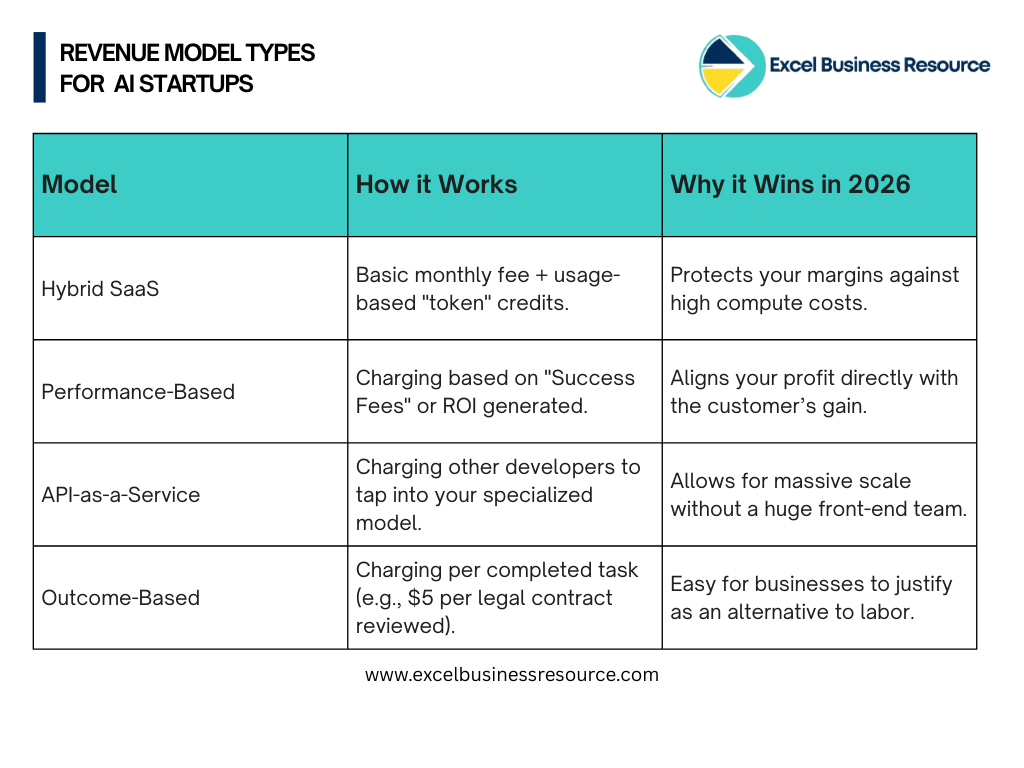
What Would be the Revenue Model Of Gen AI Startups?
How you capture value is as vital as how you create it. In the current market, generic subscriptions are being replaced by high-margin alternatives:
Strategic Pillars: SWOT, Marketing, and Ethical Governance
To make your business plan truly competitive moving forward, you must look beyond the code. Investors want to see a 360-degree view of your internal capabilities and your external growth strategy.
SWOT Analysis: Identifying Your Edge
A specialized SWOT analysis helps you navigate the current AI landscape:
Strengths: Proprietary training data, a specialized “Agentic” workflow, or an expert team with niche industry experience.
Weaknesses: High initial “compute” overhead or the current lack of brand authority in a crowded market.
Opportunities: Expanding into untapped “Sovereign AI” sectors like local government, specialized healthcare, or legal compliance.
Threats: Aggressive regulatory shifts or “Platform Risk” (e.g., OpenAI or Google releasing a native feature that overlaps with your core product).
Sample Marketing Strategy: Your First 1,000 Users
AI startup growth for the future isn’t just about ads; it’s about proving value instantly.
Content Authority: Use your own AI to produce deep-dive insights that solve specific industry problems, positioning you as a thought leader.
Product-Led Growth (PLG): Launch a free “mini-tool” that provides a “wow” moment in under 30 seconds to convert skeptics into users.
Strategic Ecosystem Partnerships: Integrate with existing platforms (like Salesforce or Microsoft 365) where your target audience already lives.
Community-Driven Feedback: Foster a Discord or Slack community where users influence your product roadmap, creating high “switching costs.”
Data Privacy and Ethical AI Governance
Sovereign AI and data residency are non-negotiable. Your plan must include an AI Governance Strategy to prove your tool is trustworthy.
Anti-Hallucination Frameworks: Explain how you use RAG (Retrieval-Augmented Generation) to ensure your AI stays factual.
Data Fortification: Detail how you anonymize user data and ensure it isn’t used to train foundational models without consent.
Bias Mitigation: Show that your outputs are audited for fairness, which is a key requirement for winning enterprise-level contracts.
The Power of Specialized Financial Modeling
The most common silent killer of AI startups is the Inference Trap. It costs money every time your AI “thinks,” and if your pricing doesn’t outpace your compute costs, growth can actually lead to bankruptcy. This is why the Financial Models for Gen AI Startups from Excel Business Resource are so critical.
Our professional FP&A team provides a level of detail that generic templates miss. What Our AI Financial Models Include:
Token-Based Cost Architecture: We calculate your Inference Costs down to the millicent, accounting for different model versions and GPU provider fluctuations.
Scalability Stress Tests: We model your Burn Rate against various user growth tiers to ensure you don’t run out of cash during a viral surge.
Compute vs. Revenue Mapping: We help you find your Break-even Point by balancing subscription revenue against API call frequencies.
Infrastructure Capex: Detailed projections for server costs, fine-tuning expenses, and data acquisition fees.
Professional Edge: Walking into a VC meeting with a model that accounts for GPU latency and token-efficiency proves you aren’t just a dreamer, you’re a disciplined founder who understands the unit economics of the future.
Your Action Plan: Writing the Document
Building a business plan doesn’t have to be complicated. If you follow these four steps, you’ll have a roadmap that actually works:
Pick Your Lane (The Niche): Don’t try to be everything to everyone. In the AI world, being a “general assistant” is a recipe for getting ignored. Be the best AI tool for a specific person—like an AI legal researcher for small firms or an AI architect for eco-friendly homes.
Map the “Magic Moment”: Show the exact workflow. How does a frustrated user go from having a massive problem to getting a perfect result in just two clicks? If you can visualize the “magic,” you can sell the product.
Showcase the “Jockey”: Investors have a saying: “Bet on the jockey, not just the horse.” Your idea is the horse, but you and your team are the jockeys. Highlight why your team has the grit and the skills to win this race.
Pinpoint Your Milestones: Be specific about the future. Where will you be in 6 months? When will you hit your first 1,000 users? Having a timeline proves you aren’t just dreaming—you’re executing.
The Bottom Line: Turn Hype into a Harvest
Writing a business plan for a Generative AI startup is about balancing futuristic tech with old-fashioned business sense. You need to prove that your tool isn’t just a temporary trend, but a sustainable machine that creates real-world value.
The AI revolution is moving at lightning speed. While most founders are getting lost in technical jargon and “cool features,” the winners are those with a clear, data-backed plan. Don’t leave your success to chance. By focusing on a specific niche, choosing a smart revenue model, and verifying your numbers with professional resources, you’ll have the clarity you need to dominate your industry.