
You’ve been thinking about opening a medical clinic. Maybe you’re a physician tired of hospital politics. Maybe you’re an entrepreneur who sees opportunity in the booming healthcare sector. Or maybe you’re somewhere in between eager, prepared, but asking the most important question first:
How much does it actually cost to start a medical clinic business, and can it make money?
This guide answers both with real numbers, a stage-by-stage cost breakdown, and an honest profitability timeline. No fluff, no guesswork. Let’s get into it.
Cost to Start a Medical Clinic Business?
The short answer: $100,000 to $525,000 for most small-to-mid-size clinics, and upward of $670,000+ when you factor in working capital reserves.
The range is wide because a solo telehealth psychiatry practice and a multi-physician orthopedic clinic are two very different businesses. The key variables are your specialty, location, clinic size, and whether you’re buying or leasing equipment.
According to sharpsheets.io, a small medical clinic can start with as little as $152,000, while a premium setup with custom interiors, advanced diagnostics, and a full marketing launch can reach $525,000.
Here’s what makes up that investment.
Complete Medical Clinic Budget Analysis: Line-by-Line Breakdown
1. Facility Build-Out and Renovation — $20,000 to $250,000
This is typically your single largest upfront cost. A small clinic in a second-generation medical space may need only $20,000–$60,000 in leasehold improvements. A specialized clinic built from shell space with medical-grade plumbing, partitioned exam rooms, HVAC upgrades, and compliance inspections can hit $150,000 to $250,000.
Pro tip: Look for second-generation medical spaces (already built out for healthcare use). This move alone can shave 10–20% off your renovation budget.
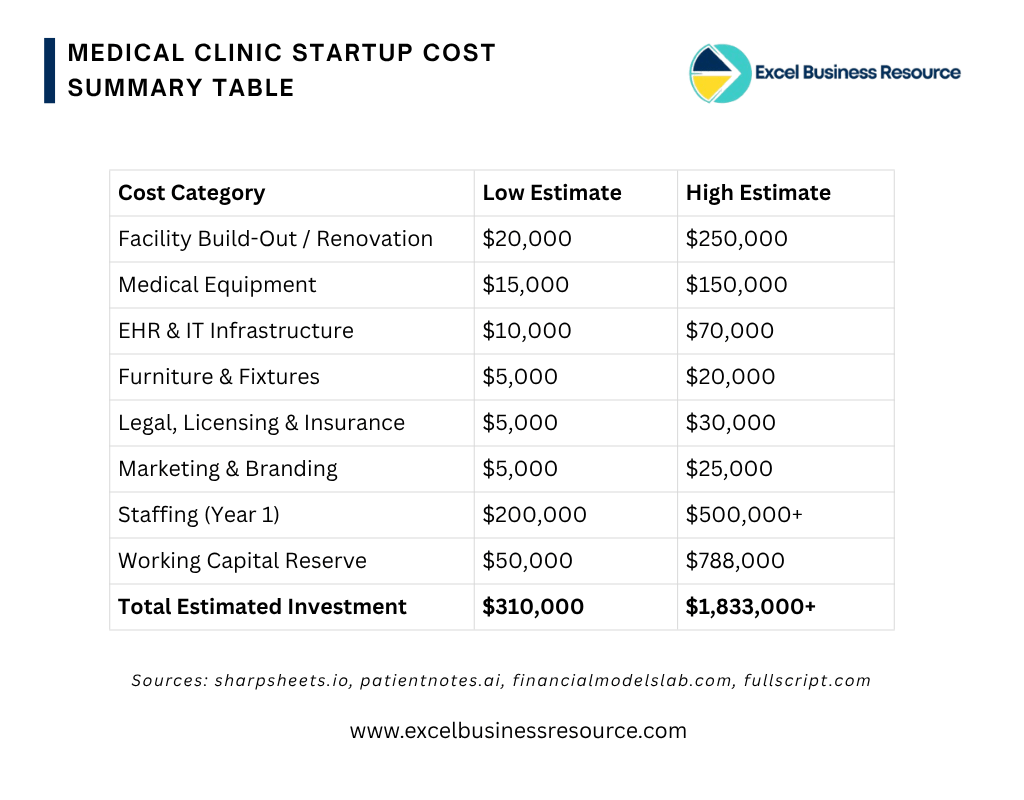
2. Medical Equipment — $15,000 to $150,000+
Equipment costs depend entirely on what you’re offering.
- Primary care basics (exam tables, stethoscopes, BP monitors, sterilization): $15,000–$50,000
- Mid-level diagnostics (EKG machines, ultrasound): $50,000–$100,000
- Specialty imaging (X-ray, MRI-adjacent tech): $100,000–$150,000+
According to nchstats.com, medical practices typically spend between $20,000 and $100,000 on equipment alone. Equipment leasing is an underrated option — it can reduce upfront costs by 30–50% compared to purchasing outright, per BusinessDojo.
3. EHR, Technology, and IT Infrastructure — $10,000 to $70,000
Every clinic needs a HIPAA-compliant Electronic Health Record (EHR) system, billing software, secure IT infrastructure, and patient scheduling tools. According to fullscript.com, total EHR implementation costs range from $5,000 to over $70,000 depending on system complexity and staff training needs. Core IT setup (servers, firewalls, encrypted backups) often exceeds $10,000 with recurring monthly support costs on top.
4. Staffing and First-Year Payroll — $200,000 to $500,000+
This is where most founders underestimate their budget. Staff salaries are consistently one of the top cost drivers. According to MGMA’s 2025 data, support staff salaries and benefits alone account for roughly 25% of total practice revenue, and total labor (including physician compensation) can consume 50–60% of all operating expenditures. For a brand-new clinic, expect to budget $200,000–$500,000 in Year 1 payroll depending on the size of your team.
5. Licensing, Legal, and Insurance — $5,000 to $30,000
Before you open the doors, you need:
- Business entity setup (LLC, PLLC, S-Corp)
- State medical license and DEA registration
- Malpractice insurance (claims-made vs. occurrence policies)
- General liability and property insurance
- Healthcare attorney fees
These startup legal and compliance costs typically range from $5,000 to $30,000.
6. Marketing and Branding — $5,000 to $25,000
You’ll need a website, local SEO setup, Google My Business listing, and some form of launch marketing. For a new clinic without an existing patient panel, budget $5,000–$25,000 in pre-opening and first-year marketing.
7. Working Capital Reserve — $100,000 to $788,000
This is the most overlooked line item — and the most dangerous to ignore. Insurance reimbursements take weeks or months to clear. Your patient volume won’t peak on Day 1. You need cash on hand to cover rent, payroll, and supplies while revenue is still building.
Most lenders recommend 6–12 months of operating expenses in reserve, which adds $50,000–$120,000 to your capital requirement for smaller practices, according to patientnotes.ai.
For larger setups, this working capital buffer can reach $788,000, as detailed by financialmodelslab.com.
How to Start a Medical Clinic: The Pre-Launch Checklist
Beyond money, there’s a sequence of decisions you need to make before you spend a dollar:
- Choose your specialty and service mix — Primary care, urgent care, specialty, or multi-service?
- Pick your legal structure — LLC, PLLC, S-Corp, or PC based on your state and tax strategy
- Write a business plan for medical care business — This is non-negotiable for securing financing and clarifying your revenue drivers
- Secure financing — SBA 7(a) loans (up to $5 million), traditional bank loans at 6–10% interest, equipment leasing, or private equity healthcare investors
- Find and negotiate your space — Target 2,000–3,000 sq. ft., negotiate free rent months, and prioritize second-generation medical spaces
- Hire and credentialing — Credential providers with insurance networks early; this process can take 60–120 days and delay your revenue start date
Profitability Timeline of a Medical Clinic
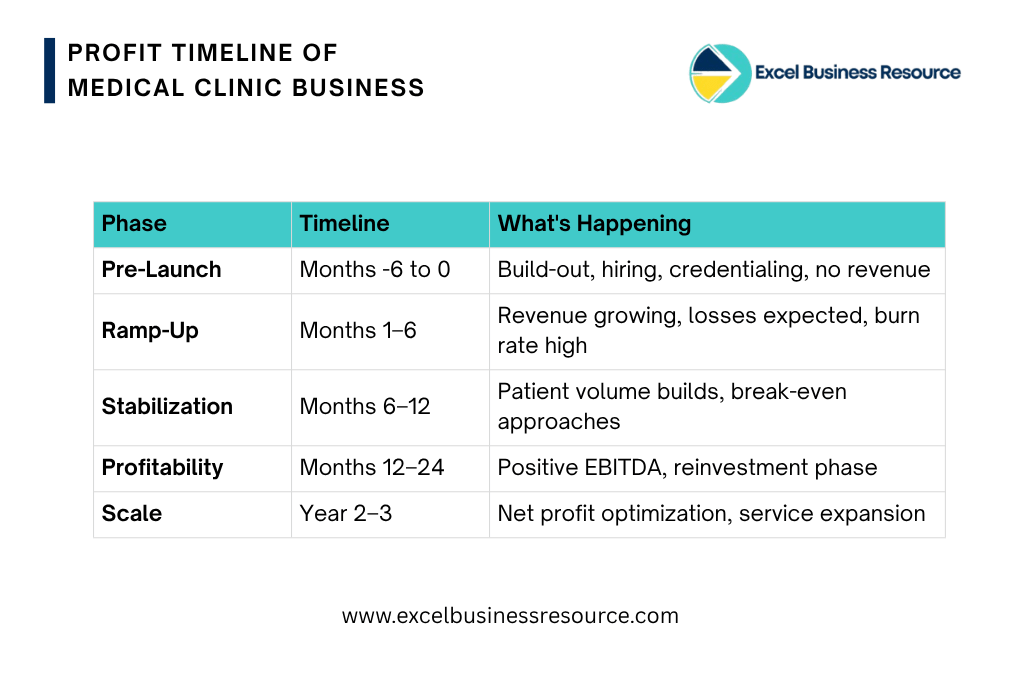
Here’s the honest answer: most medical clinics reach break-even within 12 to 24 months.
Primary care practices with lower overhead can hit profitability in 6–12 months. Specialty clinics with expensive equipment and longer credentialing cycles may take 18–36 months, according to patientnotes.ai.
The profit timeline is driven by three things: how quickly you build patient volume, how well you manage your revenue cycle, and how efficiently you control overhead.
Revenue Per Patient Visit
- Primary care consultations: $100–$250 per visit
- Routine diagnostics and procedures: $150–$350 per visit
- Specialty services (aesthetics, regenerative therapy, dermatology): $400–$900+ per procedure
According to BusinessDojo, clinics generating $200+ per visit can reach profitability with fewer daily patients, while high-volume, lower-fee models require tight operational efficiency.
Self-employed physicians in the U.S. earn around $352,000 annually on average compared to $300,000 for hospital employed physicians giving clinic owners a meaningful earnings advantage once they’ve cleared the startup phase, per docdigitalsem.com.
How to Make a Medical Clinic Business Profitable Faster
The gap between break-even in Month 8 versus Month 20 comes down to a few specific levers:
1. Add High-Margin Services Early Specialty and cash-pay services (aesthetic procedures, wellness programs, preventive health packages) generate $400–$900 per interaction with lower supply costs. Adding even one of these service lines in Year 1 can significantly pull forward your break-even.
2. Maximize Provider Utilization Target a staff utilization rate of 75–85% of available clinical hours. Low utilization means fixed costs (payroll, rent) spread across too few billable visits — the fastest way to bleed cash.
3. Tighten Revenue Cycle Management Insurance reimbursement delays are a silent killer of clinic cash flow. Keep accounts receivable aging under 60 days. Consider outsourcing billing if your in-house team isn’t hitting targets.
4. Implement Loyalty and Wellness Programs Repeat patients cost far less to retain than new patients to acquire. Wellness memberships and preventive care packages can increase patient lifetime value by 30–40%, per BusinessDojo.
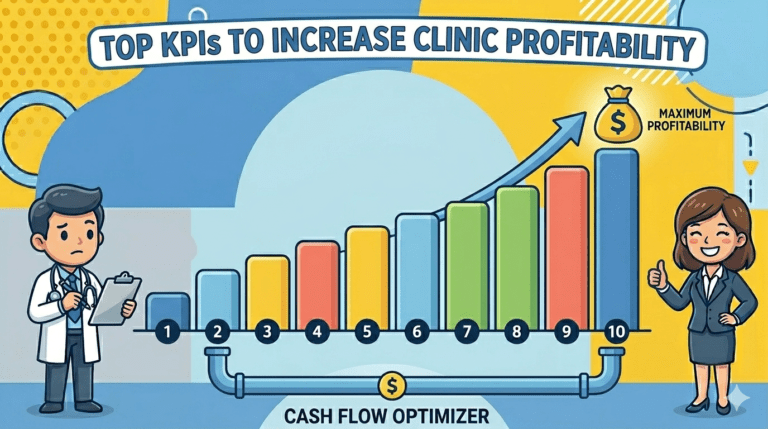
5. Track Your KPIs Monthly Key performance indicators for a medical clinic include: revenue per visit, daily patient volume, provider utilization rate, accounts receivable aging, and operating margin. What gets measured gets managed. If you’re not tracking KPIs of medical clinic from Month 1, you’re flying blind.
Model Your Numbers Before You Invest In Medical Business
Here’s something most startup guides won’t tell you: the single biggest mistake clinic founders make isn’t overspending on equipment. It’s launching without a financial model.
Without a proper financial model, you don’t know:
- How many patients you need per day to break even
- What your burn rate analysis looks like month by month
- How long your working capital will last under different scenarios
- What your revenue drivers are and which services actually move the needle
At Excel Business Resource, we’ve worked with 100+ startups and healthcare businesses on financial modeling, FP&A, and business plan development. We built a purpose-built Medical Clinic Financial Model Excel Template specifically for founders planning a clinic — whether you’re a physician, entrepreneur, or investor.

The template includes:
- 5-year financial projections with monthly and annual views
- Break-even analysis based on your patient volume and service mix
- Revenue driver modeling by service type and payer category
- Working capital forecasting and cash runway calculator
- Startup cost estimator — your full medical clinic budget template in Excel
- DCF Valuation and investor-ready outputs
- KPI dashboard for operational and financial tracking
This is the same level of financial modeling we build for our clients — now available as a ready-to-use template at a fraction of the cost.
Final Thoughts
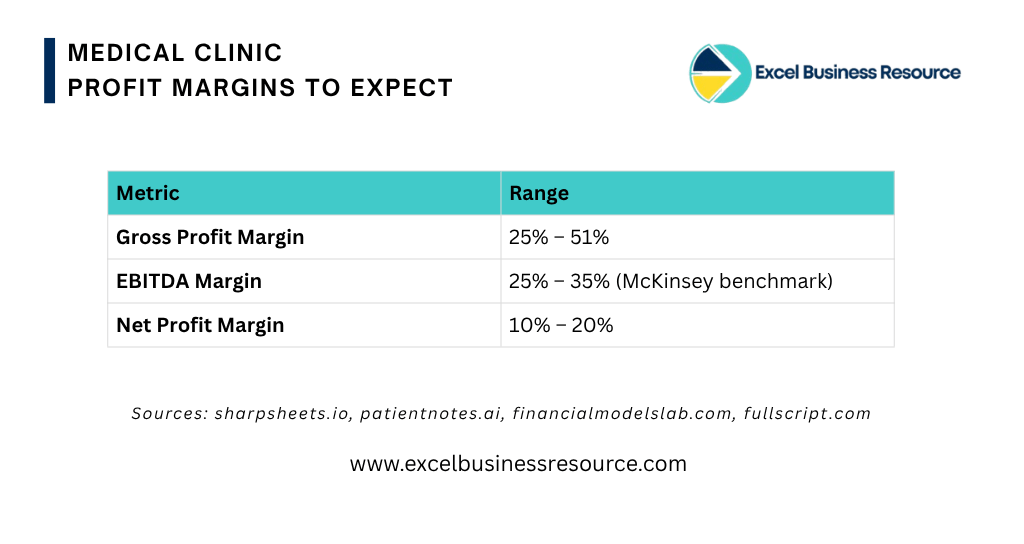
Starting a medical clinic is a serious financial commitment — but it’s also one of the most rewarding businesses you can build, both financially and in terms of impact. The numbers are real: $100,000 to $500,000+ to start, 12–24 months to profitability, and net margins of 10–20% once you hit your stride.
The founders who succeed aren’t the ones with the most capital. They’re the ones who plan rigorously, model their numbers carefully, and make data-driven decisions from Day 1.
If you’re serious about starting a medical clinic, don’t build your budget on guesswork. Use a financial projection model for medical clinic that’s been designed by people who’ve done this work with real healthcare startups.
👉 Get the Medical Clinic Financial Model — Investment-Ready Template
Excel Business Resource has partnered with 100+ startups on financial modeling, FP&A, and business planning. Learn more about our Startup Financial Model Templates and healthcare business financial model services.
Founder's Asked Questions (FAQs)
Monthly operating costs for a small-to-mid-size clinic typically range from $30,000 to $100,000+, with the biggest drivers being payroll, rent, and medical supplies. According to financialmodelslab.com, monthly fixed overhead including utilities and rent can sit around $16,900 for a lean setup.
Yes — once established. With EBITDA margins of 25–35% and net profits of 10–20%, a well-run clinic is a strong business. The challenge is surviving the first 12–24 months. That's why financial planning, working capital management, and a solid business plan for medical clinic business are essential before you invest.
In most U.S. states, non-physicians can own and operate a medical clinic as a business entity, as long as a licensed physician is employed or contracted to provide medical oversight. Some states have Corporate Practice of Medicine (CPOM) restrictions — always consult a healthcare attorney.
Specialty clinics offering cash-pay or elective services — such as aesthetic medicine, dermatology, and regenerative therapy — tend to have the highest margins. Multi-specialty clinics combining primary care with ancillary services (imaging, pharmacy, wellness) also perform well due to diversified revenue streams.