
Key BESS Market Statistics at a Glance
| Statistic | Figure |
|---|---|
Global BESS market size, 2025 |
USD 50.81 billion |
Projected global BESS market size, 2030 |
USD 105.96 billion |
Global CAGR, 2025 to 2030 |
15.8% (some estimates closer to 25%) |
Global battery storage capacity added, 2025 |
108 GW |
Utility scale share of new additions |
Roughly 80% |
Asia Pacific market size, 2025 |
USD 28.61 billion, at 16.9% CAGR |
North America market size, 2025 |
USD 10.03 billion, at 14.6% CAGR |
Containerized BESS market, 2025 to 2030 |
USD 13.87 billion to USD 35.82 billion |
Battery cost decline, 2010 to 2025 |
More than 90% |
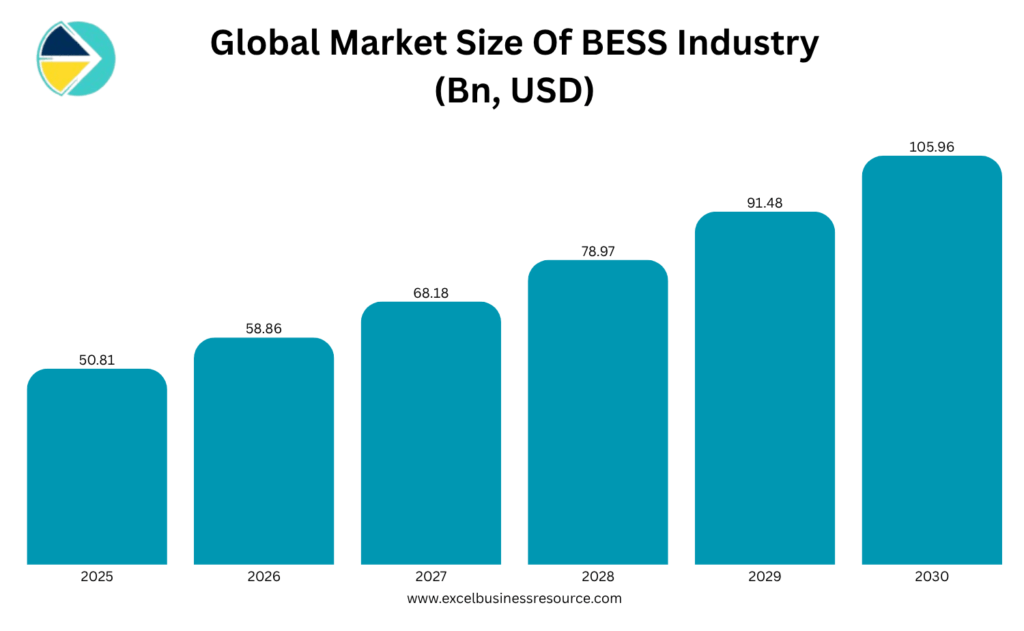
The global Battery Energy Storage System (BESS) market was valued at USD 50.81 billion in 2025. It is projected to reach USD 105.96 billion by 2030, growing at a CAGR of 15.8%, according to MarketsandMarkets. Asia Pacific leads the market. Utility scale storage drives most of the growth. Falling battery prices and rising renewable energy adoption are the biggest reasons behind this expansion.
If you only remember one thing from this article, remember that: the BESS market is not a niche anymore. It is one of the fastest growing segments in the entire energy sector.
Let’s break down the numbers.
What Is a BESS, in Simple Terms?
- A Battery Energy Storage System stores electricity so it can be used later. Think of it as a giant rechargeable battery for the power grid.
- Solar panels produce energy during the day. Wind turbines produce energy when the wind blows. A BESS captures that energy and releases it when it is needed most, like during the evening peak or a grid outage.
This simple function is why BESS has become critical infrastructure. Utilities need it. Businesses need it. Even homeowners are starting to install it.
What Is the Global BESS Market Size in 2026?
The numbers tell a clear story of rapid growth.
| Metric | Figure | Source |
|---|---|---|
Global BESS market size, 2025 |
USD 50.81 billion | |
Projected market size, 2030 |
USD 105.96 billion | |
CAGR, 2025 to 2030 |
15.8% | |
Alternate CAGR estimate |
Around 25% |
The global market size of BESS is $50.81 bn in 2025 and expected to be at 105.96 bn in 2030 with a CAGR of 15.8%. That means the market is on track to more than double in five years. Few segments in the broader energy industry are growing at this pace.
Some research firms like MarkNtel Advisors estimates a CAGR closer to 25% for the overall BESS market through 2030, driven heavily by renewable energy integration and falling battery costs. The exact figure varies by research firm and methodology, but every major report agrees on one thing: the trend line points sharply upward.
How Much Battery Storage Capacity Got Added Worldwide?
Dollar figures only tell half the story. Capacity numbers show the physical scale of this boom.
According to the International Energy Agency (IEA):
| Year | Global Capacity Added | Note |
|---|---|---|
2023 |
42 GW |
Battery storage was the fastest growing power technology that year |
2024 |
Approx. 77 GW |
Baseline for the following year’s 40% jump |
2026 |
120 GW |
Utility scale storage made up around 87 GW, close to four fifths of the total |
A few numbers stand out from this trend:
- That single year of 108 GW exceeded the historical peak for gas fired power capacity additions, which stood near 107 GW back in 2002, per the IEA.
- The United States alone added 19 GW of new battery capacity in 2025, a jump of roughly 60% year on year, according to the IEA and the U.S. Energy Information Administration.
The pace of deployment has grown dramatically in just a couple of years. This is not slow, steady growth. It is a genuine acceleration.
Why Is the BESS Market Growing So Fast?
A few forces are working together to push this growth. None of them show signs of slowing down.
- Cheaper batteries. Average battery prices dropped by more than 90% between 2010 and 2025. Lithium ion cells that once made storage too expensive for most projects are now affordable at scale.
- More solar and wind on the grid. Renewable power is intermittent. Storage is what makes it reliable and dispatchable around the clock.
- Government incentives. Tax credits, subsidies, and clean energy mandates in the US, Europe, and Asia are pushing utilities and developers toward storage projects.
- Grid modernization. Aging power grids need flexible resources that can respond in seconds. Batteries do this better than almost any other technology.
- Rising electricity demand. Data centers, electric vehicles, and industrial electrification are all adding new load to grids that already struggle at peak times.
- Frequency regulation and peak shaving needs. Utilities pay a premium for services that stabilize the grid, and batteries deliver these services faster than traditional power plants.
Put simply, storage has moved from a “nice to have” to a “must have” for any serious clean energy plan.
Which Region Leads the Global BESS Market?
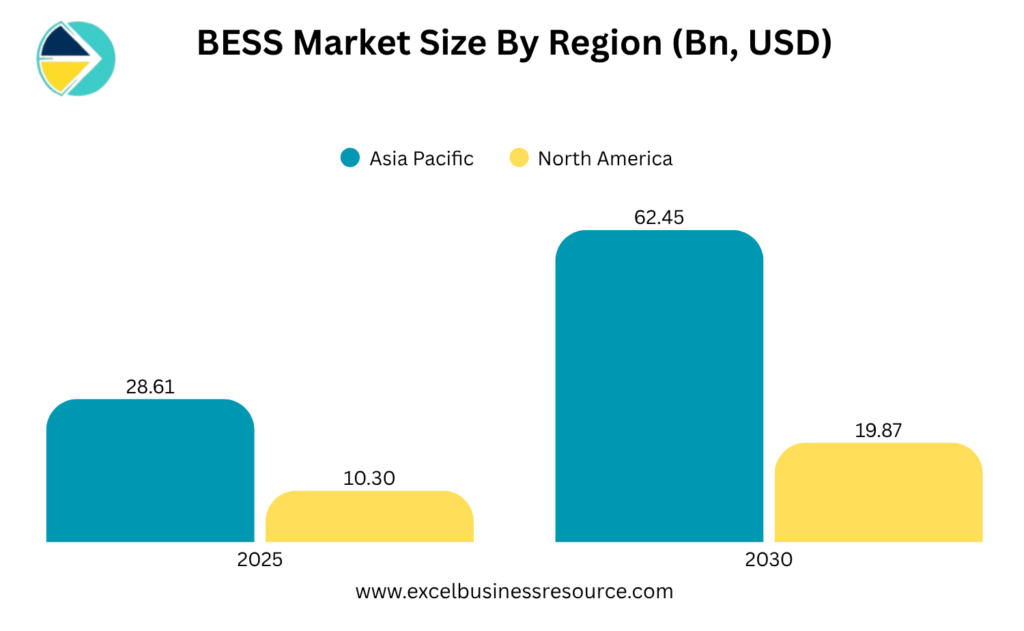
Asia Pacific dominates the BESS market, and it is not close.
| Region | Market Size, 2025 | Projected Size, 2030 | CAGR | Source |
|---|---|---|---|---|
Asia Pacific |
USD 28.61 billion |
USD 62.45 billion |
16.9% |
MarketsandMarkets |
North America |
USD 10.03 billion |
USD 19.87 billion |
14.6% |
MarketsandMarkets |
China’s massive battery manufacturing base gives Asia Pacific a natural cost advantage. Add in aggressive government renewable energy targets, and the region becomes the clear engine of global BESS growth.
The United States drives most of North America’s growth, supported by federal incentives, falling equipment costs, and a rapidly expanding domestic battery supply chain. Europe is growing too, though at a more measured pace, with a clear shift toward utility scale projects over smaller residential systems.
Who Are the Main Customers of BESS?
This is the question most business owners actually want answered. Where is the demand really coming from?
BESS demand splits into three broad customer groups: utilities and grid operators, commercial and industrial businesses, and residential homeowners. Utilities are by far the biggest buyer today, though the other two groups are catching up fast.
| Customer Segment | Global Share, 2025 | Growth Trend | Source |
|---|---|---|---|
Utility scale (grid operators, power producers) |
Around 56% |
Steady growth, still the largest segment |
Global Growth Insights |
Commercial and industrial (C&I) |
Around 28% |
Fastest revenue growth in North America, near 29.5% CAGR |
Mordor Intelligence |
Residential (homeowners) |
Around 16% |
Fastest CAGR of any end user segment globally, near 18% |
Market Research Future |
Why Do Utilities Buy the Most BESS?
Utilities and grid operators use BESS to balance supply and demand across an entire grid. A single utility scale project can store enough energy to power thousands of homes for hours. Governments and regulators also push utilities toward storage through mandates, so this segment includes both investor owned utilities and public or government run power authorities. In North America specifically, utility buyers account for around 74% of market revenue, an even higher share than the global average.
Are Data Centers Becoming a Major BESS Customer?
Yes, and this is one of the fastest moving trends in the industry right now. Most reports still fold data centers into the broader commercial and industrial category, where they sit inside the 28% share shown above. But at least one major research firm, Grand View Research, now tracks data centers as their own leading application segment, reporting a 36.2% share within their specific market scope. Rising electricity demand from AI computing and cloud infrastructure is pushing data center operators to install onsite battery storage for backup power, peak shaving, and grid independence. Expect more reports to start breaking this out as its own segment over the next year or two.
Why Is Residential BESS Growing So Fast, Despite Being the Smallest Segment?
Residential storage holds the smallest share today, but it grows the fastest. Falling battery prices, rising rooftop solar adoption, and changing net metering rules are pushing more homeowners toward battery backed solar systems, especially across Europe and parts of the United States.
What Types of BESS Are Growing Fastest?
Not every battery chemistry or format is growing at the same speed. A few trends stand out.
- Lithium ion batteries remain the dominant technology and are expected to hold the largest market share through 2030. They offer the best combination of cost, energy density, and proven reliability.
- Flow batteries are projected to post the highest CAGR of any battery type. Their ability to scale storage duration independently of power output makes them attractive for long duration applications.
- Sodium ion batteries are gaining attention as a lower cost alternative, especially for stationary storage where weight and size matter less than in electric vehicles.
- Containerized BESS systems are their own fast growing category, with medium capacity systems (1,000 to 5,000 kWh) expected to see the strongest demand.
| Segment | Market Size, 2025 | Projected Size, 2030 | CAGR |
|---|---|---|---|
Containerized BESS (global) |
USD 13.87 billion |
USD 35.82 billion |
20.9% |
For a business planning to enter this space, the format and chemistry you choose will directly shape your cost structure, your target customers, and your financial projections.
What Are the Biggest Challenges Facing BESS Growth?
Fast growth does not mean the industry is free of obstacles. A few real challenges shape how companies plan and invest.
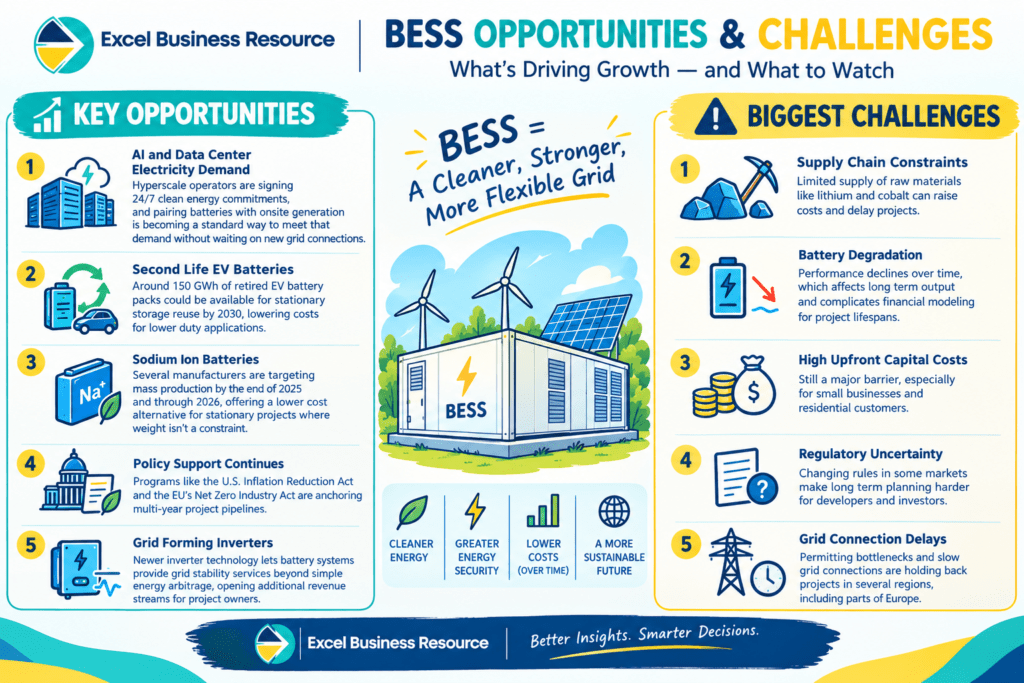
- Supply chain constraints on raw materials like lithium and cobalt can raise costs and delay projects.
- Battery degradation over time affects long term performance and complicates financial modeling for project lifespans.
- High upfront capital costs remain a barrier, particularly for small businesses and residential customers.
- Regulatory uncertainty in some markets makes long term planning harder for developers and investors.
- Grid connection delays and permitting bottlenecks slow down project timelines in several regions, including parts of Europe.
None of these challenges are stopping the market. They are simply factors that any serious BESS business plan needs to account for from day one.
What Will Drive BESS Growth Specifically From 2026 Onward?
A few trends are set to shape the next phase of growth more than the last one did.
AI and data center electricity demand:
Hyperscale operators are signing 24 hour clean energy procurement commitments, and pairing battery storage with onsite generation is becoming a standard way to meet that commitment without waiting on new grid connections.
Second life EV batteries entering the market:
Industry estimates point to around 150 gigawatt hours of retired electric vehicle battery packs becoming available for stationary storage reuse by 2030, which could lower costs for lower duty applications.
Sodium ion batteries reaching commercial scale:
Several manufacturers are targeting mass production of sodium ion cells by the end of 2025 and through 2026, offering a lower cost alternative for stationary projects where weight is not a constraint.
Policy support continuing in major markets:
Programs such as the Inflation Reduction Act in the United States and the Net Zero Industry Act in the European Union continue to anchor multi year project pipelines.
Grid forming inverters unlocking new revenue:
Newer inverter technology lets battery systems provide grid stability services beyond simple energy arbitrage, opening additional revenue streams for BESS project owners.
What Do These Numbers Mean for Your BESS Business Plan?
If you are building a BESS company, evaluating an investment, or writing a business plan for a storage project, these statistics are more than background reading. They shape real financial decisions.
A market growing at 15% to 25% a year changes how you think about:
- Revenue growth assumptions in your financial model
- Realistic customer acquisition timelines
- Pricing strategy as battery costs keep falling
- Capital raising, since investors increasingly expect storage focused pitches to reference current market data
- Risk planning around supply chain and regulatory factors
Getting these assumptions right is often the difference between a financial model that investors trust and one they quietly dismiss. A generic template will not capture the nuances of battery degradation schedules, capacity fade, or the layered revenue streams (energy arbitrage, frequency regulation, capacity payments) that make BESS projects unique.
If you are building your numbers from scratch, our BESS Financial Model template is built specifically for battery storage projects, with monthly and yearly projections, degradation modeling, and investor ready outputs. For businesses combining solar generation with storage, our integrated Solar and BESS Financial Model links both revenue streams in a single, fully connected workbook.
You can also read our guide on driver based forecasting for FP&A teams to understand how to build assumptions that hold up under investor scrutiny, and our article on EBITDA valuation and other ways of startup valuation if you are preparing for a fundraise or exit.
Frequently Asked Questions
How big is the BESS market right now?
The global BESS market was valued at USD 50.81 billion in 2025, according to MarketsandMarkets.
How fast is the BESS market expected to grow?
Most research firms project a CAGR between 15% and 25% through 2030, depending on the segment and methodology used.
Which region has the largest BESS market?
Asia Pacific leads, driven largely by China’s battery manufacturing scale and aggressive renewable energy targets.
What is driving demand for battery storage?
Falling battery prices, growing renewable energy capacity, government incentives, and the need for grid flexibility are the main drivers.
Who buys the most battery storage, utilities or homeowners?
Utilities and grid operators buy the most, accounting for around 56% of global BESS demand. Commercial and industrial businesses come next at around 28%, and residential homeowners make up around 16%, though residential is the fastest growing segment.
Why do BESS market forecasts vary so much between reports?
Different research firms define the market differently. Some count only battery hardware, others include full systems with software and installation, and some separate data center demand while others fold it into commercial and industrial totals. All of them point to strong growth, just measured on different scales.
Is now a good time to enter the BESS industry?
The market data suggests strong tailwinds, but success still depends on a solid business plan, realistic financial projections, and a clear understanding of local regulations and incentives.
Final Thoughts
The BESS market is not a future story anymore. It is happening now, at a scale most people underestimate. Billions of dollars are flowing into storage projects every year, and the growth curve is only getting steeper.
Whether you are launching a new storage venture, adding batteries to an existing solar business, or simply trying to understand where the energy industry is headed, the numbers point in one direction. Battery storage is becoming core infrastructure, not a side project.
If you are ready to turn these market numbers into a real business plan, explore our BESS Financial Model or browse our complete library of startup financial model templates to find the right starting point for your project.