
If you’ve ever built a revenue forecast by taking last year’s number and adding 20%, you know how that conversation with an investor usually ends. They ask where the 20% comes from, and the honest answer is: nowhere.
Driver-based forecasting solves exactly this problem. It replaces guesswork with a model built on the handful of operational driver i.e. pricing, conversion rate, churn, headcount that actually move your financial outcomes. Instead of saying “we’ll grow revenue,” your model says “we’ll close 40 deals at a $2,400 average contract value with a 92% renewal rate,” and the revenue number falls out automatically.
For early-stage founders, this isn’t academic. It’s the difference between a financial model an investor trusts and one they quietly dismiss in the data room.
This guide breaks down what driver-based forecasting actually means, how it differs from driver-based budgeting, why it matters more for startups than mature companies, and how to start building one, even if you’ve never touched Financial Planning & Analysis (FP&A) software before.
What Is Driver-Based Forecasting, Exactly?
Driver-based forecasting is a financial modeling approach where every forecasted number is calculated from underlying business drivers rather than copied and adjusted from historical figures. A driver is any measurable input with a direct, traceable effect on a financial outcome.
Common revenue drivers include:
- Sales volume (units sold per product line).
- Pricing strategy (impact of discounts, promotions, or inflation).
- Customer acquisition & retention (growth rate vs. churn).
- Market demand (seasonality, competitor activity, economic trends).
- Capacity (Production Capacity, Outsource Capacity, Website Traffic Handling etc)
The logic is simple. Instead of forecasting revenue as “last year plus a growth assumption,” a driver-based model expresses it as a formula:
Revenue = Number of Customers × Average Order Value × Purchase Frequency
When one driver changes, let’s say, your conversion rate improves after a pricing test, the entire forecast recalculates automatically. You are not editing a static cell; you are adjusting an assumption that ripples through your income statement, cash flow, and balance sheet in real time.
This is also where driver-based planning and driver-based forecasting get used interchangeably, though there’s a subtle difference. Planning is the broader practice of building budgets and strategic plans around key drivers. Forecasting is the rolling, continuously updated application of that same logic, used to predict near-term performance as new data arrives. Planning sets the target; forecasting tells you whether you’re on track to hit it.
How Driver-Based Forecasting Help Startups
A working driver-based model generally follows the same structure, whether built for a five-person SaaS startup or a Fortune 500 manufacturer. The Corporate Finance Institute notes that the discipline links budgeting and forecasting to the key business drivers that directly impact financial performance, such as sales, costs, and competitive dynamics, instead of relying on historical trends alone. Here’s how that plays out.
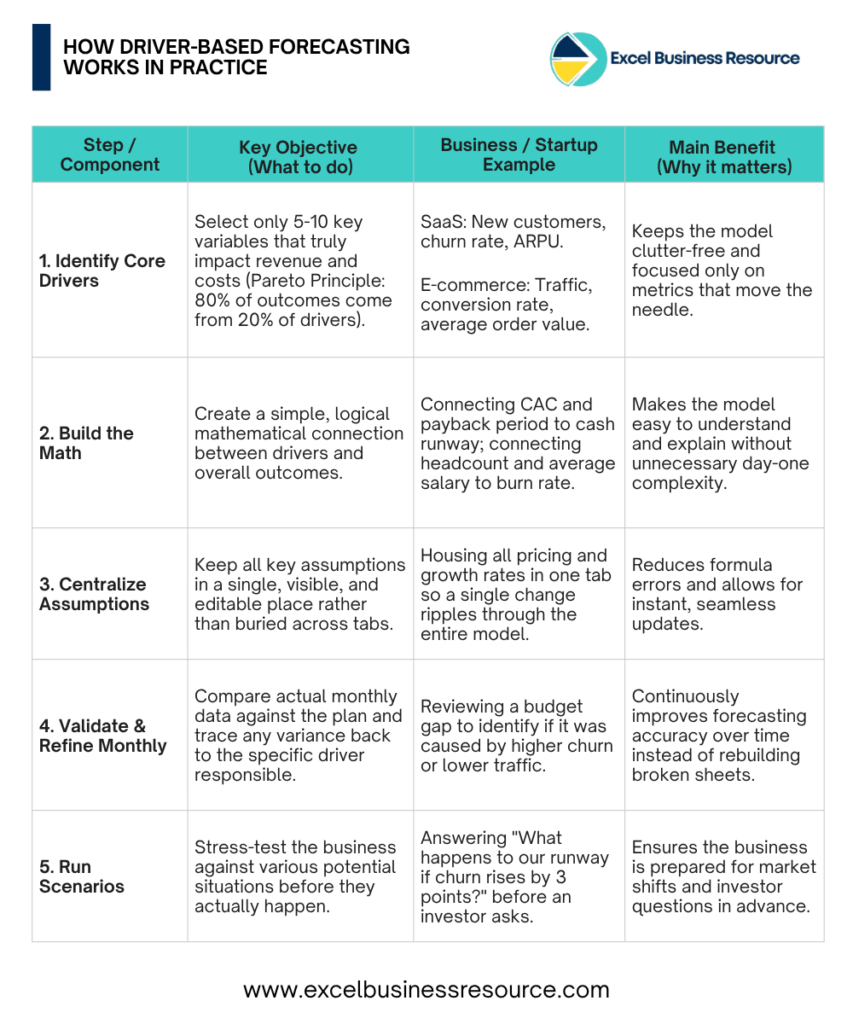
Identify the 5 to 10 drivers that actually matter:
Every business could track dozens of metrics, but only a handful materially move revenue, cost, or margin. The goal is to find the variables that move outcomes, not the outcomes themselves: revenue is an outcome, while sales volume, pricing, and conversion rate are drivers.
A subscription startup’s core drivers are likely new customers, churn rate, and average revenue per user.
An e-commerce brand’s are closer to traffic, conversion rate, and order value.
Most FP&A practitioners borrow from the Pareto Principle here: roughly 80% of performance is explained by 20% of drivers, so a model with 6 to 10 well-chosen driver’s assumptions beats one cluttered with 40 line items nobody updates.
Build the math connecting drivers to outcomes:
CAC and payback period connect to your cash runway. Headcount and average salary connect to burn rate. None of this needs to be statistically complex on day one, just logically sound and easy to explain.
Centralize your assumptions in one place:
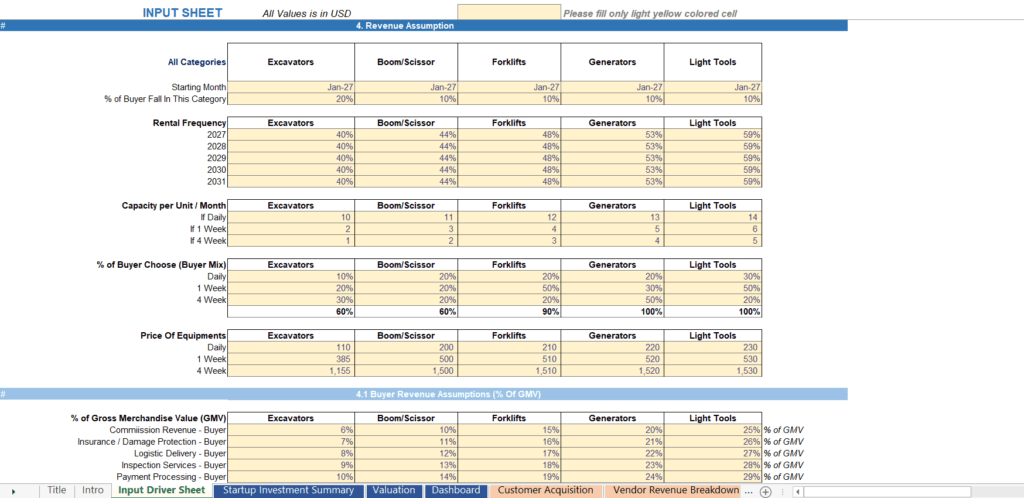
Your startup driver’s assumptions should live somewhere visible and editable, not buried across a dozen disconnected tabs, so a single pricing change ripples through the entire model automatically.
Validate against actuals and refine monthly:
Compare actuals to plan, then trace any gap back to the specific driver responsible. This habit, reviewing variance driver by driver, separates founders who improve forecasting accuracy over time from those rebuilding the same broken spreadsheet every quarter.
Run scenarios before you need them:
Because outputs flow from a small set of drivers, you can stress-test your business in minutes. What happens to runway if churn rises 3 points? A well-built model answers that before an investor asks, not during the meeting.
A Worked Example: Driver-Based Forecasting for a SaaS Startup
Here’s how this looks with real numbers. Say a SaaS startup is forecasting next quarter’s monthly recurring revenue (MRR).
Goal: Grow MRR by 15% next quarter.
Key drivers: Number of website signups, trial-to-paid conversion rate, and average revenue per account (ARPA).
Baseline assumptions: 2,000 signups per month, a 5% conversion rate (100 new paying customers), and $80 ARPA.
Baseline MRR from new customers = 100 customers × $80 = $8,000 per month
Now watch what happens as the model flexes each driver:
| Scenario | Signups | Conversion Rate | New MRR |
|---|---|---|---|
|
Baseline |
2,000 |
5% |
$8,000 |
|
+20% signups (marketing push) |
2,400 |
5% |
$9,600 |
|
+20% signups & +1pt conversion |
2,400 |
6% |
$11,520 |
If the startup only increases signups, new MRR grows by 20%. But if a pricing or onboarding fix also lifts conversion by a single point, new MRR grows by 44%, nearly 2.5 times the impact of pumping more traffic alone.
This is exactly why driver-based forecasting is more useful than a flat growth assumption: it tells the founder precisely where to spend the next marketing dollar or the next week of product time, instead of just hoping for “15% growth” to materialize.
Driver-Based Forecasting vs. Driver-Based Budgeting
These two terms are related but not identical, and mixing them up in front of an investor or board member is an easy way to look less prepared than you are. Driver-based forecasting is the rolling, frequently updated projection of where the business is heading based on current driver values. Driver-based budgeting is the process of setting a fixed annual (or quarterly) plan based on expected driver levels at the start of the period.
Corporate Finance Institute frames the distinction clearly, that the driver-based forecasting adjusts revenue projections, for example monthly, based on metrics like churn rate and new subscriptions, while driver-based budgeting sets a fixed plan, such as an annual marketing budget, based on expected customer acquisition costs. Put simply, budgeting sets the target at the start of the race; forecasting tells you, in real time, whether you are still on pace to hit it.
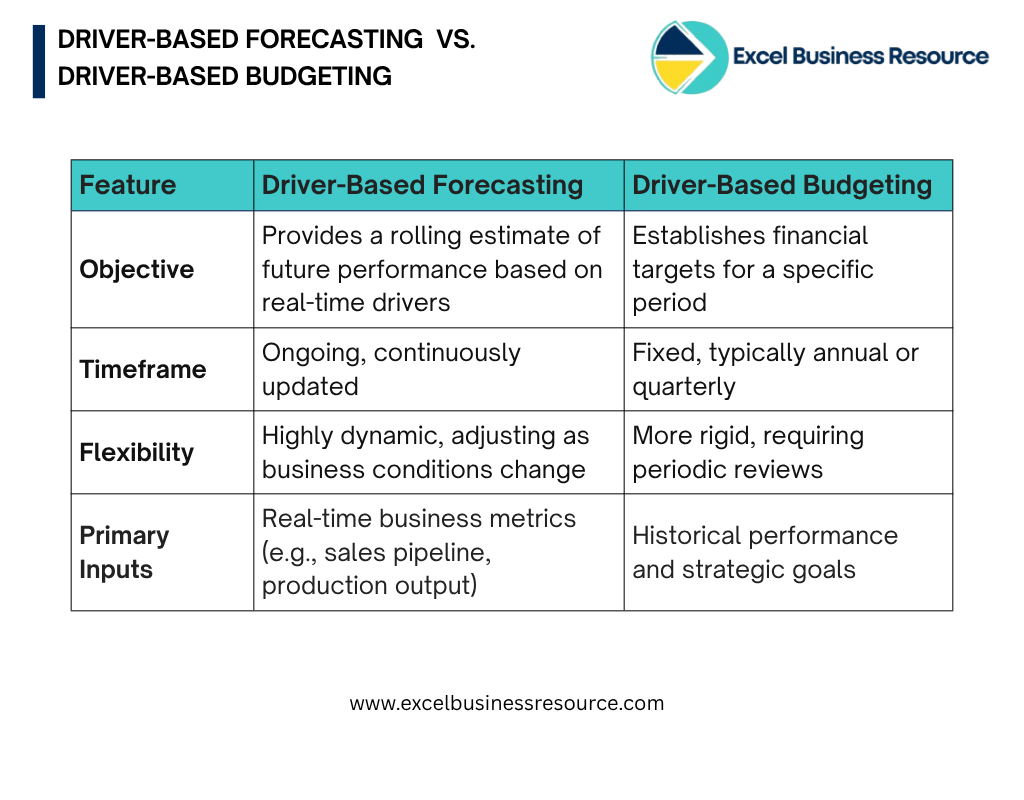
For a startup, you generally need both. Your annual budget, built through driver-based budgeting, sets the spending and hiring plan your team commits to. Your monthly or quarterly forecast, built through driver-based forecasting, tells your board and Venture Capitalist whether that plan is still realistic given what is actually happening in the market.
Why Startups Needs Driver-Based Forecasting Model:
A mature company with ten years of historical data can sometimes get away with simpler trend-based forecasting because its drivers are relatively stable. A startup doesn’t have that luxury. Your churn rate, CAC, and sales cycle length are probably still moving every quarter, sometimes it move too high & low Simultaneously, which makes forecasting without explicit drivers closer to guessing than planning.
There’s a credibility dimension too. Investors evaluating a seed or Series A deal aren’t just checking whether your revenue number looks attractive; they’re checking whether you understand your own business well enough to know what makes it move. A forecast built on explicit drivers signals exactly that kind of operational fluency. This is also where many founders realize the gap between wanting a driver-based model and having the time or modeling depth to build one correctly, which is typically the point at which it makes sense to bring in a financial modeling consultant who already knows which drivers matter for your industry, your unit economics, and your fundraising stage.
How To Start Building Your First Driver-Based Model:
If you are building this yourself in Excel or Google Sheets, here is the realistic starting point, which also we use with clients after working hands-on with 100+ startups across SaaS, e-commerce, healthcare, and manufacturing on FP&A and financial modeling engagements.
Start with revenue drivers first, since this is what investors scrutinize hardest: number of customers, average price, and purchase or renewal frequency. Then move to cost drivers, headcount by department, average fully-loaded salary, and variable costs tied to volume. Finally, connect both sides into a cash runway template so you can see, in real time, how many months of operating cash a change in any driver buys or costs you.
Learn: How Excel Business Resource’s Financial Forecasting & FP&A work has help CGL to raised $1 Million Investment.
If you don’t want to build a driver-based forecasting from scratch, then download a custom built, investor ready startup financial model templates. Whether you’re running a SaaS company, an e-commerce brand, or a healthcare startup, a well-built startup financial projection model template saves you the 40 to 80 hours it typically takes to construct a three-statement model from scratch, and reduces the formula errors that quietly undermine credibility during investor due diligence.
It’s also worth pairing your drivers with a clear view of unit economics, since CAC, lifetime value, and payback period are themselves drivers feeding your broader forecast. If you’re preparing for a raise, understanding startup valuation methods and how EBITDA multiples factor into startup valuation will show you how today’s driver assumptions translate into tomorrow’s company value.
Common Mistakes Founders Make With Driver-Based Forecasting:
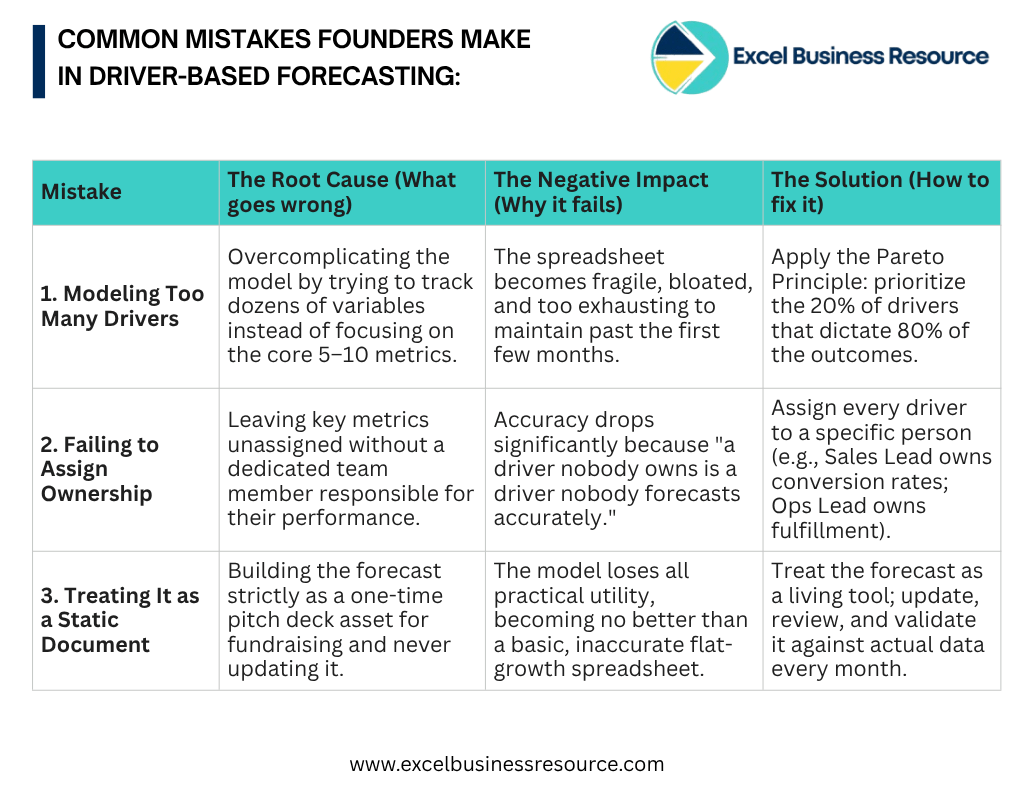
A few patterns show up again and again in early-stage models we review. The first is modeling too many drivers, which makes the spreadsheet fragile and hard to maintain past month three. The second is failing to assign ownership: every driver should have a specific person responsible for updating and explaining it, whether that’s a sales lead for conversion rate or an operations lead for fulfillment capacity. A driver nobody owns is a driver nobody forecasts accurately. The third, and most common, is treating the forecast as a one-time fundraising document instead of a living tool. A forecast built once for a pitch deck and never touched again is barely better than the flat-growth spreadsheet it replaced.
When building a driver-based financial model, founders must avoid common forecasting mistakes that could jeopardize their fundraising journey.
Final Thoughts: Forecasting That Earns Investor Trust
Driver-based forecasting is not a buzzword, It is a structural shift from guessing at outcomes to modeling the actual mechanics of how your business generates revenue and burns cash. For a startup operating in a market that shifts every quarter, that requires structural clarity which only comes through the driver’s based forecasting.
If you are weighing whether to build this in-house or bring in outside help, it is worth reading how an FP&A consultant can help scale your startup, particularly if your team’s time is better spent on product and growth than on spreadsheet architecture. And if you want a faster starting point than a blank workbook, browse our library of startup financial model templates built around exactly this driver-based logic, ready to adapt to your industry, your stage, and your next round.