
Most business owners reach a tipping point where basic spreadsheets no longer cut it. Whether you’re eyeing a funding round, launching a new product, or planning an expansion, you eventually need more than just data you need a clear roadmap of your financial future. This guide explores exactly when to bring in a financial modeling consultant, the value they provide, the typical costs involved, and the signs that you might not be ready for one just yet.
What Does a Financial Modeling Consultant Actually Do?
A financial modeling consultant builds structured, dynamic Excel or software-based models that help you forecast revenue, plan costs, understand cash flow, and run “what-if” scenarios. But the real value isn’t just the spreadsheet it’s the thinking behind it.
10 Excel Hacks Every Startup Founder Needs for Killer Revenue Forecasting – Read it, If you are doing forecasting or budgeting yourself.
Here’s what they typically deliver:
- 3-statement financial models: Income statement, balance sheet, and cash flow — all linked and dynamic.
- Revenue forecasting: Projecting growth by product, geography, channel, or customer segment.
- Scenario analysis: What happens if CAC rises 20%? What if your churn doubles? What’s your runway if revenue drops 30%?
- Investor-ready projections: Models built for due diligence, pitch decks, or bank loan applications.
- Valuation support: DCF models, comparable company analysis, and acquisition pricing support.
- Unit economics: LTV, CAC, payback period, gross margin by SKU or service line.
They don’t just hand over a file — a good consultant explains the assumptions, walks you through the outputs, and helps you understand what levers actually move your business.
5 Clear Signs Your Business Needs a Financial Modeling Consultant
1. You’re Raising Funding
Investors don’t just want to see your numbers — they want to stress-test them. A consultant builds a model that holds up under questioning, with clear assumptions and defensible projections. A weak model during due diligence is one of the fastest ways to lose a deal.
2. You’re Making a Decision Worth $100K+
Hiring 10 people. Opening a second location. Signing a 3-year lease. These decisions have long financial tails. A model helps you see the full impact — not just the upfront cost, but the break-even point, the cash flow timing, and the downside if things don’t go to plan.
3. Your Internal Team Doesn’t Have This Skill
Many startups and SMEs have a bookkeeper or a controller who’s great at historical reporting but doesn’t build forward-looking models. That’s not a failure — it’s just a different skillset. A consultant fills that gap without requiring a full-time hire.
4. You’re Getting Conflicting Numbers from Different Sources
If your accountant says one thing, your operations lead says another, and your own estimates say something else — you don’t have a model, you have a mess. A consultant creates a single source of truth that everyone can work from.
5. You’re Entering a New Market or Business Model
Launching a SaaS product when you’ve been running a services business. Expanding from B2C to B2B. Going from a single-location retail store to a franchise model. These transitions have completely different unit economics, and getting it wrong costs real money.
Understand Quickly: Why Your Startup Financial Model Might Be Sabotaging Your Strategy
When You Probably Don't Need a Financial Modeling Consultant Yet
Not every business is at the right stage. Here’s when it’s likely too early:
- You’re pre-revenue and still validating the idea — focus on customer discovery first.
- Your revenue is under $20K/month and there’s no major decision in front of you.
- You need basic bookkeeping or accounting — that’s a different service entirely.
- You just need a simple cash flow tracker — a template might be all you need right now.
Being honest about your current stage saves you money and makes sure you invest in the right kind of help at the right time.
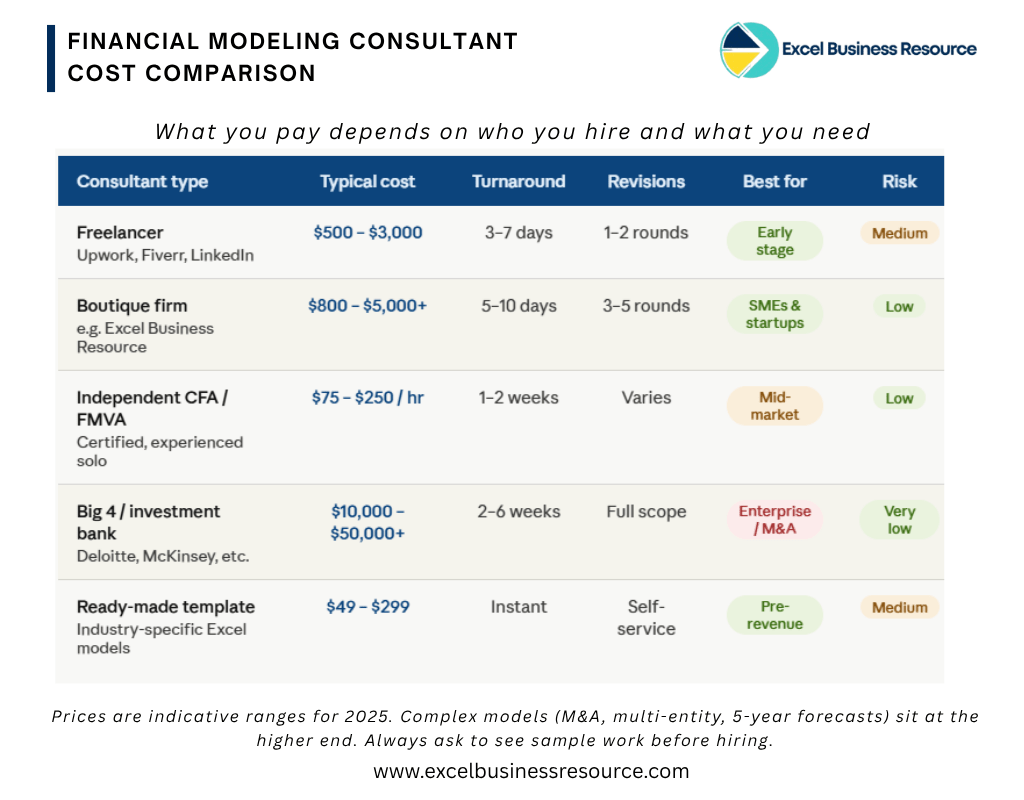
How Much Does a Financial Modeling Consultant Cost?
This is the question most articles skip. Let’s be direct:
- Freelance consultants: $500 – $3,000 for a one-time model depending on complexity.
- Boutique firms (like EBR): $800 – $5,000+ for custom, investor-ready models with revisions and support.
- Big 4 / investment bank consultants: $10,000 – $50,000+ for large enterprise or M&A work.
- Hourly rates: $75 – $250/hour depending on experience and location.
The right choice depends on what you’re building the model for. A seed-stage startup raising $500K doesn’t need the same model as a company doing $10M in revenue exploring a private equity exit.
According to IBISWorld, the financial consulting market in the US alone is worth over $67 billion — meaning there’s no shortage of options, but quality varies widely. Always ask to see examples of past models before hiring.
Red Flags to Watch Out For When Hiring
Not everyone calling themselves a financial modeling consultant has the skills to back it up. Watch for these warning signs:
- They can’t explain their assumptions clearly — if they built it, they should be able to walk you through every number.
- The model isn’t dynamic — if changing one assumption doesn’t update the rest of the model automatically, it’s not a real model.
- No industry experience — a SaaS model looks completely different from a restaurant model. Industry knowledge matters.
- They promise specific outcomes — a good consultant shows you scenarios, not guarantees.
- No revision process — one draft and done isn’t how real modeling works. Expect back-and-forth.
How to Get the Most Value from a Financial Modeling Consultant
The output is only as good as the inputs. Before you engage a consultant, have these ready:
- At least 12 months of historical financial data (P&L, balance sheet, bank statements)
- A clear description of your business model — how you make money and what drives costs
- Specific questions you need the model to answer
- Any existing projections or assumptions you’ve already made
The more context you give upfront, the faster and better the model will be.
Final Verdict: Is It Worth It?
If you’re at a meaningful inflection point in your business — raising money, making a big bet, entering a new market, or trying to understand your numbers at a deeper level — then yes, a financial modeling consultant is absolutely worth it.
The cost of a good model is almost always smaller than the cost of a bad decision made without one. For most businesses, a well-built financial model pays for itself the first time it prevents you from walking into the wrong deal, or helps you walk into the right one with confidence.
If you’re looking for a starting point, Excel Business Resource offers custom financial models built specifically for startups and SMEs — with industry-specific templates for SaaS, real estate, restaurants, ecommerce, and more.