

Thinking about starting a laundromat business? It sounds like a dream steady cash flow, simple operations, and a service people always need, even in tough economic times. But here’s the truth, the difference between a store that bleeds money on electricity bills and one that brings in predictable profit comes down to planning. Before you spend a single dollar or sign a lease, you need a clear, step-by-step roadmap. In this guide, we’ll walk you through building a simple, investor-ready laundromat plan using real numbers.
What Should a Laundromat Business Plan Include?
This step-by-step guide will show you how to write an effective business plan for a laundromat. Your plan should include the following eight sections in order:
- Executive Summary
- Company and Business Model
- Market Analysis
- Services and Revenue
- Operations and Equipment
- Marketing Strategy
- Financial Projections
- Appendix
Start Your Laundromat Business Plan with Executive Summary
Write the executive summary in the last, but place it on page one. Try to Keep it in one page. State your business concept, your location, your total project cost, how much you will borrow, and the cash flow you expect in year one. A lender should know your whole story after reading this page.
Example: a self-service store of 2,500 square feet, a $300,000 total project, $50,000 of your own cash, and a $250,000 SBA loan.
Tip: Put your loan request in the first two lines. That’s the first thing readers look for.
Move on to the Company Description for Laundromat Business
Pick one model and explain it in plain words. A self service laundromat earns from machine cycles and needs little staff. Wash and fold earns a fee per pound and needs attendants. A hybrid does both. Your model sets your staff cost, your equipment mix, and your risk.
Real example: Keira Hamilton, an SBA loan broker, wrote on BiggerPockets that she bought a laundromat for $190,000, ran it for 16 months, and sold it for $300,000. She reported seller discretionary earnings near $77,000 a year and spent 7 to 10 hours a week on it. This is one owner telling her own story, not audited data.
Tip: Clearly name who will run the store every day. If you plan to run it yourself, state how many hours a week you will spend there.

List your Product/Services and Revenue Streams
List down every way the store earns money means (all revenue streams with their pricing). For Example self-service machines, wash and fold services, detergent vending machines, and Card / App Payment Options. Whatever you decide to do show revenue accordingly so it would be easy to understand your math.
- Pricing: Standard washes cost $2.50 to $4.00 per cycle; large machines cost $8.00 to $12.00.
- Average Revenue: The industry average is around $167,000 per store each year. Use this figure as a baseline check, not a solid forecast.
- Revenue Drivers: Our guide to the revenue drivers of a laundromat business shows what pushes your own number above or below this baseline. For example, adding a wash-and-fold service with 50+ monthly clients creates a steady, diversified income stream.
Tip: Put extra income sources like vending machines on a separate line. Make sure your core business stays profitable even without this extra income.
Conduct Market Analysis for a Laundromat Business
A strong market analysis proves that local residents actually need a laundromat. Focus on counting renter households and multi-family apartments within a short drive, then list every nearby competitor along with their machine counts and prices. Because people without in-unit washers drive your business, renter density matters far more than total population.
The U.S. Census Bureau reported a homeownership rate of 65.0% in the second quarter of 2026, so about 35% of households rent 35% of households rent. Use 35% as your baseline and look for blocks well above it. The Coin Laundry Association counts about 29,500 US laundromats earning about $5 billion a year.
Competition isn’t always bad. A nearby store with broken machines means customers are looking for a better option.
Tip: Check the site on Saturday at 9 AM. Too few open parking spots means drive-in customers will go somewhere else.
Plan your Operational and Equipment Strategy
Equipment is your biggest expense, so plan it before doing anything else:
- Mix washer sizes and pair each with a bigger dryer.
- Check the building’s water pipe size, sewer fees, and gas supply.
- Confirm all utility details with the landlord before signing the lease.
A full equipment package for a 2,000 to 3,000 square foot store costs $150,000 to $400,000. Dexter Laundry sells vended washers from 20 pounds to 120 pounds, and its dealer guide suggests a dryer 1.2 to 1.4 times the washer size and 20% to 25% of floor space for machines 20% to 25% of floor space for machines.
Utilities are a top concern for store owners. The average laundromat spends 22% of its income on water, sewer, gas, and electricity. Stores with older machines can reach 30% or more, while highly profitable stores average 19%. Watch out for hidden costs like hot water boiler capacity, sewer connection fees, and plumbing upgrades your landlord won’t cover.
Tip: Read your lease to see who pays for plumbing upgrades, and get written proof of your water and gas capacity before buying machines.
Create a solid Marketing plan and Customer Acquisition plan
Most laundromat customers live nearby, so focus on local marketing. Set up your Google Business Profile, put up clear street signs, and launch with a grand opening deal. Set an exact monthly marketing budget and track how much it costs to bring in each new customer.
Example: spend $1,500 in month one on signs and a free wash day. If 300 new customers visit, each one cost you $5. Offer card or contactless app payment too.
Tip: Place a review request sign near the door asking customers for reviews. Fresh online reviews help local customers find your store first on search maps and boosts your local Google ranking.
Put together a Financial Plan and Pro Forma Projections for a Laundromat
Build three things: a startup cost list, a yearly profit forecast, and a loan check. A new store usually costs $200,000 to $500,000 to open. Split capital costs from operating costs, then test whether cash flow covers your loan with room to spare. For line by line prices, see what it cost to start a laundromat business.
Example: a $300,000 project funded by $50,000 of your cash and a $250,000 loan.
Line | Per year |
Revenue | $240,000 |
Utilities at 22% of revenue | $52,800 |
Rent | $48,000 |
Attendant labor | $36,000 |
Repairs, insurance, supplies, marketing | $36,000 |
Net operating income | $67,200 |
Loan payments ($250,000, 10 years, 10% assumed) | $39,600 |
Cash left before your own pay | $27,600 |
Debt service coverage ratio is net operating income divided by loan payments: $67,200 ÷ $39,600 = 1.7. SBA rules call for at least 1.15, and most lenders want 1.25 to 1.50. Break even sits near $204,600 of revenue, which is 85% of the forecast, so sales can drop about 15% before you lose money. Lenders usually ask for 10% to 30% down and a credit score near 650 or higher.
I assumed a 10% rate. SBA maximum rates move with the prime rate, so check the current cap before you finalize.
Share Supporting Documents in Appendix at last
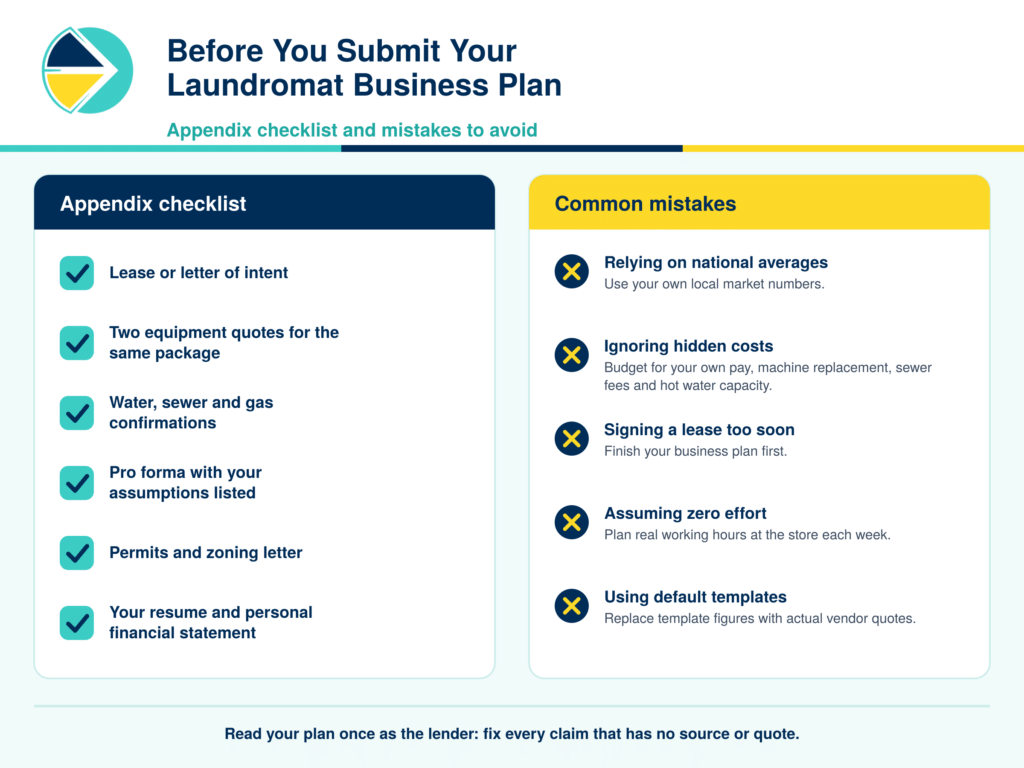
The appendix holds the proof. Attach the signed lease or letter of intent, equipment quotes, utility confirmations, your resume, the pro forma, permits, and site photos. Readers skim your story and then check these papers, so label each file and keep every number matching the plan.
- Lease or letter of intent
- Two equipment quotes for the same package
- Water, sewer, and gas confirmations
- Pro forma with your assumptions listed
- Permits and zoning letter
- Your resume and personal financial statement
Tip: Get quotes from two different sellers for the same equipment setup. Having two prices proves you verified your costs.
Common Mistakes Founders Makes
- Relying on national averages: Use your own local market numbers instead.
- Ignoring hidden costs: Budget for your salary, machine replacement, sewer tap fees, and hot water capacity.
- Signing a lease too soon: Finish your business plan first.
- Assuming zero effort: Plan on spending real working hours at the store each week.
- Using default templates: Always replace template numbers with actual vendor quotes.
Tip: Read your plan once as the lender. Mark every number that has no source or quote behind it, and fix those first.
Bottom Line
A business plan earns trust when every claim is backed by real numbers and you get those numbers by building your financial model before signing anything. Start with your actual rent, local utility rates, and two supplier quotes, then let the spreadsheet calculate your margins. If you don’t want to build formulas from scratch, the laundromat financial model template gives you a ready-made model to test your figures before showing them to a lender.
Laundromat Business Plan FAQs
What is a good utility cost percentage for a laundromat?
The average store spends 22% of revenue on utilities. Stores with net profit above 20% averaged 19%, and stores with older machines reach 30% or more.
How do I get an SBA loan for a laundromat?
Bring a full plan, 10% to 30% down, a credit score near 650 or higher, and cash flow that covers the loan at least 1.15 times. SBA 7(a) loans go up to $5 million. Keep clean books, because the BiggerPockets owner, an SBA broker, says thin records make laundromats hard to finance.
What demographics are best for opening a laundromat?
Renters in multi-family housing, especially buildings without in unit machines. About 35% of US households rent, so look for areas well above that.
How do I project revenue for wash and fold services?
Multiply customers by average order value by orders per month. Example (my illustration): 50 customers × $30 × 2 orders = $3,000 a month, or $36,000 a year.
Is owning a self-service Laundromat business profitable?
It can be. One lender estimates net margins of 20% to 35% before loan payments, but location, utilities, and your own hours decide the result.