
The cost to start a laundromat business typically falls between $100,000 and $500,000, depending on whether you buy an existing store, take over a used space, or build a new one from scratch. A small coin laundry with used machines can open for as little as $50,000, while a full commercial buildout with new equipment can climb past $1 million. Once open, a well run laundromat usually earns a net profit margin of 20% to 35%, with most owners reaching a full payback on their investment in three to six years.
If you are seriously weighing this business, you need the full picture: what each dollar actually pays for, how profit builds up month by month, and what separates a laundromat that struggles from one that prints cash every week. This guide breaks all of that down using current industry data, so you can plan your budget with real numbers instead of guesswork.
Quick Summary: Laundromat Capital & Profit Snapshot:
| Categories | Laundromat Capital & Profit Snapshot |
|---|---|
|
Turnkey / Small Buyout: |
$50,000 – $100,000 upfront cash required |
|
Average Mid-Sized Laundromat Buildout: |
$200,000 – $500,000 total investment |
|
Equipment Investment Range: |
$80,000 – $300,000 (Washers & Dryers) |
|
Average Monthly Operational Costs: |
$8,000 – $18,000 / month |
|
Net Profit Margin: |
20% to 35% ($2,500 – $8,500+ monthly net cash flow) |
How Much Do You Need To Open A Laundromat Business
Your total investment depends on one core decision, either you are buying an existing laundromat or build a new one. According to Nav, taking over a run down laundromat and upgrading it over time can cost $50,000 to $100,000 in cash, while new construction can start around $250,000 and go well beyond $1 million. Clarify Capital places most mid size laundromats with commercial grade machines and proper renovations in the $200,000 to $500,000 range.
Capital Requirements: Buy vs. Build Breakdown
To capture the right business model for your budget, startup capital splits into three primary execution paths:
Turnkey Buyout / Retool ($50,000 – $100,000): Lowest cash barrier. Acquiring an existing location that needs cosmetic updates, plumbing fixes, and replacement of 20%–30% older machines.
Standard Mid-Sized Store ($200,000 – $500,000): The industry benchmark for a 2,000 sq. ft. facility with 20–30 commercial washers, 20 stack dryers, hybrid card/coin systems, and updated utility feeds.
Ground-Up New Build ($700,000 – $1,200,000+): Premium facility with high-capacity smart equipment, ozone sanitization, customer lounge, and automated app-based access.
Debt vs. Equity Setup: Most owners do not pay 100% cash. Financing 70% to 80% through SBA 7(a) or equipment distributor loans means you typically need $40,000 to $120,000 in liquid equity down payment for a standard mid-sized project.
Laundromat Business Startup Cost Breakdown (CapEx)
| Cost Category | Typical Range | Operational Note / Key Drivers |
|---|---|---|
|
Commercial washers and dryers |
$80,000 to $300,000 |
20–40 commercial units ($5k–$7k per machine) |
|
Lease deposit and buildout |
$15,000 to $80,000 |
Lease deposit + flooring, electrical & seating |
|
Plumbing, Gas & Electrical Upgrades |
$10,000 to $50,000 |
Heavy-duty water lines, gas headers & panels |
|
Commercial Water Heating Array |
$8,000 to $20,000 |
High-capacity commercial tank or tankless array |
|
Permits, Utility Impact & Licensing |
$5,000 to $15,000 |
Municipal sewer connection & business licenses |
|
Payment Systems (Card Readers/Changers) |
$2,000 to $8,500 |
Bill changers or smart card readers per machine |
|
LLC Formation, Legal & Insurance |
$1,000 to $2,500 |
Legal setup, permits, initial liability coverage |
|
Signage, Branding & Launch Marketing |
$2,000 to $5,000 |
Exterior illuminated sign + local opening promo |
|
Working Capital (3 to 6 Months) |
$20,000 to $60,000 |
Operational buffer for early utility bills & rent |
Equipment is almost always your biggest line item. Newer commercial washers run $5,000 to $7,000 per unit, and commercial dryers start around $6,000 to $7,000, according to Nav. If you are financing a larger new build, LRE Advisors notes that full ground up projects can require $700,000 to $1 million in total project cost, with most owners financing around 75% and covering the rest with cash equity.
Monthly Cost to Run a Laundromat (Recurring Operational Expenses)
Beyond initial startup capital, budgeting your monthly cost to run a laundromat is essential for protecting cash flow. On average, a standard 2,000 sq. ft. store incurs $8,000 to $18,000 per month in operating expenses.
Utilities and commercial rent consistently constitute your two largest recurring expense categories:
| Monthly Line Item | Estimated Cost / Month | % of Total Revenue | Key Cost Drivers |
|---|---|---|---|
|
Utilities (Water, Electricity, Gas) |
$2,000 – $4,500 |
20% – 28% |
Water volume, gas water heating, continuous electric draw |
|
Commercial Rent & NNN / CAM |
$1,500 – $6,000 |
20% – 35% |
Square footage, plaza foot-traffic, property tax share |
|
Equipment Loan / Debt Service |
$1,500 – $4,000 |
15% – 20% |
7-to-10-year amortized financing on machine bundle |
|
Attendant Payroll & Labor |
$1,000 – $3,500 |
10% – 18% |
Attended stores vs. unattended CCTV-monitored setups |
|
Commercial Insurance (Liability/Property) |
$350 – $750 |
2% – 4% |
Water damage liability, slip-and-fall & property coverage |
|
Maintenance, Repairs & Supplies |
$300 – $800 |
3% – 5% |
Coin slide jams, belt replacements, bulk soap restocking |
|
Merchant Processing & App Fees |
$150 – $400 |
1% – 3% |
Credit card processing fees on smart payment machines |
How to Start a Laundromat Business Step by Step
Once your budget is clear, the actual launch process follows a fairly predictable path:
- Pick a location with strong foot traffic and a high density of renters or apartment dwellers.
- Decide between buying an existing laundromat or building new.
- Choose your equipment mix based on expected wash cycles and machine turns per day.
- Secure permits, insurance, and utility connections.
- Build out your budget using a proper Startup Financial Model Template so every assumption is tied to a number.
- Set your pricing based on local competitors and your target Revenue Drivers of Laundromat Business, such as machine utilization and average ticket size.
- Launch, track your Key Metrics of Laundromat Business weekly, and adjust pricing or hours as data comes in.
A solid Business Plan for Laundromat Business is not optional here. Lenders will ask for one, and it forces you to test your assumptions before you sign a lease.

Laundromat Budget Analysis: Where the Money Actually Goes
Proper laundromat budget analysis separates one time startup costs from recurring monthly expenses. Utilities are usually the biggest ongoing cost, running 20% to 30% of gross revenue, according to Laundry Lockers. Rent should ideally stay under 25% of revenue, and if you plan to staff the store, payroll adds another 15% to 25%.
This is why a Laundromat Business budget template matters so much before you open. It lets you stress test rent, utility rates, and machine count against realistic revenue scenarios instead of hoping the numbers work out. If cash flow is tight in the early months, a burn rate and cash runway template can show you exactly how many months of working capital you have left before you need more funding. Many owners also use a financial model built for retail businesses as a starting structure, since laundromats share similar fixed cost patterns with other storefront retail operations.
How Profitable Is a Laundromat Business?
The profitability of a laundromat business is one of its biggest selling points. Multiple industry sources, including BusinessDojo and Real Clean Group, place net profit margins at 20% to 35% for well managed stores, which is high for a brick and mortar business. Annual cash flow for a single location typically ranges from $15,000 to $300,000 depending on size and location, and the wider U.S. coin laundry sector generated roughly $5.5 billion in receipts as of the most recent Census Economic Census data.
Laundry also holds up well in a downturn. People still need clean clothes even when they cut other spending, which is part of why laundromats are often called recession resistant.
Detailed Profit Margins & Key Benchmarks
Average Net Profit Margin: 20% to 35% (calculated after rent, utilities, labor, and equipment loan payments).
Average Monthly Net Income: $2,500 to $8,500+ per store ($30,000 – $100,000+ annual net profit).
Cash-on-Cash ROI: 20% to 100% depending on initial leverage and store efficiency.
Top Operational Strategies to Boost Margins
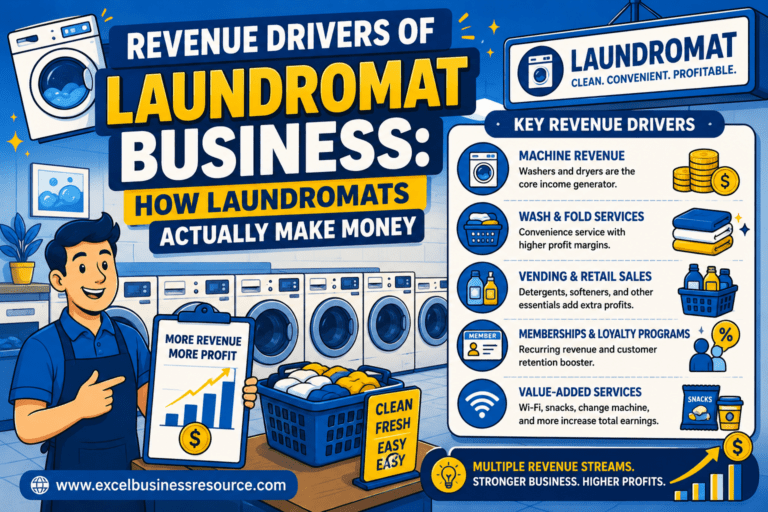
High-performing laundromats build additional top-line revenue streams beyond self-service drop-in usage:
Wash-and-Fold (Fluff & Fold) Service: Charges $1.50 – $2.50 per pound with 60%+ gross margins.
Commercial B2B Contracts: Servicing local gyms, spas, medical clinics, and Airbnb hosts during low-volume weekday hours.
Vending & Ancillary Revenue: On-site soap vending machines, arcade games, beverage sales, and Wi-Fi access adding 5% to 10% pure profit margin.
What Is the Profit Timeline for a Laundromat Business?
Here is the part most first time owners underestimate: profitability does not happen on day one.
- Months 1 to 6: You are building a customer base. Cash flow is usually break even or slightly negative as people discover the store.
- Months 6 to 18: Cash flow typically turns positive during this window as usage patterns stabilize and operations get more efficient.
- Year 2 to 3: Prime, low competition locations can reach a full payback on their investment in as little as three years.
- Year 4 to 6: Suburban or more competitive markets often need four to six years to fully recover the initial investment.
The exact timeline depends heavily on your starting capital, your rent, and how quickly you hit strong machine utilization. This is exactly the kind of forecasting a laundromat financial model should map out for you month by month, instead of leaving you to guess when you will actually turn a profit.
How to Make a Laundromat Business Profitable
A few levers consistently separate profitable laundromats from struggling ones:
- Control utility costs. Water, gas, and electric can eat 20% to 30% of revenue, so energy efficient machines pay for themselves quickly.
- Push machine turns per day. More cycles per machine directly increases revenue without adding new equipment.
- Add wash and fold service. This can add 30% to 50% to total revenue, since it carries a much higher margin than standard coin operation.
- Track your Unit Economics closely. Understanding revenue per machine and cost per cycle tells you exactly where to invest next.
- Use driver-based forecasting instead of guessing. Building your plan around real Business Drivers for Startups, like foot traffic, machine count, and average ticket size, produces far more accurate projections than a flat growth assumption.
Do You Need a Business Plan and Financial Model for a Laundromat?
Yes, and lenders will require one before approving financing. A strong business plan should include your market analysis, your full startup budget, and a financial model that projects revenue, expenses, and cash flow for at least three years.
If you are building this from the ground up, our guide on Startup Financial Forecasting Model From Scratch walks through the process step by step. You should also understand Startup Valuation methods and how EBITDA Multiple valuation works, especially if you plan to sell the business or bring in investors later. And if your projections rely on assumptions rather than a clear structure, it may be worth learning how an FP&A consultant can help scale your startup by tightening those numbers before you commit real capital.
Skip the Guesswork With an Investment Ready Laundromat Financial Model
Building all of this from scratch in Excel takes weeks, and one wrong assumption about utility costs or machine turns can throw off your entire budget. Our team at Excel Business Resource has worked with more than 100 startups on financial modeling, FP&A, and business planning, and we built a Laundromat Financial Model specifically to remove that guesswork.

The template gives you a full startup cost breakdown, a month by month profit and loss forecast, a cash flow and payback period calculator, and break even analysis, all pre-built around real laundromat business drivers. Instead of spending days building formulas, you plug in your local rent, machine count, and pricing, and the model shows you exactly when your laundromat becomes profitable. It is the fastest way to walk into a bank or investor meeting with numbers you can actually defend.
Frequently Asked Questions By Founders
How much does it cost to open a small laundromat?
A small, 1,000 to 1,500 square foot laundromat with 15 to 25 machines typically costs $100,000 to $200,000 to open, especially if you buy existing equipment rather than building new.
How long does it take for a laundromat to become profitable?
Most laundromats see cash flow turn positive within 6 to 18 months, with a full payback on the initial investment taking three to six years depending on location and competition.
Do laundromats require a lot of daily work?
Unattended coin laundry operations can run with minimal daily staffing, but you still need regular equipment maintenance, cash collection, and utility monitoring to keep margins healthy.