
A startup financial forecasting model translates your business assumptions into projected revenue, expenses, cash flow, profitability, and funding requirements.
Instead of simply estimating how much money a startup might make, a properly built model connects operational drivers such as customers, pricing, hiring, churn, and marketing spend to the financial statements.
In this guide, we show how to build a startup financial forecasting model step by step, including revenue forecasting, COGS, operating expenses, headcount, cash flow, working capital, scenarios, and key startup KPIs.
But before that, you need to understand, why VC’s likes simple financial model.
Why VCs Like Simple Financial Model Spreadsheets To Review?
VCs review hundreds of pitch decks, investment memos, financial models, and due diligence materials. They don’t have time to dig through a financial model just to figure out:
- Where is the revenue coming from?
- What are the key revenue drivers?
- What happens if CAC increases?
- How does profitability change if gross margins decline?
A financial model isn’t a test of how many complex formulas you can cram into a spreadsheet. The best startup financial model is the one a founder and an investor can open, understand, and trust immediately, for instances;
Most early-stage models fail for three reasons:
- They’re built backwards i.e. formulas come first, business logic comes later (or never).
- There’s no consistent structure, so every tab looks like a different file.
- Assumptions are buried inside formulas instead of being visible, editable inputs.
If you’ve ever opened a financial model and felt lost within thirty seconds, that’s not your fault, it’s a design problem. A well-structured startup financial forecasting model fixes this with three things: simplicity, clarity, and consistent formatting.
What should a startup financial model include?
EBR’s financial model must includes the following tabs inside the spreadsheet of any industry.
| Component | Purpose |
|---|---|
|
Assumptions |
Controls the model’s key drivers |
|
Investment Summary |
Summarized the whole forecast, analyze the investment requirements & modes of investment, how funding are allocated. |
|
Valuation |
Shows DCF valuation, EBITDA & Revenue Valuation, NPV, IRR, free cash flow, Payback period, cash burn rate etc. |
|
Revenue Forecast |
Projects sales and customer growth |
|
COGS & OpEx |
Estimates direct costs & its Operational expenses. |
|
Headcount |
Models hiring and payroll |
|
3 Statement Model |
Compile & calculate profitability, cash flow & balance sheet, either in the same tab or separated tabs. |
|
Working Capital |
Models receivables, payables and inventory |
|
CapEx |
Forecasts equipment and other capital spending |
|
Debt |
Models borrowing and repayments |
|
Funding |
Shows capital injections |
|
KPIs |
Tracks operating performance |
|
Scenarios |
Test different outcomes |
|
Dashboard |
Visualizing forecasting performance |
Step-by-Step Guide To Build A Startup Forecasting Model
The Foundation: Color-Coding and Tab Structure
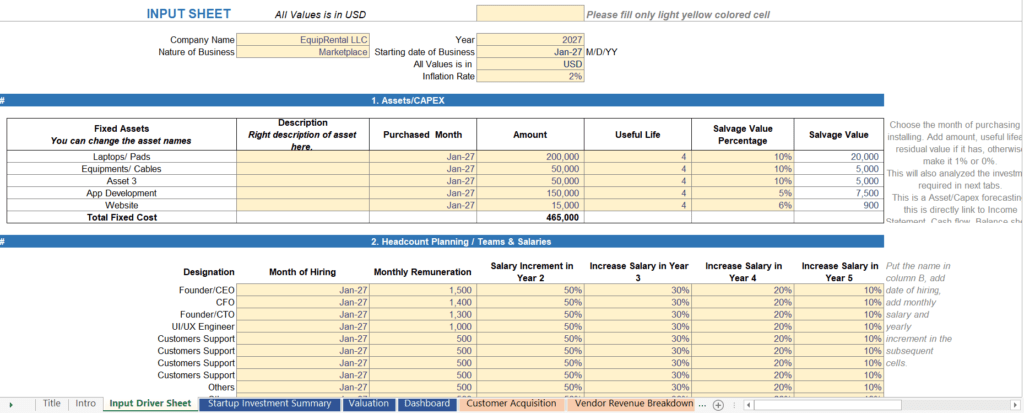
Before building a single formula, set up a system. Every professional financial model template follows a consistent color code throughout:
- Yellow cells: Inputs, drivers, and assumptions the user changes
- Black or default text: Formulas and calculations (never manually overwritten)
- Blue or green: Links pulled from another tab
This is a tiny act, but makes a difference between a model an investor trusts and one they question. Moreover, organize spreadsheet into clearly named tabs. A founder should be able to glance at the tab names and immediately know where to find the income statement, the cash flow, or the sensitivity analysis without hunting. This single habit is what separates an amateur sheet from a true startup financial planning template.
Build Driver and Assumptions Tab First
This is the single most important tab in the entire spreadsheet, and it’s the one most founders skip or bury. Every number that flows through your revenues, income statement, cash flow, and valuation should originate from Assumption’s tab. Think of this tab as the control room of your startup financial forecasting model: nothing happens downstream until something changes here first.
Structure your assumptions tab into clear sub-sections, each one isolated so it’s easy to scan and edit:
- Investment assumptions: Funding rounds, amounts raised, valuation at each round, and the timing of each raise
- Revenue assumptions: Revenue streams, pricing per plan or product, growth rate, churn, and units sold or subscribers per month
- CapEx assumptions: Equipment, software licenses, or infrastructure spend, along with useful life for depreciation
- Marketing budget assumptions: Monthly or quarterly channel spend, expected customer acquisition cost, and conversion assumptions
- Variable cost / COGS assumptions: Cost per unit, per transaction, or per customer served
- Headcount assumptions: Who you hire, when, at what salary, and what taxes or benefits load gets added on top
- Operating expense assumptions: Rent, software subscriptions, insurance, legal, and other recurring admin costs.
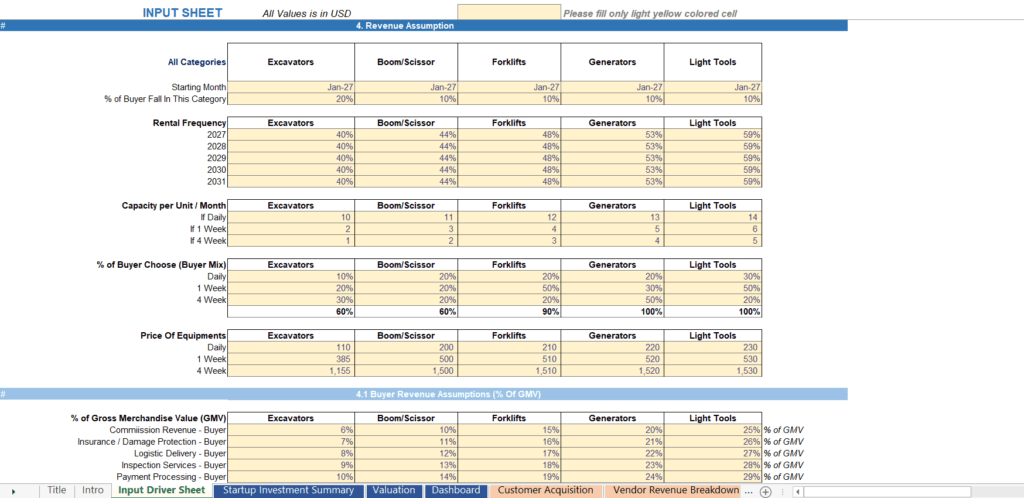
Keeping all of these sub-sections inside one tab means the founder always knows exactly where to go when something changes.
For instance, a pricing update or a shift in churn rate. This is the essence of driver-based forecasting: every output in your model is driven by a handful of changeable inputs, not hardcoded numbers.
Once your assumptions tab is solid, the rest of the model should pull from it. Here’s the logical build order professional financial modelers follow, along with what actually goes into each tab.
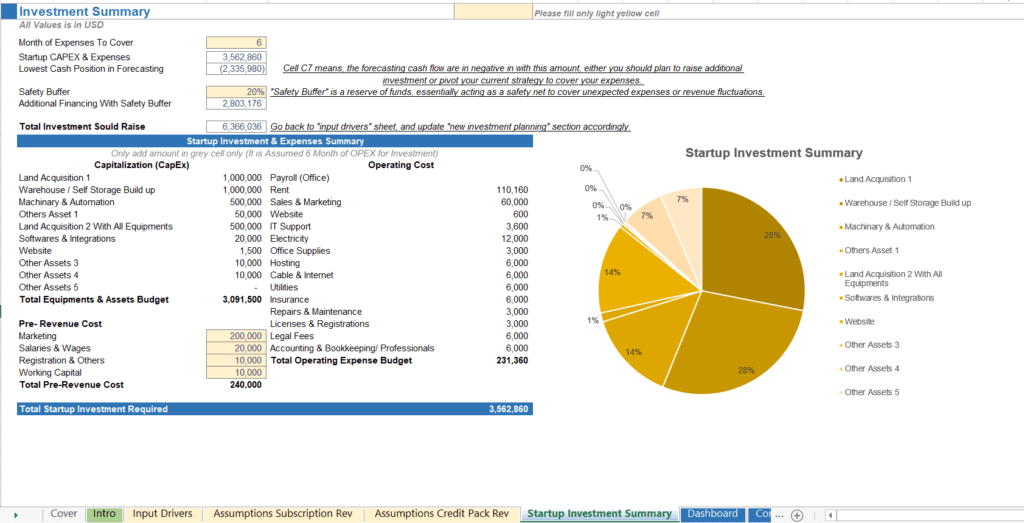
Use of Funds Tab
A simple table or chart showing exactly how raised investment will be allocated (either in product, marketing, hiring or operations). Investors may ask the reason behind it, so founder should have reasons & should link directly to your assumptions.
Show this both as a table (dollar amount and percentage by category) and as a simple pie or bar chart. Investors often look at this before they look at your valuation. It tells them whether your spending priorities match the stage and story you’re pitching.
Note: The Investment Summary tab should be placed among the initial tabs for easy access. However, its calculations and analysis should be completed last, as it summarizes the key outputs and insights from the entire financial model.
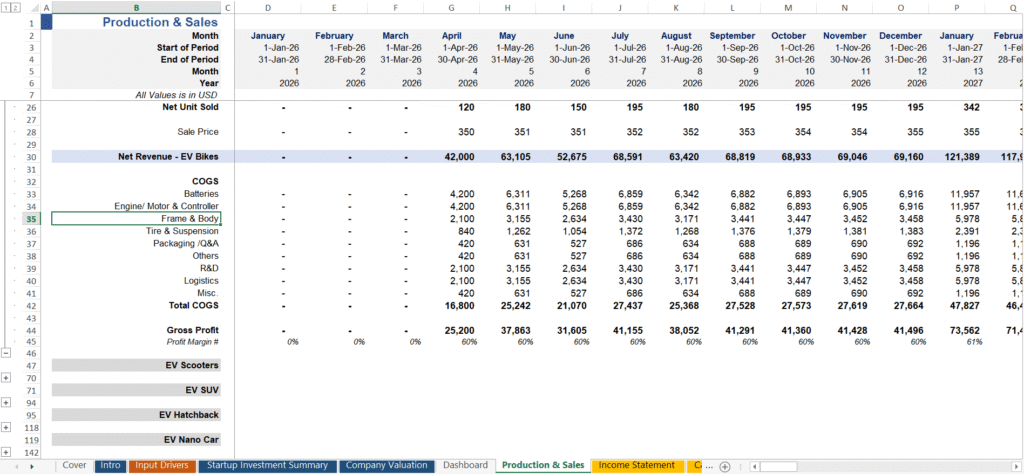
Revenue Forecasting Tab
Break down revenue by streams for instance (subscription, product sales, transaction fees, marketplace commissions, etc.) and link every growth rate and price point back to your drivers tab. This is where your pricing and volume assumptions turn into a 12-to-60-month revenue build.
The important principle is that revenue is not entered directly into the income statement. Operating assumptions drive customer numbers and pricing, which then calculate revenue automatically. This structure allows founders to test what happens when growth, pricing or churn changes.
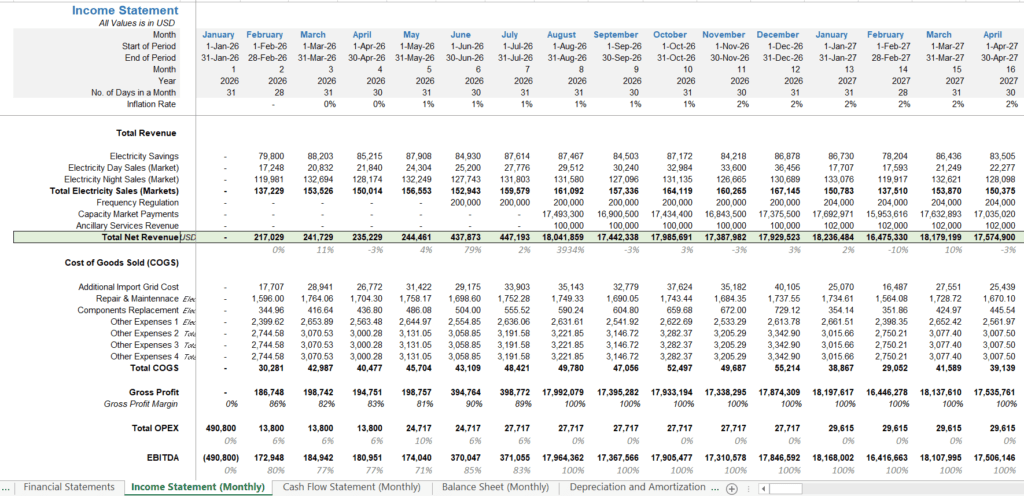
Monthly P&L, Cash Flow, and Balance Sheet
These three statements should be built monthly first, since early-stage startups live and die by monthly cash runway, not annual averages.
Your monthly P&L pulls revenue from the revenue tab, costs from COGS and opex assumptions, and payroll from the headcount tab. Your cash flow statement adjusts net income for non-cash items like depreciation, then layers in CapEx purchases, loan draws and repayments, and any funding raised. This tells your actual cash position and runway. Your balance sheet ties everything together and should always balance; if assets don’t equal liabilities plus equity, there’s a linking error somewhere upstream that needs to be traced back.
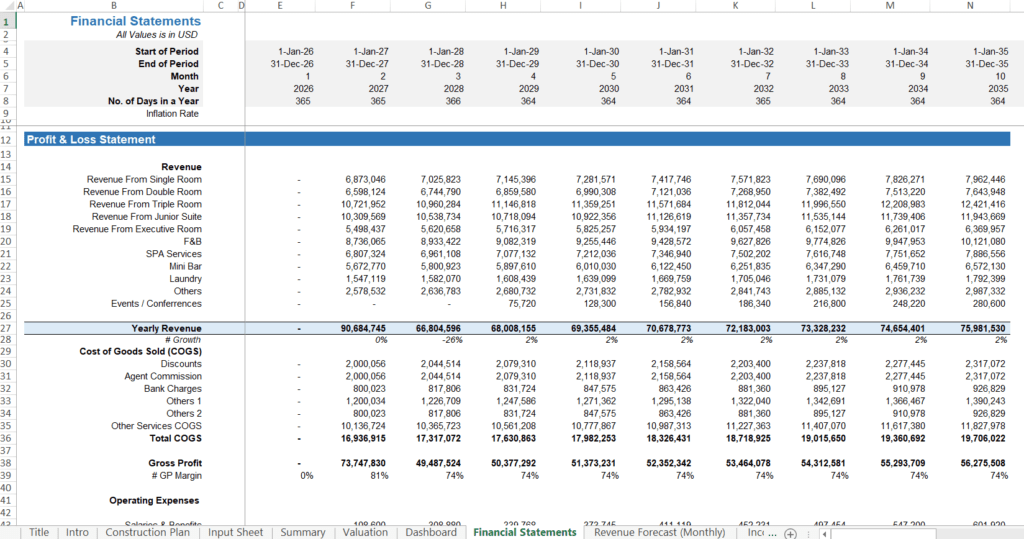
Consolidated Yearly Tab
Once monthly statements are built, roll them up into a clean annual view, this is usually the tab investors scan first.
This tab should mirror the structure of your monthly statements but summed by year, so an investor can quickly see year-over-year growth, margin trends, and profitability timelines without scrolling through 36 or 60 months of detail.
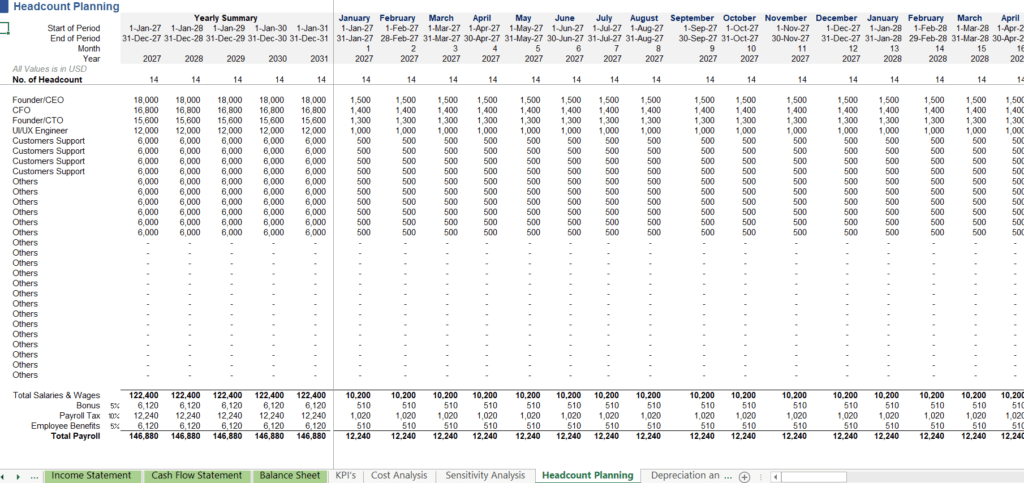
Headcount and Payroll Tab
Map out who gets hired, when, their salary, and any associated taxes or benefits. This tab usually feeds directly into your operating expenses and cash flow.
Build this as a timeline i.e. one row per role designation, with a start month, monthly salary, and an automatic flag (using an IF formula) that turns the cost on starting the hire month and keeps it running forward. Include employer-side costs like payroll tax or benefits as a percentage loaded on top of base salary, since forgetting this is one of the most common ways founders understate their real burn rate.
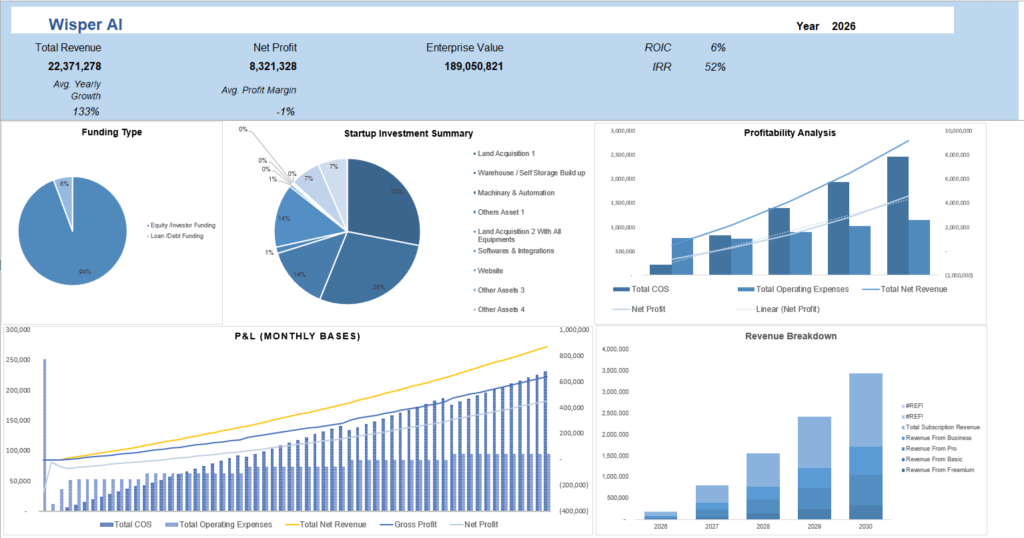
Dashboard Tab
Dashboard helps to visualized whole performance of startups in 30 seconds and easily finds the anomaly in the model. A strong dashboard typically includes a revenue and growth chart, a burn rate and runway indicator, gross margin trend, and 3-5 KPIs specific to your business model (like CAC, LTV, or churn for a SaaS company).
Note: Keep it to one screen. if someone needs to scroll, it’s no longer a dashboard.
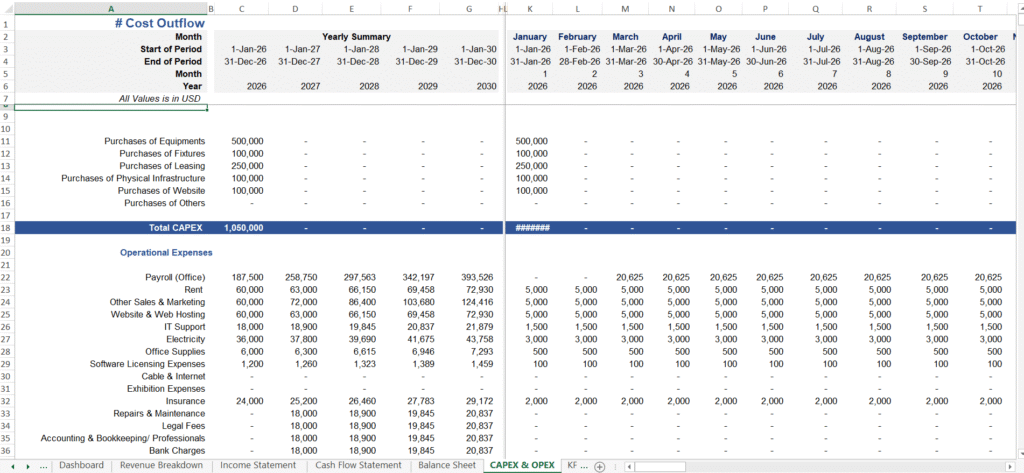
CapEx and Depreciation & Amortization Tab
This tabs helps to forecast & track every capital purchase and its depreciation schedule. This connects to your balance sheet and affects EBITDA-to-net-income calculations.
List each asset purchase with its cost, purchase date, and useful life, then calculate straight-line depreciation (cost divided by useful life in months) flowing into your monthly P&L. This tab matters more than founders expect, it’s the bridge between your cash flow statement (where the full purchase hits at once) and your income statement (where the cost is spread out over time).
Loan Amortization Tab
If you’re using debt financing, this tab calculates principal, interest, and repayment schedules — critical for accurate cash flow projections.
Set up the loan amount, interest rate, and term length as drivers, then build a standard amortization schedule showing the interest and principal portion of each payment. This split matters because only the interest portion hits your income statement as an expense, the principal repayment is purely a cash flow item.
Sensitivity Analysis
No startup financial model is complete without a sensitivity, or “what-if,” analysis. Build at least three scenarios:
- Worst case — conservative growth, higher costs, slower customer acquisition
- Base case — your realistic, most-likely projection
- Optimistic case — accelerated growth assumptions
The easiest way to build this without duplicating your entire model three times is to create a scenario switch a single dropdown cell on your assumptions tab (using data validation) that toggles between “Worst,” “Base,” and “Optimistic.” Then use an IF or CHOOSE formula on each key driver (growth rate, churn, CAC, pricing) to pull the corresponding value for whichever scenario is selected. This way, one click recalculates your entire model end to end, instead of maintaining three separate workbooks.
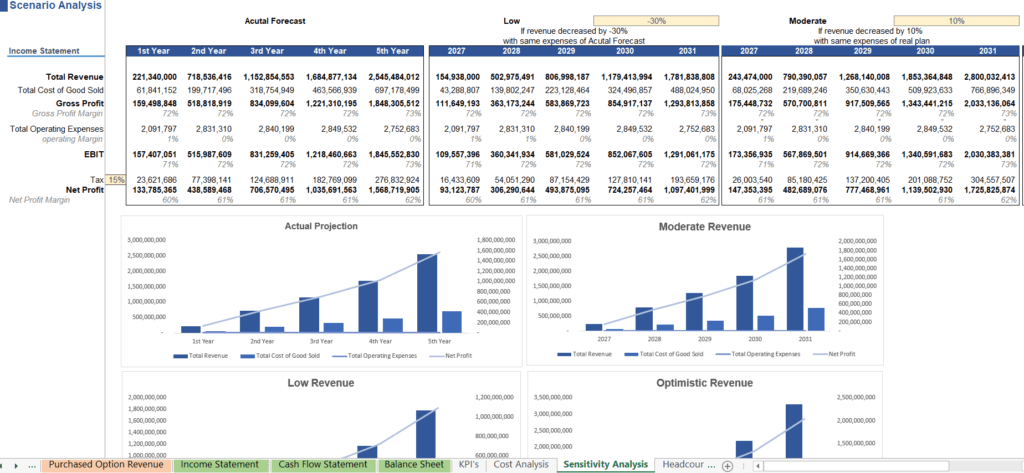
It directly demonstrates to investors that you’ve stress-tested your own assumptions. A study by CB Insights on startup failure consistently lists running out of cash and misjudging market demand among the top reasons startups fail. A sensitivity tab is your defense against both being modeled away by overconfidence (cbinsights.com).
Beyond the three standard scenarios, it’s also worth testing single-variable sensitivity for example, building a small table that shows how your 18-month runway changes if customer acquisition cost rises by 10%, 20%, or 30%. These small tables are often what investors poke at first, since they reveal how fragile or resilient your plan really is.
Valuation
Once your financial statements are built, the valuation tab translates your projections into a defensible number. A strong valuation tab usually includes:
- DCF valuation — discounting projected free cash flows back to present value using your WACC
- EBITDA multiple valuation — applying industry multiples to your projected EBITDA
- Revenue multiple valuation — common for early-stage or pre-profit startups
- Investor’s method (VC method) — working backward from expected exit value and required return
For DCF, the key driver is your discount rate (WACC), which reflects the riskiness of your cash flows. Early-stage startups typically use a higher rate than established companies because the uncertainty is greater. Project free cash flow for 5 years, discount each year back to today’s value, then add a terminal value representing everything beyond year 5. For revenue and EBITDA multiples, the trick is choosing comparable companies in your exact industry and investment or startup stages. A multiple pulled from a mature public company will overstate an early-stage startup’s value. Therefore, always pull multiples from recent funding rounds or acquisitions in your specific space where possible.
Use this Startup Valuation Calculator for instantly analyze your startup valuation using 8 different methods.
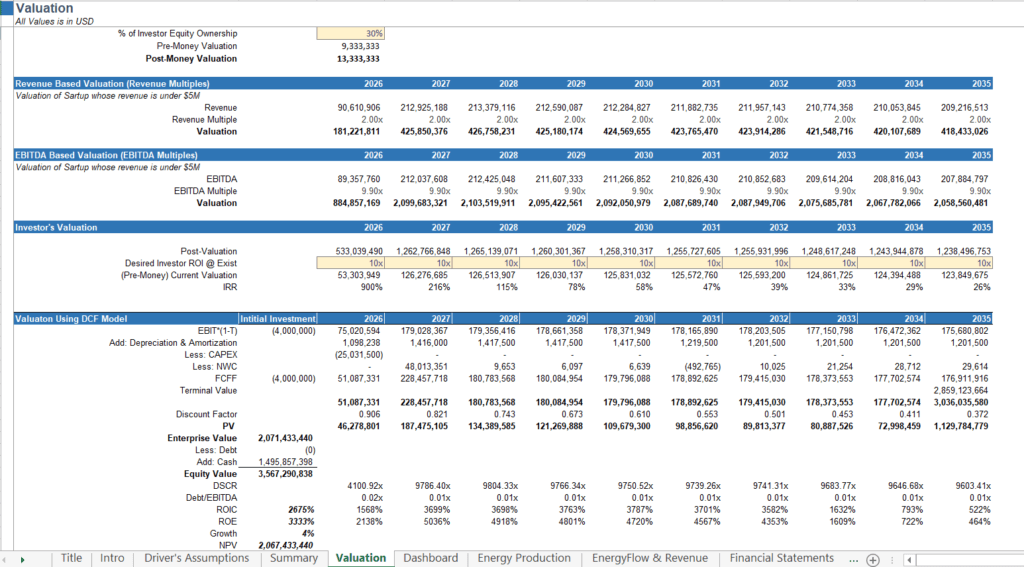
In this valuation tab, also highlight the payback period, NPV, and IRR, the metrics most VCs scan for first. Showing all four valuation methods side by side (rather than picking just one) is also a smart move, it shows investors you understand the range of reasonable outcomes rather than anchoring on a single optimistic number. For a full breakdown of methods, see our guide on startup valuation methods.
Formulas That Make a Financial Model Actually Work
You don’t need hundreds of formulas, you need the right ones, used consistently. Here’s a quick overview of the core formulas every startup financial forecasting model relies on:
SUMPRODUCT — multiplies and sums arrays in one step, ideal for calculating total revenue across multiple products or pricing tiers at once.
- INDEX & MATCH — a flexible lookup combo that pulls values across tabs (e.g., pulling a specific month’s growth rate from your assumptions tab) without the row-limit issues of VLOOKUP.
Date formulas (EDATE, EOMONTH, DATEDIF) — keep your monthly timeline dynamic, so changing your start date updates the entire model automatically.
IF / IFS formulas – Handle conditional logic, like applying different commission rates above a sales threshold.
Growth formulas (CAGR, month-over-month growth) — drive your revenue and cost projections forward based on your assumptions tab.
These formulas are the backbone, but they’re not the whole story. If you want a deeper, hands-on breakdown of each one with examples, read our companion guide: 10 Excel Hacks Every Startup Founder Needs for Killer Revenue Forecasting.
Why Startups Should Build Driver-Based Forecasting Model
Here’s why building your driver-based forecasting model instead of static numbers matters so much:
- It lets you update one assumption and see the entire model recalculate instantly, instead of manually editing dozens of cells.
- It gives investors confidence that your numbers are grounded in logic, not guesswork.
- It speeds up due diligence, since investors can test their own scenarios without needing you to rebuild anything.
- It supports better internal decision-making — you can answer “what if we hire two engineers in Q3” in seconds.
- It’s reusable. As your business evolves, you update assumptions, not the entire architecture.
This is also exactly how VCs evaluate a financial model during due diligence, they’re checking whether your logic holds up, not just whether your final number looks good. You can read more in our breakdown of how VCs evaluate a startup’s financial model.
Common Mistakes That Ruined Startup Financial Models
Even well-intentioned founders make these errors:
- Hardcoding numbers directly into formulas instead of linking to the assumptions tab
- Skipping monthly detail and jumping straight to annual projections
- Ignoring cash flow in favor of just building a P&L
- Building one giant scenario instead of worst/base/best cases
- Inconsistent formatting that makes the model hard to navigate under investor questioning
If any of this sounds familiar, it’s worth reading why your startup financial model might be sabotaging your strategy, small structural issues often cause bigger fundraising problems than founders realize.
Should You Build It Yourself or Get Help?
Building your first startup financial projection model from scratch is absolutely doable with the structure above. But it’s also time-consuming, and small structural mistakes, a broken link, an inconsistent formula, a missing scenario can quietly undermine your credibility in front of investors.
That’s exactly why applying effective financial modeling techniques reduces real operational and fundraising risk, and why many founders choose to outsource financial modeling services instead of building under pressure during an active raise.
If you’d rather start from a solid foundation, our Startup Financial Model Templates are pre-built using this exact structure i.e. driver tabs, monthly statements, valuation, sensitivity analysis, and dashboards tailored across multiple industries, so you can plug in your own numbers and get an investor-ready model in hours, not weeks.
And if your business has a more complex structure, multiple revenue streams, marketplaces, or subscription tiers, then our team can build a fully custom model for you. Explore our Financial Modeling Services to see how we work directly with founders to build investment-ready models from scratch.
Bottom Line
A good startup financial model should clearly connect your business assumptions to revenue, costs, cash flow, and profitability. Build it around real business drivers, keep it easy to understand, and make sure you can test different scenarios. When done properly, the model becomes a practical tool for planning, fundraising, and making better decisions.