
Starting a B2C SaaS business is exciting, but the financial reality often surprises first-time founders. While headlines celebrate billion-dollar valuations, they rarely mention the $35,000 to $65,000 in actual cash needed just to survive year one or the 23 months it typically takes to break even. Whether you’re bootstrapping or planning to raise funding, understanding your true cost structure and path to profitability isn’t optional. It’s the difference between building a sustainable business and becoming another failed startup statistic.
Understanding B2C SaaS Startup Costs: The Complete Breakdown
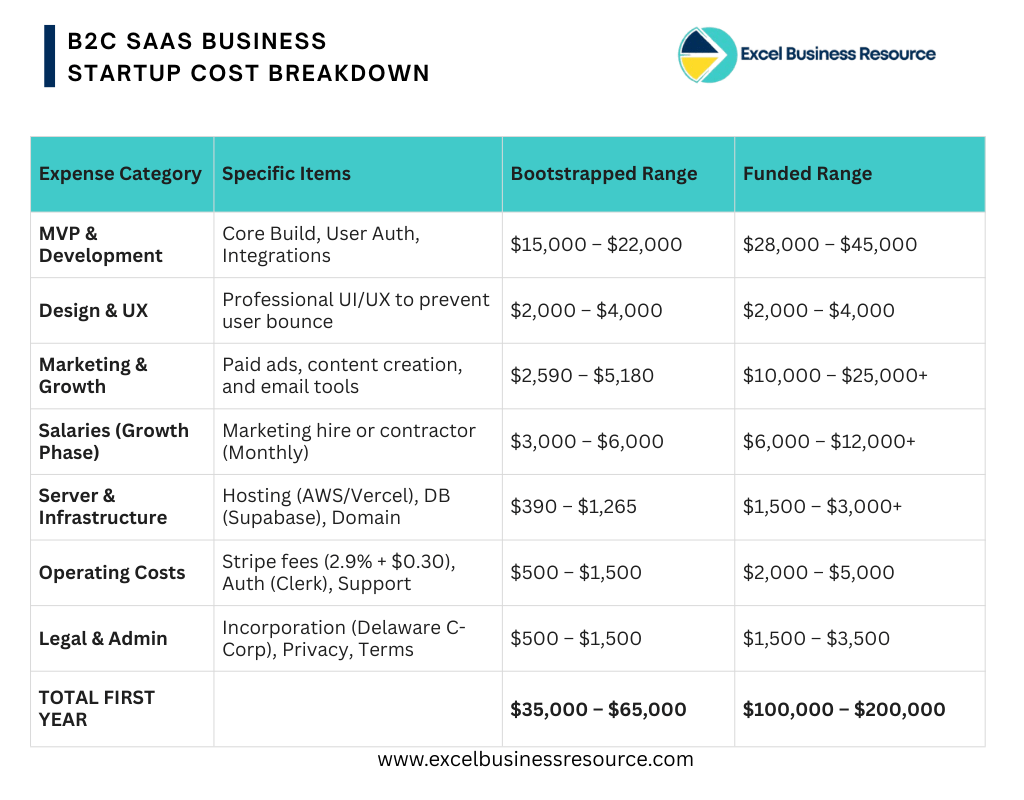
The cost to start a SaaS company varies dramatically based on your approach, but realistic budgets fall into three categories. Bootstrapped founders typically spend $35,000 to $65,000 in their first year, while funded startups invest $100,000 to $200,000, and well-funded ventures can burn through $250,000 to $500,000+. These aren’t arbitrary numbers they reflect real expenses across development, marketing, legal, and operations that catch many founders off guard.
Pre-Launch Phase: Building Your Foundation (Months 1-3)
Your biggest upfront investment is product development. For a B2C SaaS MVP, expect to spend $15,000 to $22,000 on development if you’re bootstrapping, or $28,000 to $45,000 if you have seed funding. This covers core functionality, user authentication, and basic integrations. Don’t cut corners on UI/UX design investing $2,000 to $4,000 in professional design early prevents costly redesigns later when users bounce due to poor experience.
Legal and administrative setup costs $500 to $1,500 for incorporation, terms of service, and privacy policies. Using services like Stripe Atlas ($500) or Doola ($297-$497) streamlines Delaware C-Corp formation, which investors prefer. Domain registration and initial hosting add another $120 to $350. By launch, you’ll have spent $20,000 to $32,000 just to get a functional product into users’ hands.
Launch Phase: Getting Your First Customers (Months 4-6)
This is where many founders stumble. They budget 80% for development and 20% for everything else, when the ratio should be closer to 30-40% development and 30-40% marketing. Monthly operating costs including hosting (Vercel, AWS), database services (Supabase), email delivery (SendGrid), and authentication (Clerk) run $270 to $915 per quarter for bootstrapped startups.
Marketing requires immediate investment. Plan $1,000 to $2,000 for initial paid ads testing, $1,500 to $3,000 for content creation, and $90 to $180 for email marketing tools. Customer support tools like Intercom or Plain add $0 to $150 monthly. The hard truth? Organic marketing alone rarely works for B2C SaaS, you need paid acquisition to learn what resonates.
Growth Phase: Scaling to Sustainability (Months 7-12)
As you gain traction, costs accelerate. Ongoing development for feature additions and bug fixes requires $2,000 to $4,000 monthly retainers. Your first marketing hire or contractor costs $3,000 to $6,000 monthly. By month 12, funded startups often spend $60,000 to $111,500 just in this growth phase. The goal is reaching $10,000 monthly recurring revenue (MRR) approximately $120,000 annual recurring revenue (ARR) which typically requires $150,000 to $200,000 total first-year investment.
Critical Differences: B2C vs. B2B SaaS Economics
B2C SaaS operates on fundamentally different economics than B2B. While B2B SaaS companies average $1,200 customer acquisition cost (CAC), B2C SaaS enjoys lower CAC around $70 to $274 depending on the specific niche. However, this advantage comes with a significant trade-off: churn rates.
B2C SaaS experiences 6.5% to 8% annual churn compared to 3.5% for B2B. Monthly churn for B2C ranges from 0.4% to 1%, meaning you’re constantly fighting to replace departing customers. This higher churn compresses customer lifetime value (LTV) and extends your payback period. Where B2B SaaS companies average 23 months to recover acquisition costs, B2C businesses must optimize for faster payback due to shorter customer relationships.
Your pricing strategy must reflect these realities. B2C SaaS typically relies on lower price points ($10-$50 monthly) with higher volume, requiring efficient self-service onboarding and automated support. The LTV formula for B2C SaaS must account for gross margin typically 72% to 84% for healthy SaaS platforms not just top-line revenue. If your average customer pays $30 monthly with 80% gross margin and stays 12 months, your true LTV is $288, not $360.
The Profitability Timeline: When Will You Actually Make Money?
Profitability in B2C SaaS follows a predictable pattern, but most founders underestimate the timeline. Industry data shows the average CAC payback period is 23 months, meaning you operate at a loss on each new customer for nearly two years. This reality makes runway management critical plan for at least 24 months of cash reserves.
The median New CAC Ratio reached $2.00 in 2024, meaning SaaS companies spend $2 to acquire $1 of new ARR. Bottom-quartile performers spend $2.82 per dollar of ARR, while top performers achieve $1.00. This 41% efficiency gap determines who survives. Your target LTV-to-CAC ratio should be 3:1 minimum meaning if you spend $100 acquiring a customer, they must generate $300 in gross profit over their lifetime.
Gross margin trends favor efficient operators. SaaS gross margins typically range from 72% to 84%, with top-quartile companies achieving 85% to 90%. B2C SaaS should target the higher end since you lack enterprise service revenue that drags down margins. Every percentage point matters improving from 75% to 80% gross margin on $1M ARR adds $50,000 to your bottom line annually.
Why Building Financial Model Template For SaaS Startups
Starting a B2C SaaS startup is a high-stakes game where the math matters just as much as the code. Many founders believe that if they build a great app, the subscriptions will simply roll in. However, the reality of 2026 is that a startup will likely never reach profitability and a founder will never truly know when they’ll breakeven without a professionally built B2C SaaS financial model and reporting dashboard.
Without these professional tools, you are essentially flying blind. A common fatal error is spending 100% of your capital on the initial build, leaving zero budget for the vital feedback loops and marketing needed to survive. A professional model acts as your operational roadmap, making you 3x more likely to secure funding and 2x more likely to avoid a sudden cash crisis.
What’s Inside a Professional Financial Model For SaaS Business?
A professional B2C financial template is far more than a simple list of expenses. It is a dynamic engine that tracks Revenue and Retention by accounting for monthly churn (typically 0.5% to 1% for B2C), expansion revenue from upgrades, and contraction from downgrades. Because B2C SaaS usually sees 85% to 95% net retention which is lower than B2B the model must be precise to ensure long-term survival.
It also includes a Multi-Channel CAC Analysis that separates expensive organic growth (costing $480–$942 per customer) from highly efficient referral programs that can acquire users for as little as $150 through viral loops. Furthermore, it scales your Operating Expenses, predicting how hosting costs on platforms like AWS or Vercel will jump from $50 to over $1,500 as you grow, while factoring in the 2.9% plus $0.30 fee for every Stripe transaction.
The Power of Real-Time Analysis
With a professional dashboard, you stop guessing and start leading. You can perform a Breakeven Analysis to see exactly which month your bank account stops shrinking and starts growing. You can track your CAC Payback Period to ensure you recover marketing costs in under 12 months, and monitor your LTV:CAC Ratio to maintain the “golden rule” of 3:1. Even small tweaks, like reducing churn from 5% to 3%, can be modeled to show a massive 67% increase in customer lifetime value.
Answering the Questions Investors Actually Care About
When you sit down with investors, a professional model gives you the confidence to answer their toughest questions. You can clearly demonstrate your Burn Rate and Runway, showing them exactly how many months of “survival” or “growth” you have left. You can prove your path to $10,000 MRR, which typically takes 7 to 12 months of consistent execution for a successful B2C startup. Most importantly, it shows you have a plan for Scalability, proving that your margins will stay protected through automated support and value-based pricing as your user base explodes.
Valuation Considerations for B2C SaaS Startups
Understanding how to value SaaS startups helps you make strategic decisions early. Investors value SaaS companies based on ARR multiples, with B2C typically commanding lower multiples than B2B due to higher churn and lower switching costs. However, efficient B2C SaaS with strong unit economics can achieve premium valuations.
Key valuation drivers include your LTV-to-CAC ratio (target 3:1+), gross margin (75%+), and net revenue retention (90%+ for B2C). Growth rate matters top-quartile SaaS companies grew 50% annually in 2024, though this declined from 60% in 2023. Profitability timeline also impacts valuation; companies showing clear paths to profitability within 12-18 months command higher multiples than those requiring perpetual funding.
Practical Strategies for Cost Optimization
Smart founders reduce burn without sacrificing growth. Start with infrastructure—use serverless architectures (Vercel, Railway) that scale costs with usage rather than over-provisioning for hypothetical scale. Leverage no-code tools for landing pages (Framer, Webflow at $10-$49 monthly) before hiring developers.
Focus on product-led growth to reduce CAC. Freemium models, while increasing churn risk, lower acquisition costs through viral distribution. Optimize your onboarding to reduce time-to-value customers who experience core value within the first session retain at significantly higher rates. Implement automated dunning and card updating to reduce involuntary churn, which can account for 0.8% to 1.1% of monthly losses.
Finally, build your financial model before you spend. A comprehensive B2C SaaS financial model template helps you scenario-plan different funding levels, pricing strategies, and growth rates. This isn’t just for investors it’s your operational roadmap for avoiding cash crunches.

Conclusion: The Path to Profitable B2C SaaS
Starting a B2C SaaS startup requires $35,000 to $200,000 depending on your funding approach, with profitability typically arriving 18 to 24 months after launch. Success demands understanding the unique economics of B2C: lower CAC but higher churn, volume-driven revenue, and relentless focus on unit economics.
The founders who win don’t just build great products they master the financial model behind sustainable growth. They know their CAC by channel, monitor churn cohorts weekly, and optimize gross margins relentlessly. Whether you’re creating your first business plan for SaaS startups or refining your B2C SaaS financial projection model, remember that profitability isn’t an accident. It’s engineered through disciplined financial planning from day one.
About Excel Business Resource: We specialize in financial modeling and FP&A services for startups, having supported 100+ companies in data analysis, financial modeling, and business planning. Our team helps B2C SaaS founders build investor-ready financial models that accurately project costs, revenue, and profitability timelines. Visit www.excelbusinessresource.com to learn how we can help you build a financially sustainable SaaS business.
Founder's Ask Questions (FAQs)
Starting a B2C SaaS startup typically costs between $35,000 and $65,000 for bootstrapped founders in year one, while funded startups invest $100,000 to $200,000
. This includes MVP development ($15,000–$45,000), legal setup ($500–$1,500), marketing ($3,000–$6,000), and operating expenses ($270–$915 monthly)
. The variation depends on whether you hire developers, use no-code tools, or outsource to agencies.
Most B2C SaaS startups take 18 to 24 months to reach profitability, with the average CAC payback period at 23 months
. However, this varies based on your customer acquisition cost, monthly churn rate (typically 0.4%–1% for B2C)
, and pricing strategy. Companies with efficient viral loops or strong organic channels can shorten this to 12–15 months, while those relying heavily on paid ads may take 30+ months.
For B2C SaaS, a healthy customer acquisition cost (CAC) ranges from $70 to $274
, significantly lower than B2B SaaS. Your lifetime value (LTV) should be at least 3x your CAC—meaning if you spend $100 to acquire a customer, they must generate $300+ in gross profit
. With B2C churn rates of 6.5%–8% annually
, maintaining this ratio requires strong onboarding and retention strategies.
The most overlooked costs include payment processing fees (2.9% + $0.30 per transaction via Stripe) , involuntary churn recovery tools ($50–$200/month), compliance costs (GDPR, data privacy), and customer support scaling (B2C requires 3–5x more support volume than B2B). Many founders budget 80% for development and 20% for marketing, when the optimal split is closer to 40/40
.
B2C SaaS valuations typically use ARR multiples (annual recurring revenue), with efficient B2C companies commanding 5–10x ARR depending on growth rate, gross margin (target 75%+), and net revenue retention (target 90%+)
. Unlike B2B, B2C SaaS is valued lower per dollar of revenue due to higher churn, but can achieve premium multiples with strong viral coefficients and low CAC payback periods.