
A grocery store makes a profit by securing three main factors: the number of customers, their purchase frequency, and the amount they spend per visit. An array of goods, prices, location, quality of products, private labels, loyalty programs, and home delivery affect the demand for a supermarket. According to statistics, an average US Supermarket rents a retail store for $19,790 per month and makes $668,377 on foot per week in 2025. The food retail industry’s average net profit margin is 2.1%. Therefore, a small percentage of sales translates to profits. To ensure higher revenues, one needs to learn the critical success factors for a grocery store and invest more effort and money.
Here is a quick view of the main grocery store revenue drivers and how each one helps you earn more.
| Revenue Driver | What It Means | How to Improve It | What It Grows |
|---|---|---|---|
|
Foot traffic |
Number of people who enter your store |
Pick a strong location, extend opening hours, run local promotions |
Customer count |
|
Conversion rate |
Share of visitors who buy |
Keep shelves full, label aisles clearly, open enough checkout lanes |
Customer count |
|
Average basket size |
Amount spent per visit |
Place related items together, offer bundles, use the checkout area |
Sales per customer |
|
Product mix |
Balance of staples and higher margin items |
Review sales by category, give more space to top earners |
Sales and margin |
|
Pricing |
What you charge for each item |
Price staples fairly, earn more on specialty and prepared foods |
margin |
|
Fresh food |
Produce, meat, fish, and bakery items |
Focus on quality, order carefully to cut waste |
Visit frequency |
|
Private label |
Products sold under your store name |
Start with rice, oil, or snacks and expand |
Margin and loyalty |
|
Promotions and loyalty |
Offers and rewards for repeat shoppers |
Use points cards and targeted offers, avoid constant discounts |
Repeat visits |
|
Online and delivery |
Pickup and home delivery orders |
Start with phone or chat orders, then add online ordering |
New sales channel |
|
Extra services |
Deli, bakery, bill payment, catering |
Add services that fit your customers’ needs |
Extra income |
This guide is about how a grocery store makes money. It does not cover startup spending. For that, read our separate guide on the cost to open a grocery store. Cost tells you what to put in. Revenue drivers tell you what you can get back.
What Are the Revenue Drivers of a Grocery Store?
Revenue drivers are the factors that move your sales up or down. In a grocery store, they fit into one simple formula:
Revenue = Number of customers × Average basket size × Number of trading days
Every strategy in this article improves one part of that formula. Some bring more people in. Others get each person to spend more.
Small gains in two drivers can lift monthly sales by 21%. Here is how the numbers work for a small store with 30 trading days.
| Scenario | Customers Per Day | Average Basket | Daily Sales | Monthly Sales |
|---|---|---|---|---|
|
Current store |
500 |
$30 |
$15,000 |
$450,000 |
|
Traffic grows 10% |
550 |
$30 |
$16,500 |
$495,000 |
|
Basket grows 10% |
500 |
$33 |
$16,500 |
$495,000 |
|
Both grow 10% |
550 |
$33 |
$18,150 |
$544,500 |
Each driver alone adds $45,000 a month. Together they add $94,500. Note that the industry average of $668,377 a week comes from large supermarkets. A small neighbourhood store will sit well below it.
How Does Foot Traffic Drive Grocery Sales?
Foot traffic is the number of people who enter your store. No traffic means no sales.
Location shapes traffic more than anything else. A store near homes, offices, or a busy road gets steady visits. Three things decide your traffic:
- Location and access. Easy parking, clear signs, and a short walk from the road all help.
- Nearby competition. A big chain close by takes a share of your shoppers.
- Opening hours. Early mornings and late evenings can bring in people your rivals miss.
You can also build traffic after you open. Post on local social media, partner with nearby schools or offices, and stock items shoppers cannot find elsewhere.
What Is Conversion Rate in a Grocery Store?
Conversion rate is the share of visitors who buy something. Most grocery visitors come with a list, so conversion is often high. Some still leave empty handed because they cannot find an item or the queue is too long.
Keep shelves full. Label aisles clearly. Open enough checkout lanes at busy hours. Train staff to help shoppers who look lost. These fixes cost little and pay back fast.
How Do You Increase Average Basket Size?
Basket size is the amount a customer spends per visit. It is often the easiest driver to improve, because these shoppers are already in your store.
Use smart product placement. Put related items near each other. Place pasta sauce beside pasta. Put snacks near drinks.
Offer bundles. A “buy three, save 10%” offer nudges people to add more.
Use the checkout area. Small, low cost items near the till add sales with little effort.
Suggest complete meals. A display with all the ingredients for a simple dinner helps shoppers buy every part.
Why Does Product Mix Matter for Grocery Revenue?
Your product mix is the balance of items you sell. It shapes both sales and profit. Staples like milk, eggs, rice, and bread bring people in often, but they earn thin margins. Fresh food, private label, and prepared foods earn more per sale.
Here is a typical view of sales volume and gross margin by grocery category.
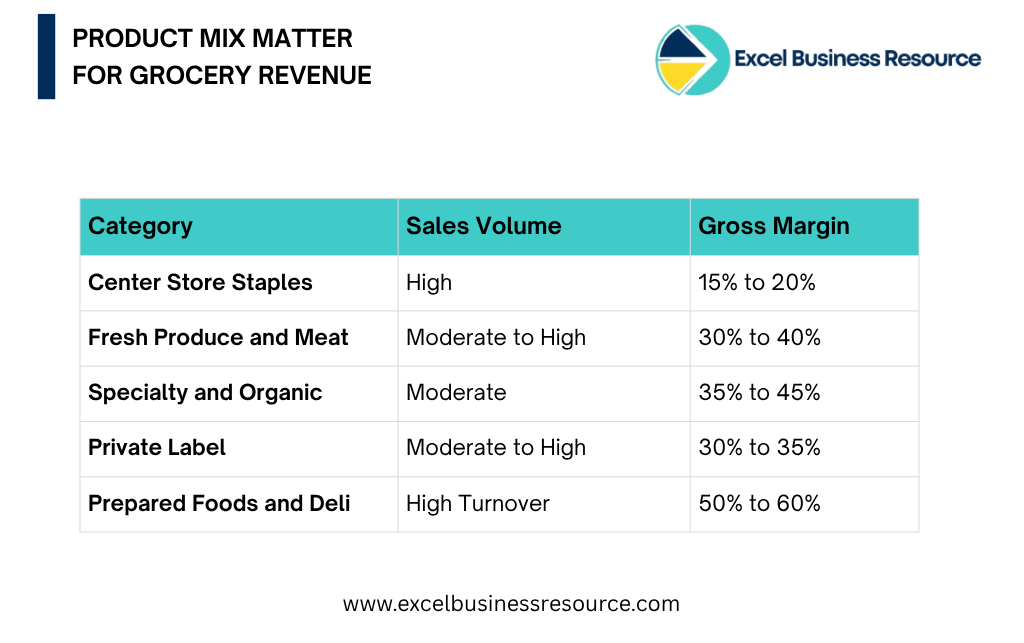
These ranges are a guide. Real margins change with store size, location, and waste. One grocery pricing guide sets deli and prepared food targets at 45% to 55%, the highest in the store. Another puts prepared foods at 40% to 60% and says a well run deli can deliver 15% to 25% of store profit from only 5% to 10% of revenue.
Use this table as a planning tool. Staples build traffic. Higher margin categories build income. Review your sales each month, find your fastest sellers, and give them more shelf space.
How Does Pricing Affect Grocery Store Revenue?
Shoppers know the price of everyday items like milk and bananas. If your prices on these look high, they may shop elsewhere.
Price staples close to the market so shoppers see you as fair. Earn more on convenience items, specialty products, and prepared foods. Test small price changes and watch how sales respond. Do not compete on price alone. Large chains buy in huge volume and can always go lower. A small store wins on freshness, service, and choice.
Can Fresh Food and Private Label Products Boost Revenue?
Yes. Both are strong drivers for an independent store.
Fresh food. Produce, meat, fish, and bakery items give people a reason to visit often. A good fresh section also lifts the rest of the basket. Fresh food spoils, so order carefully. Typical shrink runs 2% to 3% of sales, which costs a $2M store $40,000 to $60,000 a year. LaunchAdvisor
Private label. These are products sold under your own store name. You buy them at a lower cost, so your margin is usually higher than with national brands. US store brand sales hit a record $282.8 billion in 2025, growing nearly three times as fast as national brands. Roughly one in every four grocery products bought is a store brand. Start with a few categories and grow from there.
How Do Promotions and Loyalty Programs Increase Sales?
Promotions bring shoppers in. Loyalty programs bring them back.
A good promotion has a clear goal. You may want to clear old stock, launch a new item, or lift a slow weekday. Avoid constant discounts. They train shoppers to wait for deals and cut your margin.
A loyalty program rewards repeat visits with points, member prices, or a free item after a set number of purchases. It also shows you what each customer buys, so you can send offers that fit their habits.
Does Online Ordering and Delivery Add to Grocery Revenue?
It can. FMI found that 94% of grocery shoppers bought groceries both online and in stores in 2025. Pickup and delivery reach people who do not live near your store. Supermarket News
Start small. Take orders by phone or a messaging app and deliver within a short radius. Watch delivery costs closely. A delivery that costs more than the margin on the order does not help you.
Extra services can add income without more floor space. Consider a deli counter, fresh bakery items, bill payment, party trays, or weekly staple boxes.
How Do You Track and Forecast Grocery Revenue?
You cannot grow what you do not measure. Track these numbers every week: daily customer count, average basket size, sales by category, revenue per square foot, and repeat customer rate.
At Excel Business Resource, we have worked with over 100 startups on financial modelling, FP&A, data analysis, and bookkeeping. One pattern repeats. Owners who track a few key numbers spot problems early. Owners who guess often miss them.
Our Grocery Store Financial Model Excel Template turns these drivers into a five year forecast. You enter customers, basket size, and category sales. The model builds your revenue forecast, income statement, cash flow, balance sheet, and breakeven point. Its sensitivity analysis shows what happens if traffic drops or basket size grows. It works in Excel and Google Sheets.
Final Thoughts
Grocery revenue comes from a few clear drivers: traffic, conversion, basket size, product mix, pricing, fresh food, private label, loyalty, and extra services. Improve them one at a time and measure each change. Test your numbers on paper before you invest, and you will know which drivers deserve your money first.
Frequently Asked Questions
What is the biggest revenue driver in a grocery store?
Customer traffic and basket size together. Traffic decides how many people buy. Basket size decides how much each one spends. Location and product mix sit behind both.
How much revenue does a grocery store make?
It depends on size, location, and format. FMI reports average weekly sales of $668,377 per US supermarket in 2025. That figure reflects large stores. A small neighbourhood store earns far less.
What is the average profit margin of a grocery store?
It is very low. Industry margins averaged 2.1% in 2025, and about 11% of retailers reported operating losses. Volume, waste control, and product mix decide who stays profitable.
Which grocery department has the highest margin?
Prepared foods and deli usually lead, with gross margins often above 45%. Fresh produce, specialty, and private label items follow. Center store staples earn the least.
How can a small grocery store compete with big chains?
Focus on what big chains do poorly. Offer fresher produce, friendly service, local products, and personal touches. Add private label items and delivery to build loyalty.
How can I increase grocery store sales quickly?
Raise your basket size. Improve product placement, add bundles, and keep shelves full. These changes cost little and show results fast.
Does private label really help a grocery store earn more?
Yes. Store brands usually carry higher margins than national brands, and shoppers can only buy them from you. That builds repeat visits.
Is a grocery store a good business to start?
It can be, if you plan well. Demand is steady because people always need food, but margins are thin and waste hurts. Study your revenue drivers and build a forecast before you commit.