
If you’re thinking about opening a coffee shop, the first question you’re really asking is: how does a coffee shop business generate revenue and can it generate enough to make this worth it?
That’s a fair question. And it deserves a real answer, not a generic one.
The global coffee shop market was valued at $228 billion in 2025 and is projected to reach $290 billion by 2032, growing at a CAGR of 3.5% (Source: Maximize Market Research). In the US alone, the branded coffee shop market sits at $54 billion with over 42,700 outlets nationwide (Source: World Coffee Portal via CoffeeDasher).
That’s a massive market. But size doesn’t automatically mean profitability for you.
This article breaks down every real revenue driver a coffee shop has with actual numbers, so you can evaluate whether this venture makes financial sense before putting a dollar on the table.
How Does a Coffee Shop Generate Revenue?
At its core, a coffee shop makes money by converting foot traffic into transactions consistently, across multiple product categories, multiple times a day. But the revenue is never just one thing. The most profitable coffee shops operate multiple revenue streams simultaneously.
Here’s what that looks like in practice:
Revenue Driver #1 – Beverage Sales (The Foundation)
Beverages are the engine. Espresso-based drinks, brewed coffee, teas, cold brews, frappes, and seasonal specials this is where 60–70% of a typical coffee shop’s revenue comes from.
What makes it powerful is the gross margin on beverages:
- The gross margin on brewed coffee is typically 70–85% per cup (Source: Pool Six Coffee Roasters)
- A standard latte that sells for $5–$6 may have a raw ingredient cost of just $0.40–$0.80
- Coffee shops commonly apply a 4–5x markup on the cost of materials
The average coffee shop sells around 230 cups per day, while larger chain locations can exceed 600 cups daily (Source: BusinessDojo).
Specialty and craft beverages push average ticket sizes higher. A customer ordering a single-origin pour-over or a custom cold brew drink can easily represent a $7–$10 transaction vs. a $3 drip coffee. This is why specialty coffee shops that position as premium experiences often outperform generic cafes on both revenue and margins.
Key insight for investors: Beverage margins are strong, but consistency of volume is what drives profitability. A shop that serves 150 customers per day at $6 average ticket generates ~$270,000/year from beverages alone.
Revenue Driver #2 – Food Sales (Low Margin, High Value Add)
Food doesn’t carry the same margins as coffee. Pastries, sandwiches, salads, and snacks typically yield 40–60% gross margins — lower than beverages, but they do something critical: they raise the average transaction value (ATV).
A customer who comes in for a $5 latte and adds a $4 croissant has just increased their spend by 80%. Do that across 100 transactions per day, and the compounding effect is significant.
Food sales typically account for 15–25% of total revenue in a well-run coffee shop. Health-conscious menu items are increasingly driving this — about 32% of coffee shops report that adding gluten-free, vegan, or organic food items significantly boosted their sales.
(Source: Sharpsheets.io via QSR Magazine).
Practical note: Baked goods sourced from local bakeries require minimal kitchen infrastructure and can be sold at healthy retail markups making them one of the most capital-efficient ways to expand your food revenue.
Revenue Driver #3 – Retail Products & Branded Merchandise
This is one of the most underutilized revenue streams for independent coffee shops.
Retail products include:
- Whole bean and ground coffee bags (high margin, builds brand loyalty)
- Branded mugs, tumblers, and tote bags
- Brewing equipment (pour-over kits, French presses, grinders)
- Coffee subscriptions — recurring revenue with high retention
Merchandise drives two things: revenue and brand marketing. Every customer carrying your branded cup out the door is a walking advertisement.
Coffee shops that invest in retail product lines can add 5–15% additional revenue on top of in-store sales. Subscription-based coffee bag delivery is growing particularly fast, creating predictable monthly revenue that helps smooth out the seasonal volatility all coffee shops face.
Revenue Driver #4 – Catering & Wholesale
Catering is a high-ticket, low-overhead revenue stream that most coffee shop owners overlook in their early business planning.
Corporate catering providing coffee service for office meetings, conferences, and events can bring in $500–$3,000+ per event depending on scale. And the data backs this up: coffee shops that offer catering services see a 15% increase in overall revenue (Source: Gitnux).
Wholesale is another path. Supplying coffee beans to local restaurants, offices, or retail stores creates recurring B2B revenue that doesn’t depend on foot traffic. Some independent café owners use their roasting operations to supply 5–10 wholesale accounts dramatically changing the financial profile of the business.
Revenue Driver #5 – Digital Orders, Delivery & Drive-Thru
Consumer behavior has shifted. People want their coffee fast, and they want to order before they arrive.
App-based ordering, third-party delivery (Uber Eats, DoorDash), and drive-thru formats have become major revenue channels especially post-pandemic. Drive-thru coffee shops consistently outperform walk-in-only shops on transaction volume during peak hours.
The numbers support this direction: Dutch Bros Coffee, a drive-thru focused chain, reported a 34.9% year-over-year revenue increase in Q4 2024, reaching $342.8 million in revenue (Source: Matthews).
Delivery adds incremental revenue at the cost of commission fees (typically 15–30% of order value). The key is to price delivery menu items accordingly so the margin isn’t entirely eroded.
Revenue Driver #6 – Loyalty Programs & Repeat Visit Engineering
Loyalty programs are not a “nice to have” they are a revenue multiplier.
- Starbucks attributes over 40% of its total US sales to its Starbucks Rewards program, which has 31 million active members (Source: Open Loyalty)
- A loyalty program can increase visit frequency by up to 25%.
- Online gift cards generate a 10% boost in holiday sales (Source: Gitnux).
For independent shops, a simple digital stamp card or app-based loyalty system can meaningfully change customer retention. The math is straightforward: turning a once-a-week customer into a three-times-a-week customer triples their lifetime value without spending a dollar on new customer acquisition.
Revenue Driver #7 – Events, Space Rental & Community Programming
Many coffee shops are exploring their physical space as a revenue channel itself:
- Ticketed events (cupping sessions, latte art classes, live music)
- Co-working hour memberships for regular remote workers
- Private event rentals during off-peak hours (evenings, weekends)
- Pop-up partnerships with local brands or food vendors
These aren’t guaranteed revenue streams for every location, but in urban and suburban markets, they can meaningfully extend the earning hours of a shop that would otherwise go quiet after 11am.
What Do the Real Numbers Look Like?
Here’s what actual coffee shop financials look like at different scales:
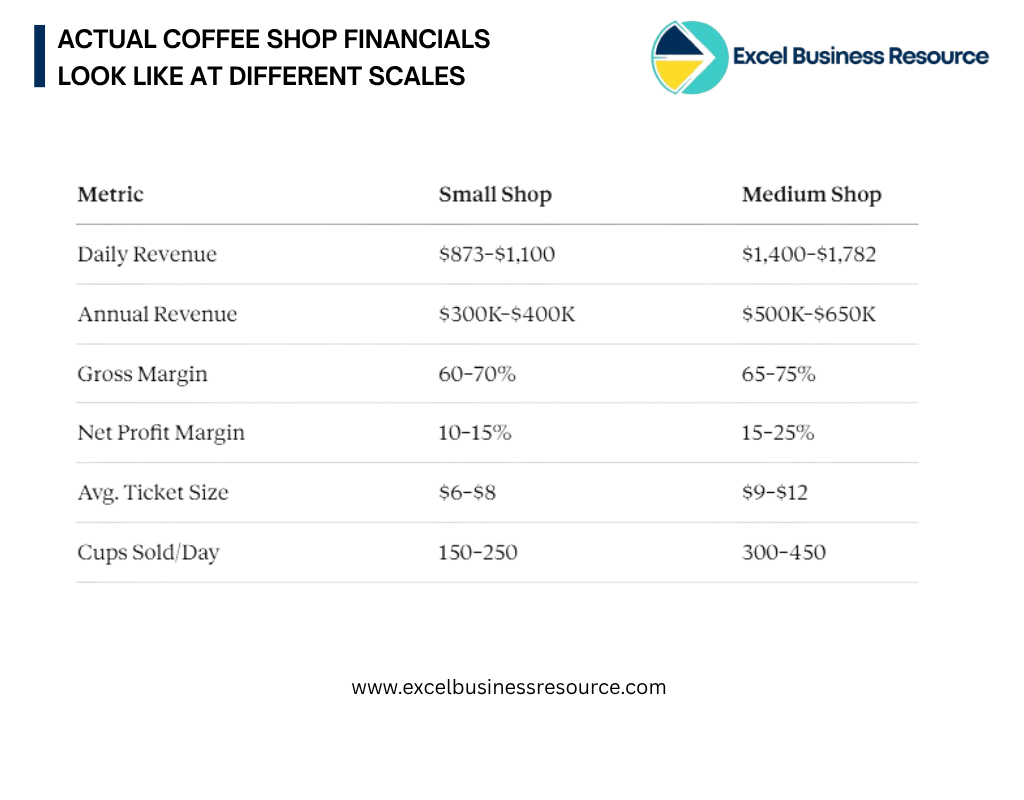
The average independent coffee shop runs a net profit margin of 13.8%, with most shops landing between 10–25% (Source: Coffee Shop Keys – 2025 Industry Report).
That’s meaningfully better than most restaurant formats. But it’s not guaranteed — it requires deliberate cost management across labor (35–45% of revenue), rent (target under 15%), and COGS.
Plan the Numbers Before You Pour the First Cup
Here’s what we’ve seen working with 100+ startups at Excel Business Resource: the coffee shop owners who succeed don’t just know their recipe they know their numbers. They understand their unit economics, their revenue drivers by channel, and their path to profitability month by month.
That’s exactly what our Coffee Shop Financial Model Excel Template was built for.
It’s an investment-ready financial model that includes:
- Revenue projections by channel (beverages, food, retail, catering, delivery)
- Cost structure breakdown (COGS, labor, rent, utilities, marketing)
- Monthly P&L, cash flow, and break-even analysis
- KPI dashboard for ongoing performance tracking
- Startup cost estimator so you know exactly what you need to raise or invest
Whether you’re pitching investors, applying for a loan, or just making sure the numbers work before you sign a lease this template gives you the financial clarity to move forward with confidence.
The Bottom Line
A coffee shop is not a simple business but it is a predictable one when you understand the revenue drivers.
The shops that make serious money don’t rely on a single revenue stream. They combine high-margin beverages with strategic food offerings, loyalty programs that drive repeat visits, catering for B2B revenue, and retail products that build brand equity. Each layer adds to the base and over time, that compounding effect is what makes the business genuinely profitable.
The market is growing. Consumer demand is strong. The question is whether your coffee shop will be built on guesswork or on a solid financial foundation.
Start with the numbers. Build from there.
Excel Business Resource has partnered with 100+ startups across financial modeling, FP&A, and business planning. Our financial templates are used by founders, investors, and consultants worldwide.