
After working with more than one hundred startups across thirty plus industries over the past several years at Excel Business Resource, I have seen one pattern repeat itself again and again. Investors reject around 80% of hotel development business plans not because the idea is bad or the location is weak, but because the financial model is wrong. Founders spend months perfecting their concept and brand story, then slap together a financial plan that uses guesswork instead of real data. Investors see this immediately. They know that a hotel is not just a building. It is a living business that burns cash every single day until occupancy stabilizes. In this guide, I am sharing the same framework that we use for premium clients at Excel Business Resource. Whether you need a hotel development business plan template or you want to build a financial model for a hotel development startup from scratch, these steps will help you create a document that gets investors to say yes.
Investors do not read business plans for fun. They read them to find reasons to say no or yes. So before you write a single word, you need to know what is going on inside the mind of an investor when they read your plan. Investors in the hospitality space look for five specific things.
First, they want proof that you understand the total cost to start a hotel development business. This means land, construction, furniture, before opening expenses, and working capital. Second, they want to see a clear path to profitability with realistic occupancy ramps. Third, they need confidence in your management team or operator. Fourth, they look for a unique concept that fills a real gap in the market. Fifth, and most important, they want a financial model that shows sensitivity analysis. They need to know what happens if occupancy hits 40% in year one instead of 60%. If your plan answers these five questions with data and honesty, you are already ahead of most founders.
Now that you know what investors want, let us walk through the exact sections your hotel development business plan needs. Each section below includes a pro tip from my experience working with founders.
Start with a Sharp Executive Summary
Your executive summary serves as your elevator pitch on paper. Write it last, but place it first. In two pages or less, explain what you are building, where it sits, who will run it, how much money you need, and what returns investors can expect. Use plain language. Avoid fluff. Investors scan this section first, and if it feels vague, they stop reading.
Tip: Include a one-page visual snapshot of your five-year revenue and profit forecast. Investors remember pictures better than paragraphs.
Once you have hooked the reader with your summary, it is time to tell them exactly what you are building.
Define Your Company Description and Concept
This section tells the story behind your hotel. Describe the property type, room count, star rating, target guest, and unique selling point. Explain why this concept fits this location at this moment in time. If you have secured a management agreement or brand flag, mention it here.
Tip: Add a simple matrix that compares your concept against three nearby competitors on price, amenities, and guest experience. This shows you did your homework. With your concept clear, you now need to prove that guests will actually show up.
Conduct Deep Market Analysis and Competitive Positioning
Investors need to know that demand exists and that you can capture it. Break down your target market into segments such as leisure travelers, business guests, bleisure travelers, and group bookings. Analyze industry trends. IBISWorld estimates that the United States hotel market revenue reached around $263 billion in 2024 and will grow to nearly $396 billion by 2030. In the United Kingdom, IBISWorld forecasts hotel market revenue to reach around £27.5 billion in 2025 to 2026. These numbers show that the sector is growing, but they also mean competition is fierce. Map your direct competitors, their occupancy rates, average daily rates, and weaknesses. Then show exactly how you will win market share.
Tip: Use primary research. Visit competitor properties, read their online reviews, and note the top complaints. Address those complaints in your concept.Proven demand means nothing if you cannot deliver a great experience every single day.
Build a Detailed Operations and Management Plan
A beautiful building means nothing without strong operations. Lay out your organizational chart from general manager down to department heads. Define staffing needs, roles, and salary ranges. Outline standard operating procedures for housekeeping, front desk, maintenance, and food service if applicable. Highlight the experience of your key team members. Investors pay close attention to who is running the show because hotel development is one of the most operationally complex real estate investments.
Tip: If you lack hotel operations experience, partner with a professional management company and name them in your plan. This single move can increase investor confidence dramatically. Strong operations need a steady stream of bookings to stay busy.
Create a Marketing and Sales Strategy That Drives Bookings
Your marketing section should explain how guests will find and book your hotel. Outline your distribution strategy including direct bookings, online travel agencies, and corporate contracts. Describe your brand identity, pricing strategy, and promotional plans for launch. Include key performance indicators such as target website traffic, booking conversion rate, and cost per acquisition.
Tip: Budget at least twelve to eighteen months of before opening marketing spend. Most founders underestimate how long it takes to build awareness in a new market. Marketing brings guests, but numbers bring investors.
Develop a Financial Plan That Investors Trust
This is the section that makes or breaks your fundraising. Your financial plan must include startup costs, revenue forecasts, expense estimates, cash flow projections, and break-even analysis. Industry research suggests that development costs for limited service hotels typically start around $150,000 per room and can exceed $1,000,000 per room for luxury properties, depending on location and amenities. Break down every dollar. Show monthly projections for the first two years, then annual projections for years three through five. Include multiple scenarios such as base case, best case, and worst case. Add a debt service coverage ratio and return on investment calculations.
Tip: Build your model in Excel using a hotel development financial model excel template that includes dynamic occupancy ramps. Investors can spot a static model from a mile away, and they know static models lie.
Even the smartest founder’s trip over the same obstacles. Here are four mistakes I have seen repeatedly while working with hotel development startups, along with practical ways to avoid them.
Download the Professional-Grade Tool Save 100+ Hours
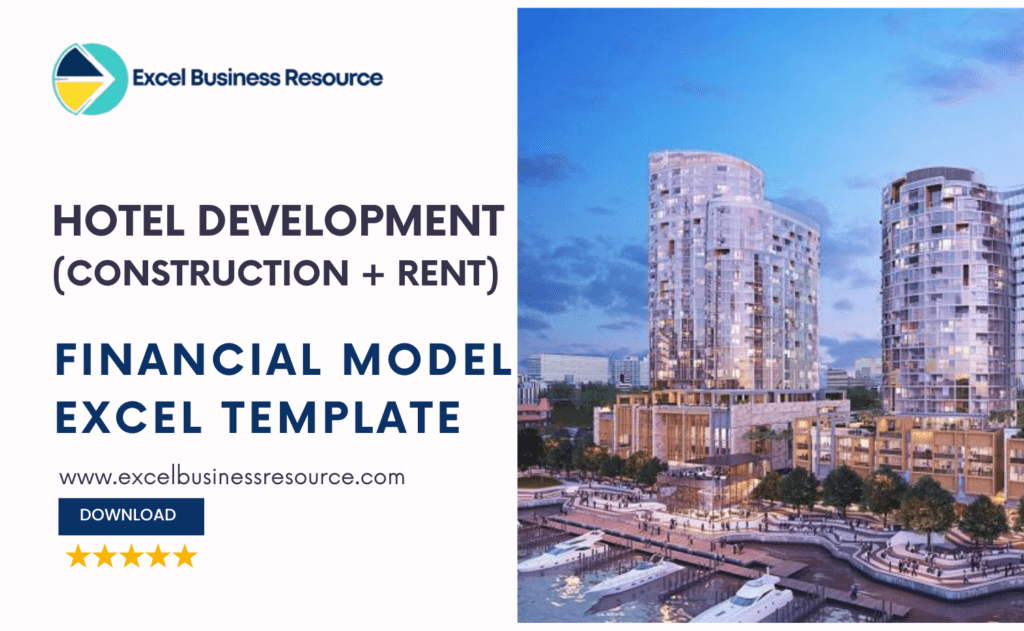
The complete modeling framework described in this guide is built and ready to use in the Hotel Development Financial Model Excel Template from Excel Business Resource.
Common Pitfalls: Why Do Hotel Development Founders Make These Mistakes?
Mistake One: Underestimating Working Capital Needs
Many founders calculate construction costs perfectly, then forget that the hotel needs cash to survive after opening. Payroll, utilities, marketing, and supplier payments do not stop while you wait for occupancy to climb. Industry research suggests that working capital shortfalls destroy more promising ventures than market downturns ever do. The fix is simple. Add a separate working capital line item equal to at least twelve to eighteen months of operating expenses. Show this clearly in your funding request.
Mistake Two: Ignoring Seasonality and the Ramp Up Period
Founders often project sixty five percent occupancy starting in month one. This almost never happens. New hotels need time to build reviews, train staff, and attract repeat guests. Your financial model for a hotel development startup must show a gradual occupancy ramp, typically starting around thirty five to forty five percent in year one and reaching market levels by year three. Factor in seasonality too. If your property sits in a summer destination, show lower winter revenue and adjust staffing accordingly.
Mistake Three: Overlooking Regulatory and Permitting Timelines
Zoning approvals, building permits, environmental clearances, and liquor licenses can add six to twelve months to your timeline. Founders who promise investors an opening date that ignores these delays lose credibility fast. The fix is to speak with local authorities early, hire experienced permitting consultants, and pad your construction timeline by at least twenty percent.
Mistake Four: Weak Team Credentials Without an Operator
Investors back people, not just properties. If your founding team has strong real estate experience but zero hotel operations background, investors will worry. The fix is to bring on a hotel management partner, an advisory board member with hospitality experience, or a general manager with a proven track record. Name these people in your plan and explain their roles.
Now that you know what to include and what to avoid, let us bring this all together.
The difference between a hotel development business plan that collects dust and one that collects checks comes down to one thing. Investors need to believe that you see the full picture, not just the glamorous opening day ribbon cutting. They need to know that you have accounted for the quiet months, the unexpected costs, and the slow climb from first guest to full house. The founders who win funding are the ones who treat their financial model as the heart of the plan, not an afterthought. They build realistic projections, stress test every assumption, and surround themselves with operators who know how to run the business. If you take only one insight from this guide, let it be this. Your concept might attract attention, but your numbers will close the deal. Start with honest math, back it up with a clear operational plan, and present it all with the confidence of someone who has done the work. Your hotel dream is absolutely worth building, and with the right investor ready hotel development business plan template in your hands, you are already closer to breaking ground than you think.
FAQs: Questions Most Founders Ask
The cost to start a hotel development business varies widely based on location, property type, and amenities. Industry research suggests that limited-service hotels can start around $150,000 per room, while luxury developments can exceed $1,000,000 per room. A typical select service property often falls in the middle range. Always include land, construction, furniture, before opening costs, and working capital in your total budget.
Yes, hotel development can generate strong profits, but it depends heavily on location, market demand, operational efficiency, and timing. Industry research suggests that hotels in strong markets with limited new supply tend to perform better. Profitability usually arrives after a two to three year ramp up period once occupancy and average daily rates stabilize.
An investor ready hotel development business plan template should include an executive summary, company description, market analysis, operations plan, marketing strategy, and a detailed financial plan with five-year projections. It should also include sensitivity analysis, break even calculations, and a clear funding request.
Most hotel development projects take between two and a half to four years from initial planning to opening day. This includes site selection, design, permitting, construction, and before opening preparation. Founders who underestimate this timeline often run into cash flow problems.
The biggest challenges include securing prime land, navigating complex regulations, managing high upfront capital costs, hiring and retaining skilled staff, and surviving the ramp up period before the hotel reaches stable occupancy. Revenue volatility and seasonality also create ongoing pressure.
Yes, a hotel development financial model excel template helps you organize revenue forecasts, expense categories, cash flow projections, and investor returns in one place. It also allows you to adjust occupancy rates, average daily rates, and costs quickly to test different scenarios. Investors expect to see a dynamic model, not static numbers.
Start by building a strong business plan and financial model. Then network at hospitality industry events, reach out to private equity firms that specialize in real estate, and connect with family offices that understand hospitality. A strong pitch deck and a realistic financial model for a hotel development startup will open more doors than a great concept alone.