

Building software from scratch takes hundreds of late-night coding sessions, continuous debugging, and massive mental energy. But if you launch a startup without locking in your ownership legally, a smooth exit or a seed funding round can turn into a nightmare overnight.
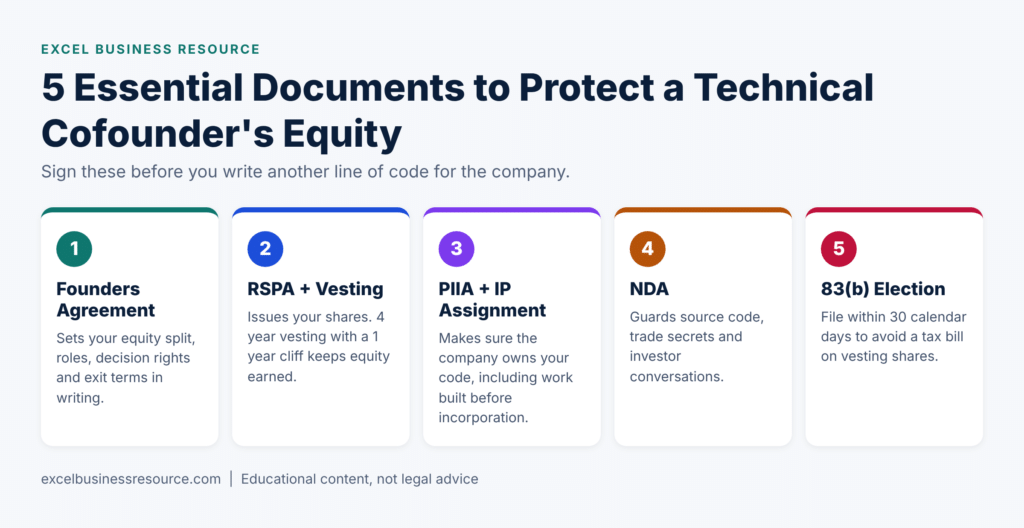
A technical cofounder needs five core documents to protect equity: a Founders Agreement, a Restricted Stock Purchase Agreement (RSPA) with a vesting schedule, a Proprietary Information and Inventions Agreement (PIIA) with an IP Assignment, a Non-Disclosure Agreement (NDA), and a filed 83(b) election. The first two settle how much you own and how you earn it, the next two settle who owns your code, and the last one stops a tax bill on shares you cannot sell.
Most technical founders sign almost nothing. The business partner talks to the lawyer, handles incorporation, and issues the shares, while you keep shipping. Then a seed investor asks for the paperwork and the holes show up in about ten minutes.
Having built cap tables and financial models for over 100 startups at Excel Business Resource, we see this gap repeat constantly. The person writing the code often has the thinnest paper trail behind their stake. This guide fixes that. It is education, not legal advice, so ask a startup lawyer to review your final documents.
Technical Cofounder Equity Protection at a Glance
| Legal Agreement | Primary Purpose | What It Protects You From |
|---|---|---|
Founders Agreement |
Sets equity percentages, roles, exit terms, and deadlock rules. |
A written split and a clear deadlock process. |
RSPA |
Issues founder shares legally. |
Clear share count and vesting terms. |
Vesting and Buyback Clause |
Makes equity earned progressively over time. |
Stops an early-departing founder from keeping everything. |
PIIA |
Assigns work produced during tenure to the company entity. |
Clean ownership of code built during the engagement. |
IP Assignment |
Moves pre-incorporation work into the company. |
Settles who owns pre-incorporation code. |
NDA |
Guards confidential material, architecture, and discussions. |
Source code and trade secrets leaks. |
83(b) Election |
Taxes shares at initial grant value. |
No surprise tax bills as shares vest. |
ESOP (Stock Option Plan) |
Reserves a pool of shares for future hires. |
Planned, rather than improvised, dilution. |
Core Agreements Every Technical Cofounder Needs
Skipping even one of these documents leaves a major hole in your protection. Here is what each one actually does:
Founders Agreement: The master contract where your exact equity split, responsibilities, decision rights, and exit terms live. It stops people from relying on loose handshake agreements.
Restricted Stock Purchase Agreement (RSPA): The legal vehicle that puts shares into your name while locking in your vesting rules.
PIIA (Proprietary Information and Inventions Agreement): Ensures that whatever you code during your tenure belongs to the company, not to you personally.
IP Assignment Agreement: Moves any software or prototypes you built before incorporation safely inside the company.
NDA: Protects your source code, algorithms, and sensitive investor discussions from leaking.
Stock Option Plan (ESOP): Reserves future hiring shares ahead of time so your own equity isn’t randomly slashed when investors demand an option pool.
Once these are signed, keeping track of them is critical. Reviewing a structured startup equity management guide shows you how to keep your cap table clean after incorporation.
How Equity Is Split Between Technical and Business Cofounders
There is no magic formula, and anyone who tells you otherwise is guessing. Technical cofounders joining at the idea stage typically land between 30% and 50%. If you join after a prototype is already built, your percentage will likely be lower. What should drive the final number? The risk you are taking, your full-time commitment, and who is actually bringing the product to life.
Always write the split down and put it into a cap table immediately. Run two or three different scenarios before you commit, including how your share looks after a seed round. Testing your numbers inside a Free Cap Table Template helps you see the reality of your stake before signing anything.
Why Reverse Vesting Is Essential to Protect Equity
Vesting often feels like something restrictions-heavy companies impose on you. In reality, it protects you from the cofounder who disappears.
Imagine a two-person startup with a 50/50 split and zero vesting. If your partner leaves in month four, they still own half the company. You end up building for years, raising capital, and carrying all the risk while a ghost holds 50% of every outcome. Investors hate seeing that on a cap table and will often walk away.
Here is how reverse vesting solves this: you own your shares from day one, but the company holds a buyback right over unvested shares if you leave early. The standard setup is 4-year vesting with a 1-year cliff. Nothing vests in year one; then 25% unlocks at once, followed by steady monthly vesting over the next three years.
Total Granted Stock (100%)
- Months 0–12: The Cliff (0% Vested | Company can buy back 100%)
- Month 12: First Vesting Milestone (25% Unlocked)
- Months 13–48: Monthly Linear Vesting (~2.08% per month until 100%)
Two terms matter a lot for technical founders:
Single vs. Double Trigger Acceleration: Single trigger vests your shares instantly if the company is acquired. Double trigger requires an acquisition plus your termination without cause. Investors heavily prefer double trigger because it keeps technical talent locked in post-sale.
Good Leaver vs. Bad Leaver Clauses: A good leaver (leaving due to family or health reasons) keeps more vested stock. A bad leaver (joining a direct competitor) faces forced buybacks at nominal value. Define these before anyone needs them.
If a technical cofounder quits in month eight under a 1-year cliff, they keep what has vested, which is zero. Without vesting, they would walk away with half the company.
Proprietary Information and Inventions Agreement (PIIA) Breakdown
For a technical founder, this is the most critical document because your code is your core asset. When investors run due diligence, their first question is simple: does the startup actually own its product?
A solid PIIA protects you by:
Assigning all company-related code directly to the business entity
Using strict present-tense legal phrasing like “hereby assigns” instead of “agrees to assign”
Enforcing confidentiality during and after your time at the company
Including explicit carve-outs for your prior work.
Who Owns Code Written Before Incorporation?
Usually, whoever wrote it unless a signed paper says otherwise. If you built the prototype alone on weekends before forming an LLC, that code legally belongs to you, not the startup. That sounds great until you realize no institutional investor will fund a company that can’t prove clear ownership of its core product. The fix is assigning that prior work to the company in exchange for your equity while keeping unrelated side projects excluded.
Example from the Field: We worked with a two-person analytics startup where the technical cofounder kept the core parsing engine repository under a personal GitHub account. When they went out for seed funding, the term sheet stalled because no IP assignment was ever executed. We helped them structure a retroactive IP transfer agreement tied to their RSPA, clearing diligence in under a week.
Protecting Technical Cofounder Stock Options and Shares
Not every founder receives stock on day one; some receive stock options instead. The distinction is massive.
An 83(b) election applies directly to restricted stock. Options only qualify if you exercise them early before they vest. Without an 83(b) election, you are taxed at every single vesting date based on the stock’s value at that exact moment. In a fast-growing startup, that triggers a massive tax bill on paper wealth for shares you cannot even sell yet.
The IRS rules here are unforgiving:
You have exactly 30 calendar days from the share transfer date.
There are zero extensions, and weekends or holidays count.
File Form 15620 correctly and keep absolute proof of delivery.
Missing this window means there is no fix. Always confirm your tax obligations with a qualified professional.
Protecting Your Equity Against Dilution in a Seed Round
Your ownership percentage will drop when outside investors come in that part is normal. Unmanaged dilution, however, is a trap.
Option Pool Timing: Investors usually demand an ESOP pool created before the round, meaning founders absorb 100% of the dilution. Negotiate this early.
Preemptive Rights: These give you the right to buy shares in future funding rounds so you can maintain your ownership percentage.
Anti-Dilution Protection: Usually written to protect investors, so read every word carefully.
Model your numbers before signing any term sheet. A shift in option pool sizing often changes your final payout much more than a shift in company valuation.
Common Equity Trap Mistakes Early Cofounders Make
- Building Code on Verbal Promises: Spending six months coding an MVP before signing a formal vesting agreement.
- Missing the 30-Day IRS Window: Forgetting to file an 83(b) election and facing massive tax bills down the road.
- Leaving Code in Personal Accounts: Storing company repositories on personal GitHub accounts without executing a formal IP assignment.
- Ignoring Dilution Math: Focusing only on starting percentages while ignoring how option pools and convertible notes impact ultimate exit payouts.
Final Thoughts
Lock down your equity before you write another line of code. Put your split in writing, tie it to reverse vesting, assign your IP cleanly, file your 83(b), and model your dilution before the first term sheet hits your inbox.
Need help with a cap table, a dilution forecast, or a custom financial model? Excel Business Resource builds specialized financial templates and models for growing startups.
Frequently Asked Questions
What happens to equity if a technical co-founder quits early?
If an RSPA with a standard vesting schedule is in place, the company exercises its buyback right on all unvested shares at nominal value. The quitting founder retains only the portion of equity that vested prior to their departure date.
How is equity split between technical and business co-founders?
While many teams default to a 50/50 split, realistic allocations factor in technical complexity, pre-existing IP brought to the table, cash contributions, and market-rate salary adjustments. The best practice is to base splits on future execution commitment rather than early ideas.
How do I ensure a tech co-founder does not get screwed on equity?
Secure protection by executing a Co-Founders’ Agreement, setting up double-trigger vesting acceleration, documenting pre-existing code carve-outs, and using clear cap table forecasting tools before taking on outside capital.
What agreement does a technical cofounder need to protect equity?
A Founders Agreement, an RSPA with vesting, a PIIA with IP assignment, an NDA, and an 83(b) election.
Can a technical cofounder keep ownership of the code?
Only if the company agrees in writing. Investors expect the company to own the core product, so founders typically trade pre-existing IP assignment for formal company equity.
How do I see what my stake looks like after a seed round?
Build a detailed cap table and test different pool sizes and valuations before accepting any investor offer.