

🚀 Excel Business Resource provides financial modeling, FP&A, and business planning services for startups. With experience across 100+ companies, we transform complex financial data into compelling investment narratives.
Why the Right Metrics Matter More Than Ever
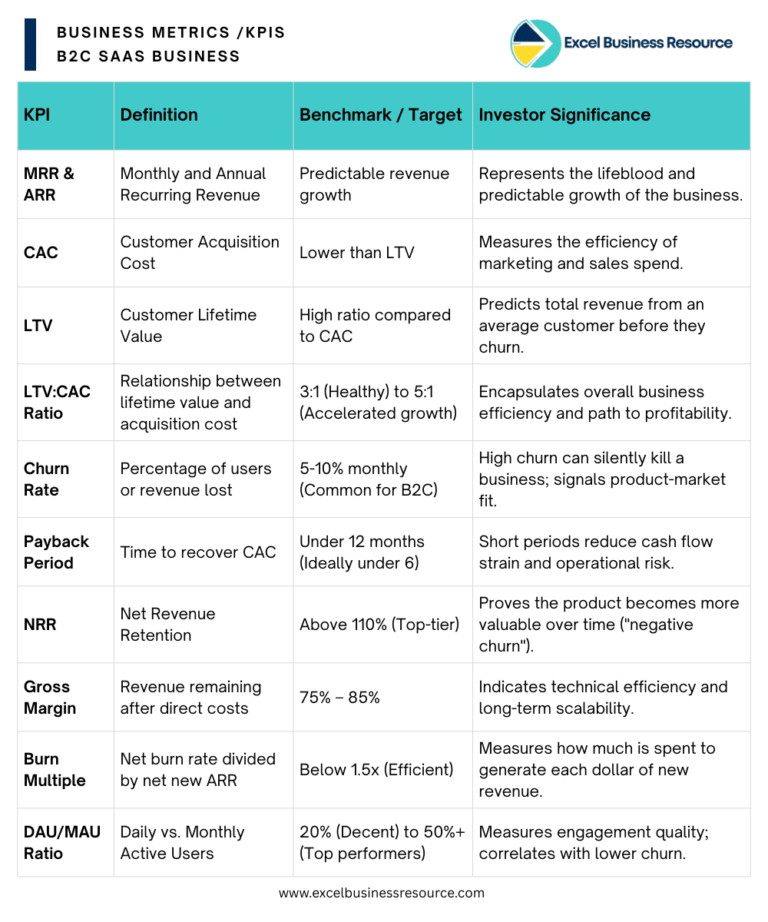
Building a B2C SaaS startup feels like steering a ship through fog. You have users signing up, revenue trickling in, and a product that seems to work but do you actually know if your business is healthy? Here’s the reality: investors don’t care about vanity metrics like total downloads or registered users. They want to see the numbers that predict whether your business will survive and scale.
At Excel Business Resource, we’ve built financial models for over 100 startups, helping them secure funding and optimize their operations. We’ve seen founders crash and burn because they focused on the wrong KPIs, and we’ve watched others land million-dollar rounds by telling the right story with their data. This guide breaks down the ten metrics that actually move the needle when you’re pitching investors or running your B2C SaaS financial model template.
Whether you’re building your first SaaS Excel model or refining your financial forecasting model for B2C SaaS startup, these KPIs form the backbone of any serious business plan for SaaS startups.
1. Monthly Recurring Revenue (MRR) and Annual Recurring Revenue (ARR)
MRR and ARR represent the lifeblood of your subscription business. MRR tracks your predictable monthly revenue, while ARR gives you the annualized view that investors prefer for SaaS valuation discussions.
Smart founders don’t just report these numbers they segment them. Break down your MRR into new revenue, expansion revenue from existing customers, and reactivation revenue from churned users coming back. This granularity shows investors you understand your revenue drivers of SaaS startups intimately.
When building your B2C SaaS financial projection model, ensure your MRR calculations account for seasonality. Consumer SaaS often sees spikes during January (New Year’s resolutions) and September (back-to-school), which can distort your growth narrative if not properly modeled.
2. Customer Acquisition Cost (CAC)
CAC tells you exactly how much you’re spending to win each new customer. Include everything marketing salaries, ad spend, content production, and sales tools. Many founders underestimate this by forgetting overhead costs.
The magic happens when you calculate CAC by channel. Your Instagram ads might cost $15 per customer while Google Ads run $45. This insight lets you optimize spend before investors even ask. In your startup financial model template, create separate CAC lines for each acquisition channel to show sophisticated financial planning.
Investors particularly scrutinize CAC trends. If your CAC is rising faster than your lifetime value, you’ve got a fundamental business model problem that no amount of growth hacking can fix.
3. Customer Lifetime Value (LTV)
LTV predicts the total revenue you’ll earn from an average customer before they churn. For B2C SaaS, this calculation requires careful consideration of your pricing tiers and usage patterns.
The relationship between LTV and CAC determines your unit economics health. Successful B2C SaaS companies typically maintain a 3:1 ratio or better. If you’re below 3:1, investors will question your path to profitability. Above 5:1 might mean you’re underinvesting in growth.
Your consumer based SaaS financial planning template should include sensitivity tables showing how changes in churn rate or average revenue per user affect LTV. This demonstrates sophisticated financial planning and helps investors stress-test your assumptions.
4. CLTV:CAC Ratio
This single metric encapsulates your business efficiency. It answers the critical question: “For every dollar we spend acquiring customers, how many do we get back?”
A ratio below 3:1 signals potential trouble either your acquisition costs are too high or you aren’t monetizing users effectively. Ratios above 5:1 suggest you could accelerate growth by spending more on marketing.
When presenting this in your SaaS model template, show how the ratio improves as you scale. Early-stage companies often see poor ratios that get better with brand recognition and organic growth. This trajectory matters more than the absolute number.
💡Learn: How you can Increase your CLTV & CAC Ratio
🚀Download: CLTV & CAC Analysis Excel Template
5. Churn Rate and Retention Metrics
Churn kills B2C SaaS businesses silently. While enterprise SaaS might survive 5% annual churn, consumer apps often face 5-10% monthly churn. You must track both customer churn (percentage of users leaving) and revenue churn (percentage of revenue lost).
Net Revenue Retention (NRR) adds crucial context. If you’re losing customers but the remaining ones spend more, NRR might still exceed 100%. This expansion revenue signals product-market fit that raw churn numbers hide.
In your SaaS budgeting template, model different churn scenarios. Show investors you’ve planned for the worst case while working toward the best. This conservative approach builds trust and demonstrates experience.
6. Payback Period
The payback period reveals how many months it takes to recover your customer acquisition costs. For B2C SaaS, investors typically want to see payback periods under 12 months ideally under 6.
Longer payback periods strain cash flow and increase risk. If you’re spending $50 to acquire a customer paying $10 monthly, you need 5 months just to break even. During those 5 months, you’re essentially lending money to your business.
Your financial model template for B2C SaaS startup should clearly display this metric and show how it shortens as you improve conversion rates or increase pricing. This demonstrates operational maturity that investors reward with higher valuations.
7. Net Revenue Retention (NRR)
NRR measures whether your existing customer base is growing or shrinking in value. Calculate it by taking your starting MRR, adding expansion revenue, subtracting contraction and churn, and dividing by starting MRR.
Top-tier B2C SaaS companies achieve NRR above 110%, meaning even without new customers, revenue grows 10% annually through upsells and usage increases. This “negative churn” is the holy grail of subscription businesses.
When discussing SaaS valuation, emphasize NRR improvements over time. It proves your product becomes more valuable to users the longer they stay—a key indicator of durable competitive advantage.
8. Gross Margin
Gross margin shows what percentage of revenue remains after direct costs (hosting, payment processing, customer support). B2C SaaS should target 75-85% gross margins, significantly higher than traditional software due to cloud infrastructure efficiencies.
Low gross margins suggest either pricing problems or technical inefficiency. If you’re spending 40% of revenue on AWS and Stripe fees, investors will question your scalability.
Your SaaS pricing model template Excel should include detailed cost of goods sold calculations. Break down hosting, payment processing, and support costs separately so investors can verify your margin assumptions.
9. Burn Multiple
Burn multiple divides your net burn rate by net new ARR. It answers: “How much are we spending to generate each dollar of new annual recurring revenue?”
Efficient B2C SaaS companies maintain burn multiples below 1.5x. Above 2x suggests unsustainable growth, while below 1x indicates capital-efficient expansion. This metric has become increasingly important as investors prioritize profitability over pure growth.
Include burn multiple trends in your B2C SaaS financial planning template. Show how efficiency improves as you achieve economies of scale in marketing and operations.
💡Learn:
10. Active User Metrics (DAU/MAU Ratio)
Daily Active Users divided by Monthly Active Users measures engagement quality. A 20% DAU/MAU ratio indicates users return roughly once per week—decent for most B2C apps. Top performers like social platforms often exceed 50%.
This metric proves your product isn’t just collecting dust after signup. High engagement correlates with lower churn and higher willingness to pay. When building your SaaS revenue forecast model, tie growth assumptions to realistic DAU/MAU improvements rather than just total user acquisition.
Building Your Financial Model Around These KPIs
Tracking these metrics is only half the battle you need to model them accurately in your startup financial model template. At Excel Business Resource, we specialize in creating B2C SaaS forecasting that automatically calculate these KPIs and generate investor-ready dashboards.
A robust financial forecasting model for B2C SaaS startup should include:
- Monthly and annual views of all ten KPIs
- Sensitivity analysis showing impact of ±20% changes in key assumptions
- Scenario planning for best, base, and worst cases
- Clear assumptions documentation so investors can audit your logic
Your business plan for B2C SaaS startups should weave these metrics into your narrative. Don’t just present numbers tell the story of how improving CAC payback period enabled faster growth, or how increasing NRR reduced your capital requirements.
Connecting Metrics to Valuation:
Understanding how to value SaaS startups requires linking these KPIs to valuation methodologies. Investors typically apply VC valuation methods that combine:
- DCF valuation using projected free cash flows.
- Comparable company analysis based on revenue multiples.
- Startup valuation methods specific to SaaS metrics.
Strong performance across these ten KPIs justifies higher revenue multiples. A company with 120% NRR, 3-month payback periods, and 80% gross margins might command 10x+ revenue multiples, while struggling peers settle for 3-4x.
Your SaaS valuation ultimately depends on proving sustainable, efficient growth. These KPIs provide the evidence investors need to justify premium valuations.
From Metrics to Funding:
Investors see thousands of pitch decks. The founders who win funding present these ten KPIs with confidence, context, and a clear improvement plan. They don’t just report numbers—they explain the operational changes driving metric improvements.
Whether you’re creating a budgeting template of SaaS startup in Excel for internal planning or preparing for your Series A, these metrics form the universal language of SaaS investing. Master them, model them accurately, and communicate them clearly.
Founder's Ask Questions
The top 10 KPIs that investors actually care about include Monthly Recurring Revenue (MRR), Customer Acquisition Cost (CAC), Customer Lifetime Value (LTV), LTV:CAC ratio, churn rate, payback period, Net Revenue Retention (NRR), gross margin, burn multiple, and DAU/MAU ratio. These SaaS metrics form the foundation of any B2C SaaS financial model template and directly impact your SaaS valuation during fundraising. At Excel Business Resource, we build financial forecasting models for B2C SaaS startups that automatically calculate and visualize these KPIs for investor presentations.
To build an automated SaaS Excel model, you need dynamic formulas that link revenue assumptions to real-time KPI calculations. A professional B2C SaaS financial model template should include automated MRR tracking, cohort-based churn analysis, and unit economics dashboards. At Excel Business Resource, we specialize in financial model templates for B2C SaaS startups where metrics like CAC, LTV, and burn multiple update automatically as you adjust pricing or growth assumptions saving hours of manual work while ensuring accuracy for investor meetings.
B2C SaaS financial model templates require fundamentally different assumptions than B2B models. Consumer SaaS typically experiences higher monthly churn (5-10% vs. 5% annually), lower average revenue per user, and relies more on paid social acquisition than enterprise sales. Our consumer SaaS financial model templates include pre-built scenarios for freemium conversion, viral coefficient modeling, and seasonal usage patterns that B2B startup financial model templates don't address. These distinctions are critical for accurate financial planning and SaaS revenue forecast models.
Investors use these KPIs to determine which startup valuation methods apply to your business. Strong unit economics and low churn justify premium DCF valuation approaches, while high growth rates support comparable company analysis. Your burn multiple and LTV:CAC ratio directly influence the revenue multiples investors apply. At Excel Business Resource, we create B2C SaaS financial projection models that stress-test these metrics against various VC valuation methods, showing exactly how improving each KPI increases your company's worth.
Yes. Many founders ask us to enhance their current SaaS model template rather than starting over. We audit your existing B2C SaaS financial model template, identify gaps in SaaS metrics tracking or investor presentation, and upgrade it with advanced features like scenario planning, sensitivity analysis, and SaaS pricing model optimization. Whether you need better unit economics visualization, SaaS budgeting template integration, or formatting for SaaS valuation discussions, we preserve your core assumptions while delivering investor-grade quality. This approach is ideal if you've outgrown a B2C SaaS financial model template free download but don't need complete rebuild.
You can download professional-grade SaaS startup financial model templates at Excel Business Resource. Unlike generic financial model template for B2C SaaS startup options, our templates are built specifically for consumer subscription businesses and include all ten KPIs investors expect. We offer both B2C SaaS financial model template free resources for early-stage validation and premium financial forecasting models for B2C SaaS startups designed for Series A and beyond. Every template incorporates business plan for SaaS startups best practices and SaaS valuation methodologies used by top VCs.