

Thinking about opening a gym? You’re not alone. With nearly 77 million Americans holding gym memberships in 2024 and U.S. fitness industry revenues hovering around $45–46 billion, the opportunity is real. But so is the risk.
The cost to start a gym business is one of the first questions every aspiring fitness entrepreneur asks — and one of the most underestimated. Equipment, lease, renovations, licenses, staffing… each line item adds up faster than most people expect. Get the numbers wrong at the planning stage, and you’ll burn through your capital before you ever hit break-even.
This article walks you through every major cost category, what drives profitability, and a realistic timeline for when your fitness club can start making money. We’ve worked with 100+ startups on FP&A and financial modeling and gyms are one of the most nuanced businesses to model correctly. Let’s break it down.
What Type of Gym Are You Starting?
Before looking at numbers, you need to define your gym concept — because the type directly determines your startup investment, revenue model, and profit potential.
- Boutique Studio (yoga, pilates, cycling, HIIT): Smaller space, premium pricing, lower overhead
- Mid-Size Commercial Gym: General population market, membership-driven, moderate capital
- Large Full-Service Club: High revenue potential but thinnest margins due to rent and equipment depreciation
- Personal Training Studio: Lowest overhead, highest margin per session ($75–$150/session)
- CrossFit / Functional Fitness Affiliate: Community-driven, surprisingly strong unit economics (~27% average profit margin)
Each model lives on a completely different financial curve. A boutique cycling studio charging $180/month and operating in 2,500 sq. ft. has fundamentally different economics than a 15,000 sq. ft. big-box gym charging $40/month.
Analyzing startup costs is an important step when planning a gym business. But costs tell only part of the story. You should also assess how the gym will generate revenue and profits.
Explore the key revenue drivers of the gym business and compare their earning potential against the initial investment. This will give you a clearer picture of the gym’s profitability and long-term growth potential.
Gym Business Startup Cost Breakdown:
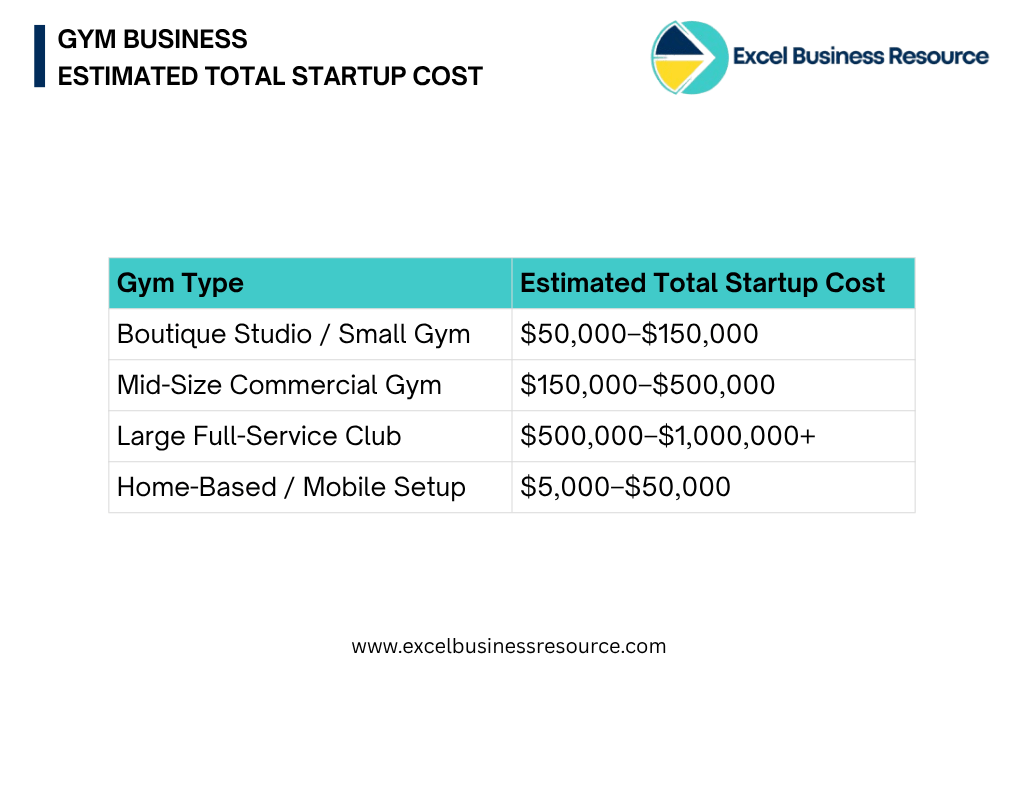
Here is a realistic, category by category gym business budget analysis for a mid-size commercial gym (roughly 4,000–8,000 sq. ft.):
1. Location & Lease
This is typically your single largest cost driver. Commercial gym space in the U.S. ranges from $15 to $50 per square foot annually, depending on city, traffic, and demographics. For a boutique or mid-sized gym (2,000–5,000 sq. ft.), annual lease costs typically fall between $45,000 and $90,000.
A 10,000 sq. ft. facility in a prime urban area can easily run $150,000–$350,000 per year on rent alone. Your location choice will make or break your entire financial model — don’t pick cheap rent in a low-traffic area and try to market your way out of it.
2. Renovation & Build-Out
Unless you’re taking over an existing gym space with working plumbing, HVAC, and reinforced flooring, budget for significant tenant improvements. Basic build-outs start around $40 per square foot for minimal interior work and can climb to $250–$300+ per square foot for premium finishes, locker rooms, showers, sauna installations, or electrical upgrades.
For a mid-size gym, expect to spend $30,000–$150,000 on renovations, depending on the baseline condition of the space.
3. Gym Equipment
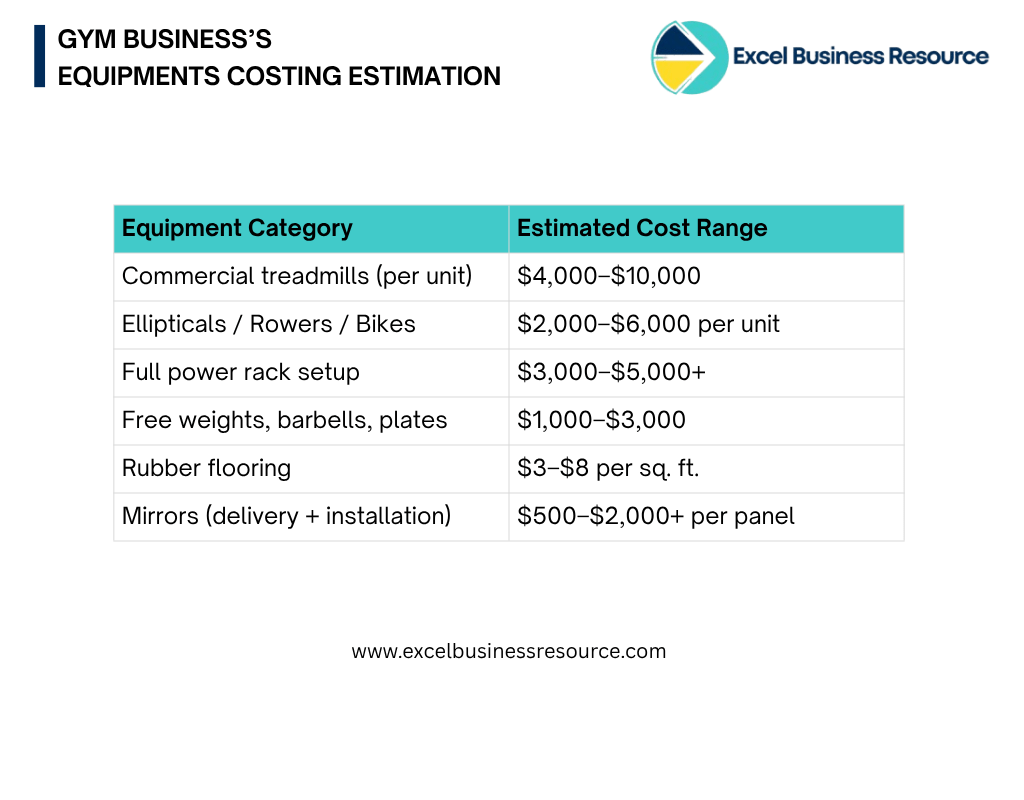
Equipment is the heart of your startup budget and where most founders either over-invest or cut dangerous corners.
Source:Vibefam | Hevy Coach
For a small boutique studio, equipment can cost $10,000–$40,000. A fully equipped commercial gym with commercial-grade cardio machines and a complete strength floor can exceed $100,000–$500,000. One cost-saving lever: purchasing refurbished equipment can cut costs by 30–50%, as long as you verify condition and warranty coverage.
4. Licenses, Permits & Insurance
Don’t skip this — legal exposure in the fitness industry is real.
- Business licenses & permits: $2,000–$5,000 upfront; $500–$1,500 annually for renewals
- General liability insurance: $1,500–$3,500/year for smaller studios; more for full facilities
- Workers’ compensation: Depends on payroll size and state
5. Staffing
Staff costs vary dramatically by model. A personal training studio might operate with just the owner plus one or two trainers. A full-service gym needs front desk staff, personal trainers, cleaning crew, and management. Budget $8,000–$25,000/month for a mid-size gym’s payroll, depending on headcount and whether trainers are employees or independent contractors.
6. Technology & Software
Membership management software, point-of-sale systems, booking tools, and access control are non-negotiable in 2025. Budget $500–$1,500/month for gym management tech, depending on your platform choices.
7. Working Capital Reserve
This is what separates well-planned gym launches from failed ones. You need enough cash reserves to cover 6–12 months of operating expenses before reaching break-even. For a mid-size gym with monthly expenses of $25,000–$45,000, that’s a working capital reserve of $150,000–$300,000+ beyond your startup costs.
Profitability of Gym Business:
Here’s the data founders need to see before committing capital:
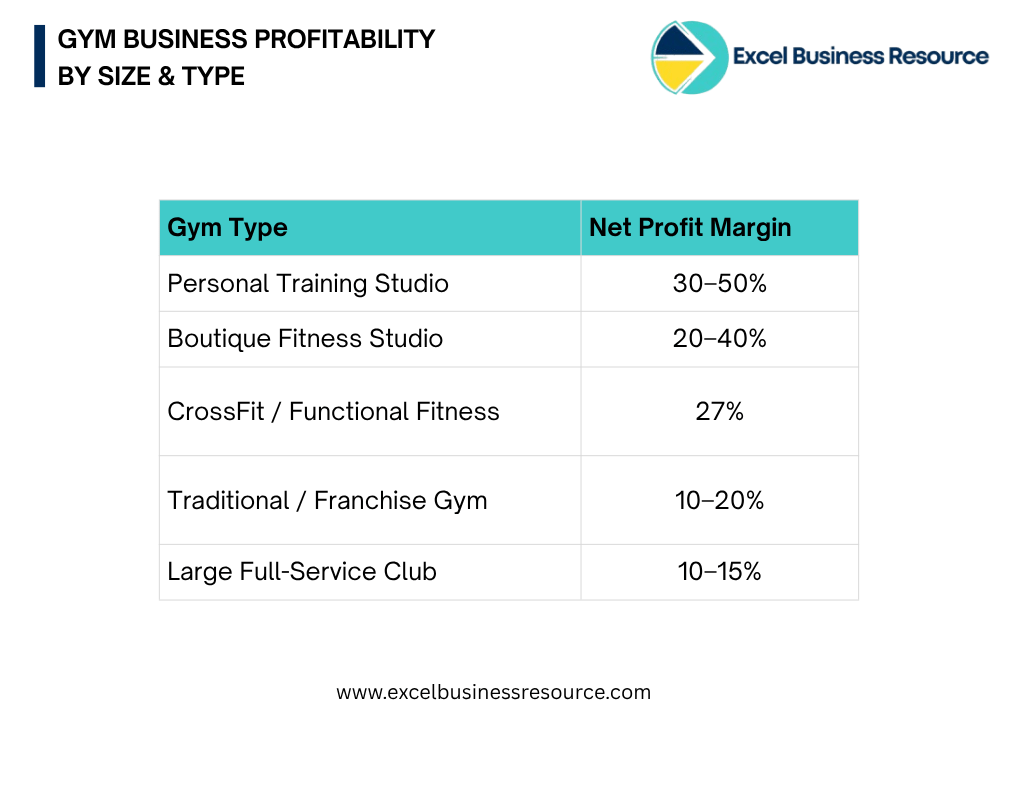
The average gym net profit margin sits at 10–15%, but the model and execution quality determine where you actually land. Boutique studios consistently outperform because of premium pricing, smaller footprints, and stronger member retention.
One sobering data point: research suggests only 52% of gyms operating for less than three years are profitable. The other 48% are either breaking even or burning cash often because they underestimated startup costs or overestimated ramp-up speed.
Profit Timeline of a Fitness Club: Break Even Point?
This is the question investors and smart founders ask first. The honest answer:
- Operational break-even (monthly revenue covers monthly expenses): 6–18 months for most gyms
- Full investment payback (recouped total startup capital): 4–8 years for most models; boutique studios can get there faster
- Lender expectations: Banks typically want to see positive cash flow within 12–24 months
The single biggest factor that accelerates break-even? Pre-selling memberships before opening. Gyms that open with 50–100 pre-sold members hit operational break-even significantly faster. Early wins are possible in 30–90 days if you fix pricing gaps and launch an additional revenue stream like personal training before month two.
How to Make a Gym Business Profitable Faster
Based on working with multiple fitness and wellness startups, here are the levers that matter most:
- Control rent and payroll — Together these consume 40–65% of revenue. A 3% reduction in either can add $15,000+ annually in net profit for a $500K gym.
- Track your KPIs obsessively — Monitor average revenue per member, monthly churn rate, class utilization, and lifetime value. (See our article on Top Metrics of Gym Business that drive real profits.)
- Minimize monthly churn — Gyms with less than 6% monthly churn are almost always profitable. Member retention is cheaper than acquisition every time.
- Layer revenue streams early — Don’t wait until year two to introduce personal training packages, nutrition coaching, or wellness add-ons.
- Build a proper financial model before you spend — Knowing your break-even member count, monthly burn rate, and cash runway gives you real strategic control.
Do You Have a Financial Model for Your Gym?
If you’re serious about launching or scaling a fitness business, guessing at numbers isn’t a strategy. You need a purpose-built financial model that maps your startup costs, monthly operating expenses, membership growth projections, and profitability timeline — all in one place.
Our Gym Financial Model Excel Template is built specifically for fitness club founders and investors. It includes:
- Startup cost planner — Lease, equipment, build-out, working capital
- Revenue projections — Membership tiers, personal training, add-ons
- Monthly P&L and cash flow — Know exactly when you hit break-even
- Scenario analysis — Model best case, base case, and downside
- Investor-ready outputs — For bank financing or equity rounds
- Pre-built KPI dashboard — Track the metrics that drive gym profitability

Whether you’re putting together a business plan for a gym business, pitching to a lender, or just stress-testing your own assumptions, this template saves you weeks of spreadsheet work and ensures your numbers are built on real industry benchmarks.
We’ve helped 100+ startups build investment-ready financial models across industries including sports and fitness. Browse our full library of Sports & Fitness Business Financial Model Templates to find the right tool for your venture.
Final Verdict: Is a Gym Business Worth It?
The gym business is not a passive investment. It requires hands-on management, relentless attention to member retention, and smart cost control from day one. But for founders who build a solid financial foundation, choose the right model, and execute on pre-opening momentum — the returns are real.
The fitness market is growing. Consumers are more health-conscious than ever. And boutique, community-driven concepts continue to outperform. If you know your numbers before you sign a lease, you’re already ahead of most gym owners who failed in year one.
Start with a clear gym business budget analysis. Model your unit economics before you commit capital. And if you want to understand how investors value fitness businesses, our resource on Startup Valuation Methods and DCF Valuation walks through the frameworks that matter.
The cost to start a gym business is significant. But with the right plan, it’s an investment not a gamble.
Excel Business Resource specializes in financial modeling, FP&A, and business plan development for startups and growth-stage companies. Our team has worked with 100+ founders across industries including fitness, retail, SaaS, and hospitality. Explore our financial forecasting model templates →