
If you’re thinking about opening a gym or investing in one, the first question on your mind is probably: how does a gym business actually make money? The fitness industry isn’t just about memberships anymore. A well-run gym today runs on multiple revenue engines and understanding each one is the difference between a gym that barely survives and one that scales profitably.
At Excel Business Resource, we’ve worked with 100+ startups across financial modeling, FP&A, and business planning. And we’ll tell you straight: gym businesses that rely on a single revenue stream are always the first to struggle. Let’s break down every major way a gym generates revenue and how you can build a model that actually works.
The State of the Fitness Industry (Why This Matters Now)
Before we get into the revenue mechanics, here’s the context you need as an investor or entrepreneur.
The global fitness industry is worth approximately $257 billion as of 2024, growing at a 5.6% annual rate (MirrorsDelivered). In the U.S. alone, gym industry revenues in 2025 are estimated at $45–46 billion, with nearly 77 million Americans holding gym memberships both record highs (MMCG Invest). By 2030, U.S. revenues are projected to climb to the mid-$50 billions.
The demand is there. The challenge and the opportunity is in building a gym business with the right mix of revenue streams, cost controls, and retention strategy.
How Gym Businesses Generate Revenue: The Complete Breakdown
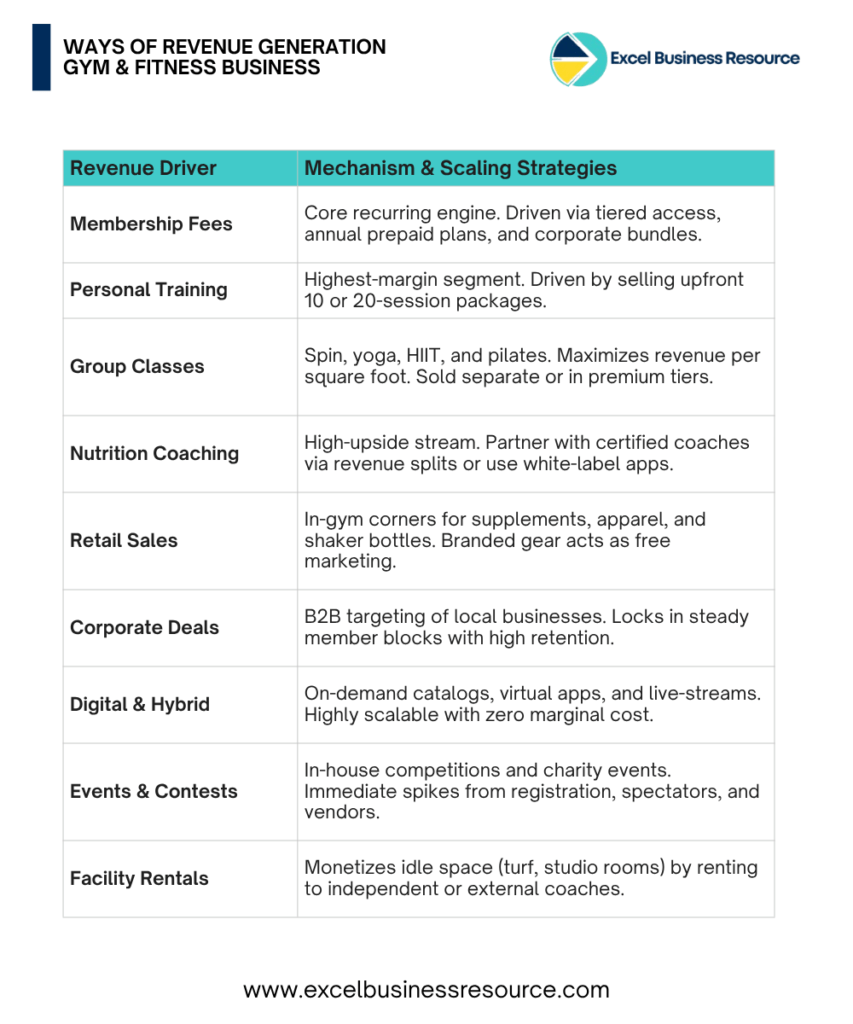
1. Membership Fees — The Core Revenue Driver:
Memberships are the backbone of any gym’s income. Most gyms charge monthly or annual fees that range from $10/month for budget chains like Planet Fitness to $100–$200+/month for premium or boutique fitness clubs.
Membership revenue works because it’s recurring and predictable exactly what investors and lenders want to see in a financial model. However, the trap most gym owners fall into is relying on memberships for 80–90% of total revenue (ChalkItPro). A few months of high member churn and the whole model starts to crack.
To strengthen this stream, top-performing gyms use:
- Tiered memberships — basic access vs. premium (includes classes, sauna, towel service)
- Annual prepaid plans — better cash flow and higher retention
- Family or corporate bundles — higher lifetime value per account
A gym with 300 members paying an average of $60/month generates $18,000/month in baseline membership revenue. That’s your starting point — not your ceiling.
2. Personal Training — The Highest Margin Revenue Stream:
Personal training is arguably the most profitable revenue stream a gym can have. Clients pay $50–$150 per session (or more in premium markets), and the gym takes a cut of what trainers earn typically 40–60%.
For gyms with in-house trainers on staff, this turns into a clean, high-margin income line with very little additional overhead. Many successful boutique studios and CrossFit gyms report that personal training alone accounts for 20–30% of total revenue.
Want to grow this fast? Package personal training into 10- or 20-session bundles sold upfront. It increases cash flow and locks in client commitment.
3. Group Fitness Classes
Spin, yoga, HIIT, pilates, Zumba — group classes have become a major revenue driver, especially for boutique studios. You can charge separately for classes on top of base memberships, typically $15–$30 per drop-in session or bundled into a premium tier.
The economics here are excellent. A yoga class with 20 participants at $20 each generates $400 in under an hour with one instructor. For any gym thinking about how to make a gym business profitable, adding structured group programming is one of the fastest ways to increase revenue per square foot.
4. Nutrition Coaching & Wellness Programs:
This is one of the most underutilized revenue streams for gym owners, and it has massive upside. Nutrition programs range from simple macro-counting plans at $50/month to full individualized coaching at $150–$250/month (ChalkItPro).
You don’t need a registered dietitian on staff to start. Many gyms partner with certified nutrition coaches and take a revenue split. Some even white-label nutrition app platforms for an added digital income stream.
5. Retail Sales — Supplements, Apparel & Merchandise:
Your members are already buying protein powder, gym clothes, and accessories — the question is whether they’re buying from you or Amazon or from any other sources.
A small in-gym retail corner stocked with supplements, branded apparel, resistance bands, and shakers can generate $1,000–$5,000/month in additional revenue with minimal effort. More importantly, branded merchandise becomes a marketing asset every member wearing your gym’s t-shirt is free advertising.
6. Corporate Wellness Partnerships:
One overlooked but highly scalable revenue stream is corporate wellness. Local businesses actively look for wellness benefits to offer employees, and a gym can provide corporate membership packages at a slight discount in exchange for a guaranteed block of members.
A single corporate deal with a company of 50 employees can bring 5–20 new members at negotiated group rates with strong retention, because social dynamics of training with coworkers build-in accountability.
Identify 10–15 businesses within a short drive of your gym and build a simple corporate wellness deck. This is a direct channel to grow revenue without spending on digital ads.
7. Digital & Hybrid Memberships:
Post-pandemic, the gym industry has permanently shifted toward hybrid fitness models. Members who can’t always come in person still want access to workouts, coaching, and accountability.
Many gyms now offer hybrid add-ons clients pay an extra $19–$49/month for app access, live-streamed classes, or on-demand workout libraries (HearWellness). This is recurring revenue with near-zero marginal cost once the content is created.
For gyms looking to grow beyond their local geographic market, digital memberships are the clearest path to scaling revenue without scaling physical space.
8. Events, Competitions & Community Activities:
In-house fitness competitions, charity workout events, and community throwdowns generate one-time revenue spikes while massively strengthening your gym’s community. Entry fees typically range from $30–$75 per participant, with additional income from spectators, vendor spots, and branded merchandise.
Events also double as your best marketing channel they attract new prospects who experience your gym culture firsthand.
9. Facility Rentals:
If your gym has open floor space, a turf area, a boxing ring, or a private studio room — rent it out. Early mornings or late nights when member traffic is low are perfect windows for:
- Independent trainers renting space by the hour
- Yoga or dance instructors running their own classes
- Corporate team training sessions
This converts idle physical assets into recurring income with zero operational overhead.
Gym Business Budget Analysis: What Does It Actually Cost?
You can’t talk about revenue without talking about costs. Here’s a realistic gym business budget snapshot based on 2025 benchmarks.
Startup Costs: Most new gym owners need between $150,000 and $500,000 in total startup capital, depending on facility size, location, and equipment. Premium full-service facilities can exceed $500,000.
Monthly Operating Expenses (Small to Medium Gym):
- Rent: $5,000–$15,000
- Payroll: $6,000–$12,000
- Utilities: $2,000–$10,000
- Insurance: $200–$700
- Marketing: $1,000–$3,000
- Miscellaneous: $1,000–$2,000
- Total: $15,000–$30,000/month
Read our detail article of cost to start a gym business & it’s profitability.
Running these numbers without a structured financial model is where most gym founders make costly mistakes. That’s exactly why a purpose-built Gym Financial Model Excel Template matters. It maps your revenue assumptions, operating costs, break-even timeline, and cash flow in one integrated model, so you’re not guessing.
Profit Timeline of a Gym Business:
This is the question every investor and founder needs an honest answer to.
Month 1–6: Member acquisition phase. Revenue grows slowly while fixed costs remain constant. Most gyms run at a loss during this window. Pre-selling memberships before opening is the single most effective way to compress this period.
Month 6–12: Revenue starts to stabilize if retention is strong. A small neighborhood gym can begin approaching break-even within 9–12 months of opening.
Month 12–24: Most gyms reach operational break-even covering monthly costs within 12 to 24 months (SmartHealthClubs). Full-service clubs with higher overhead tend to sit toward the longer end of this range.
Year 2–3+: With consistent membership growth and diversified revenue streams, profit margins for stable gyms typically range from 10–30%. Boutique studios with tight operations can hit 20–40% margins when capacity is maximized and personal training revenue is strong (Wodify).
Full investor payback typically takes 4–8 years for most gym models, especially franchise concepts with higher startup costs (ProjectionHub). This distinction between monthly break-even and full capital recovery is something every investor needs to model separately.
Key Insight: Pre-selling 150–200 founding memberships before opening can dramatically cut your break-even window. Every founding member signed before day one reduces the cash you need to bridge the ramp-up period.
Every Gym Owner Should Track KPIs:
If you want to know the financial health of your gym at a glance, track these KPIs monthly:
- Monthly Recurring Revenue (MRR) — your predictable membership base
- Member Churn Rate — aim for below 5% monthly
- Revenue Per Member — includes all streams, not just membership fees
- Customer Acquisition Cost (CAC) — how much you spend to get each new member
- Average Revenue Per Unit (ARPU) — benchmark against industry norms
- Burn rate — how fast you’re spending reserves before break-even
These aren’t just vanity metrics. They’re the same KPIs lenders and investors scrutinize before committing capital. If you haven’t built a framework around unit economics for your gym, you’re flying blind.
Understand in detail: Why KPIs of gym & fitness businesses are important.
How to Make a Gym Business Profitable Faster
Based on working with startup founders across the fitness and wellness space, here’s what actually moves the needle:
1. Diversify early. Don’t wait until year two to add personal training packages or nutrition coaching. Build these revenue streams from month one.
2. Nail your pricing model. Underpricing memberships to attract volume is a trap. Know your unit economics, what does each member actually cost you to serve?
3. Control your rent-to-revenue ratio. Keep rent below 15% of mature revenue. Above 20%, margins become nearly impossible to protect (ProjectionHub).
4. Invest in retention, not just acquisition. Acquiring a new member costs 5–7x more than retaining an existing one. Every percentage point of churn you reduce directly improves your bottom line.
5. Model before you spend. A gym business financial forecasting model isn’t a luxury it’s your decision-making framework. It tells you how many members you need to cover costs, which revenue streams have the highest ROI, and when you’ll hit profitability under different growth scenarios.
Plan Your Gym's Finances with a Purpose-Built Model
If you’re serious about starting or growing a gym, guesswork isn’t a strategy. You need a financial model that reflects the real revenue drivers of a fitness business — membership tiers, personal training splits, class revenue, retail, corporate deals, and beyond.
Our Gym Financial Model Excel Template is built for exactly this. It includes:
- Revenue projections across all major gym income streams
- Monthly and annual P&L, cash flow, and break-even analysis
- Scenario modeling (conservative, base, optimistic)
- Investor-ready financial statements
- Editable assumptions for your specific gym type and market

Whether you’re building a business plan for a gym, pitching to an SBA lender, or stress-testing your own numbers before committing capital. This model gives you the financial clarity to move forward with confidence.
You can also explore our full library of Sports & Fitness Business Financial Model Templates for related businesses in the wellness space.
Final Thoughts:
The gym business can be highly profitable but only when you understand all the revenue drivers and plan your finances with precision. Memberships are the foundation, but personal training, group classes, nutrition coaching, retail, corporate wellness, digital memberships, and events are what separate a gym that grows from one that stagnates.
The fitness industry is in a strong growth cycle. The market is there. The margins are achievable. What separates the gym owners who make it work from those who don’t often comes down to one thing: knowing their numbers before they open the doors.
Excel Business Resource is a financial modeling and FP&A firm that has worked with 100+ startups across financial planning, business analysis, and investment-ready model creation. For a Startup Valuation Calculator and other tools, explore our full resource library.