
A startup booted fundraising strategy means growing on customer revenue first, then raising outside money only when your numbers give you the upper hand. Most founders hear “raise a seed round” before anyone asks whether they need one. The median equity takeaway by founder in seed round is about 18% of a company, and the options pool and SAFE conversions can push the real cost higher. If you have paying customers, or a clear path from customer to revenue, then you have more leverage than you think.
This guide shows how the bootstrap fundraising strategy works, when to raise seed investment, which non-dilutive funding options to try first, and which metrics make investors take a bootstrapped founder seriously. It is written for pre-revenue and early stage founders who want to scale without excessive dilution.
Quick answer: A startup booted fundraising strategy funds growth through revenue, grants, and low-cost debt first. The founder raises equity only after proving unit economics of business, ideally with a CAC to LTV ratio near 3:1, a CAC payback under 12 months, and a clean cap table to investors.
What Is a Startup Booted Fundraising Strategy?
A startup booted fundraising strategy is a plan to fund growth with customer cash, small non-dilutive sources, and carefully timed equity. You decide when to raise, how much to raise, and what you must prove first.
Venture money is rare. Famous Entrepreneur.com site quoted that venture capitalists fund only about 0.05% of startups. Self-funding is the normal path, so a clear fundraising plan matters.
How a Startup Booted Fundraising Strategy Works
- The first funding is always form founder’s savings and first paying customers. This is the customer-funded growth model.
- Track unit economics every month, so you know if each customer adds cash or burns it.
- Apply for grants, R&D tax credits, or revenue-based financing to extend runway.
- Raise a small round only when the numbers show you can use outside money efficiently.
- Keep the cap table clean so the next investor can price your round quickly.
Startup Booted vs Bootstrapping vs Venture Capital Strategy
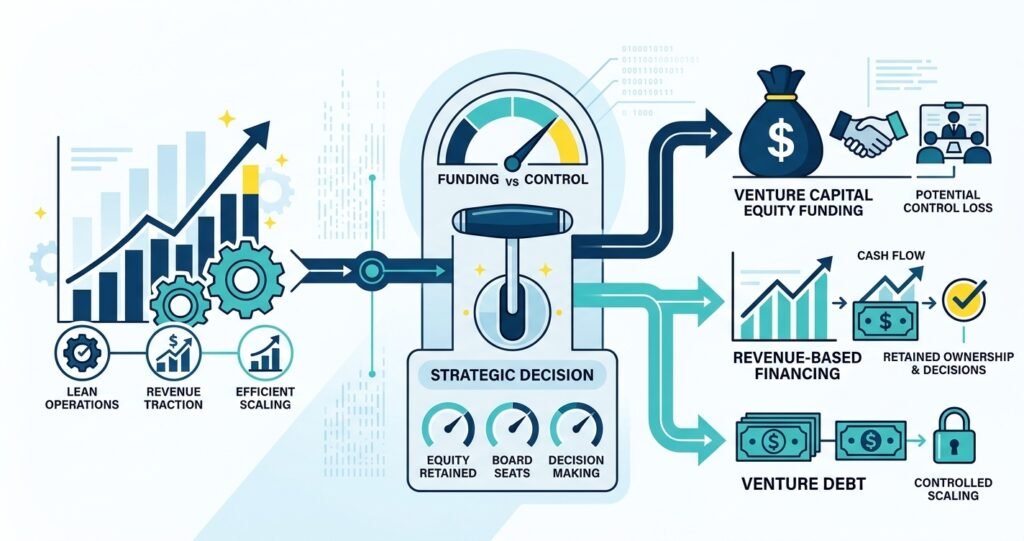
Pure bootstrapping avoids outside money altogether. A startup booted fundraising strategy uses outside money on purpose, later and on better terms. Venture capital sells equity early in exchange for speed.
| Factor | Bootstrapping | Startup booted strategy | Venture capital |
|---|---|---|---|
|
Main funding |
Savings and revenue |
Revenue plus grants, credits, RBF, and a small SAFE |
Giving equity against investment |
|
Equity sold early |
None |
Little, and delayed |
Median seed sells 18% of equity
|
|
Founder control |
Full |
High, with investors added later |
Shared with investors |
|
Growth speed |
Limited by cash |
Paced by unit economics |
Fastest, with pressure to scale |
|
Main risk |
Cash runs out before scale |
Needs strong financial discipline |
Dilution and exit pressure |
|
Best for |
Low capital businesses |
Founders who want leverage before raising |
Capital heavy, fast moving markets |
Either you are using your personal saving or growth revenue or willing to raise external investment, you need to detail understanding of startup booted financial modeling guide. This will help you in better decision making for cash flow, equity management.
When Should a Bootstrapped Startup Raise External Capital?
Founder should always raise outside money, when the investment helps in revenue growth fast enough, and your numbers prove it. Do not raise because a competitor did. Check following signals first:
- Customers renew, and demand is higher than you can serve.
- CAC payback is under 12 months and your CAC to LTV ratio is near 3:1.
- You can name what the money buys and the result it should deliver.
- You can size the round for 18 to 24 months of runway.
Free Startup Cash Runway & Burn Rate Excel Template (Download Now)”
Track net burn rate, forecast runway months, and model scenario planning with our free financial template for founders.
Startup Bootstrap Fundraising Strategy for Pre Revenue Founders
Without revenue, your proof to investor is only demand size or market size, i.e. paid pilots, waitlists, signed letters of intent, and customer interviews. Lean on grants, R&D credits, and a small SAFE. Keep burn low, because every extra month of runway improves your bargaining position.
Bootstrapped to Seed Fundraising: The Pre-Seed to Seed Transition
Pre-seed proves the problem. Seed proves you can sell repeatedly. Carta’s July 2026 data puts the median seed at a $24.3M valuation on $4.1M raised, but AI deals pull that median up. Carta also found that fewer than 10% of seed rounds sold 30% or more of the company. Use that figure when an investor asks for too much.
Non-Dilutive Funding Options in a Startup Booted Fundraising Strategy
Non-dilutive funding options extend runway without selling shares. Try them before you open a priced round.
Revenue-based financing (RBF):
You repay a share of monthly revenue until you reach a cap, usually 1.1x to 1.5x the amount advanced. A 1.5x cap repaid in 14 months costs 35% or more annualized, so model slow and fast growth before you sign.
Venture debt for early-stage startups:
Usually offered to companies that already have institutional investors, so most bootstrapped founders use it later.
Government innovation grants:
In the US, SBIR and STTR award equity free money. As of October 16, 2026, agencies can issue Phase I awards up to $335,937 and Phase II awards up to $2,239,578 without SBA approval. Outside the US, check your national innovation agency.
R&D tax credits:
A qualified small business can apply up to $500,000 a year against employer payroll taxes. You need under $5M in gross receipts and no gross receipts before the five year window.
SAFE notes with valuation caps:
Ownership equals the investment divided by the post-money cap. A $250K SAFE at a $4M cap gives 6.25%.
Convertible notes for self-funded startups:
Unlike SAFEs, they carry interest and a maturity date, so read the repayment terms closely.
Cash flow management and runway expansion:
Annual prepay plans, faster invoicing, and burn rate reduction are the cheapest capital you have.
Quick comparison of non-dilutive funding options
| Funding option | How it works | Main tradeoff |
|---|---|---|
|
Revenue-based financing |
Repay a share of monthly revenue until a 1.1x to 1.5x cap |
Annualized cost can pass 35% if you repay fast |
|
Venture debt |
A loan, usually alongside institutional investors |
Hard to get without backers, and repayment is fixed |
|
Government grants |
Equity free awards for R&D, such as SBIR and STTR |
Competitive, slow, and mostly US based |
|
R&D tax credits |
Up to $500,000 a year against payroll taxes |
Needs payroll and careful documentation |
|
SAFE with valuation cap |
Cash now, converts to equity at the next round |
Stacked SAFEs dilute founders |
|
Convertible note |
Debt that converts to equity later |
Interest and a maturity date |
|
Cash flow management |
Prepay plans, faster invoicing, lower burn |
Gains are limited by your sales |
What Metrics Should Founders Track in a Startup Booted Fundraising Strategy?
Your metrics are your bargaining power. Track these numbers every month so you know when your unit economics validation is strong enough to raise, borrow, or keep growing on revenue. The benchmarks below come from SaaS, so adjust them for your model.
| Metric | Common benchmark | Why founders should watch it |
|---|---|---|
|
CAC to LTV ratio |
3:1 or better; early stage investors may accept 2:1 with a clear path to 3:1 |
Each customer returns more than it costs |
|
Payback period optimization |
Under 12 months is healthy; under 18 is often acceptable |
How fast acquisition cash comes back |
|
Gross margin percentage |
70% or higher for SaaS |
Room left after delivery costs |
|
MRR traction |
Steady monthly growth with low churn |
Demand repeats |
|
Burn rate reduction and capital efficiency ratio |
Burn falling against new revenue |
You turn cash into growth |
Here is the math. With $200 monthly revenue per customer, 80% gross margin, 2% monthly churn, and $2,000 CAC, LTV is $200 x 0.80 ÷ 0.02 = $8,000. That gives a 4:1 ratio. Payback is $2,000 ÷ $160 monthly gross profit, or 12.5 months.
Free CLTV vs CAC Analysis Excel Template (Download Now)
Automate unit economics tracking: calculate LTV, CAC, CAC Payback Period, and LTV:CAC ratio in seconds
Real Companies That Grew With Little Outside Capital
These examples show the strategy at work. Each company put revenue first and took outside money late, or never.
- Mailchimp grew for two decades without venture funding and was acquired by Intuit in 2021 in a deal reported at about $12 billion. Read the coverage from Indie Hackers.
- Zapier built its automation platform with very little outside capital. Forbes reported a valuation of around $5 billion in 2021.
- Basecamp (37signals) has long run as a profitable, self-directed business. Co-founder Jason Fried has spoken about two decades of bootstrapping Basecamp.
- GitHub shows a middle path. It was built for years without outside funding before taking a $100 million investment from Andreessen Horowitz in 2012.
These companies are exceptions in one sense, since most startups fail whatever funding path they choose. The lesson is the order of operations: prove the business first, then choose capital on your terms.
Investor Readiness for Bootstrapped Founders
Bootstrapped founders negotiate from strength when they can show a model, not just a pitch.
Build a Bootstrapped Valuation Framework
Work backwards from dilution. Dilution is roughly the amount raised divided by post-money valuation. Raising $1M at a $5M post-money valuation sells 20%. Decide if you accept that, then build base, slow, and fast cases to see what the round must achieve.
Don’t pitch blind. Calculate your exact startup valuation in minutes with EBR’s Startup Valuation Calculator.
Retain Founder Equity and Control With a Clean Cap Table
Headline dilution hides extra cost. A worked example of waveup shows roughly 25 points of ownership leaving when a new option pool and SAFE conversions land in the same seed round, against an 18% headline. Stacking SAFEs at many different caps often surprises founders at the first priced round (CRV). Model every conversion before you sign.
Download: Master your equity split. Free Cap Table template for pre & post-investment modeling
Why a Financial Model Decides the Outcome
Excel Business Resource have worked with 100+ startups on data analysis, FP&A, and financial modelling. A model that links revenue, burn, runway, and dilution lets you answer investor questions on the spot.
- Start with our investor ready and early stage financial model templates.
- Need a forecast built around your own numbers? See our custom financial modeling services.
Startup Booted Fundraising Strategy FAQs
How can a bootstrapped founder raise money without giving up equity?
Combine customer revenue with non-dilutive funding: SBIR style grants, the R&D payroll tax offset, revenue-based financing, and tighter cash management. Each extends runway without selling shares.
Is revenue-based financing better than equity for bootstrapped companies?
It can be, if you have steady revenue and healthy margins. RBF has a capped, known cost and no dilution, but a fast repayment can push the annualized cost above 35%. Equity costs nothing monthly but is permanent.
When should a bootstrapped startup raise external capital?
Raise once CAC payback is under 12 months, your CAC to LTV ratio is near 3:1, demand exceeds capacity, and you can show what the money will produce.
What metrics do investors look for in a bootstrapped startup?
CAC to LTV, CAC payback, gross margin, MRR growth and churn, burn rate, and a clean cap table.
Final Thoughts on Startup Booted Fundraising Strategy
A good startup booted fundraising strategy keeps you in control: earn first, extend runway with non-dilutive funding, and raise equity from a position of proof. If you want help turning your numbers into an investor ready forecast, talk to our team about financial modeling.