
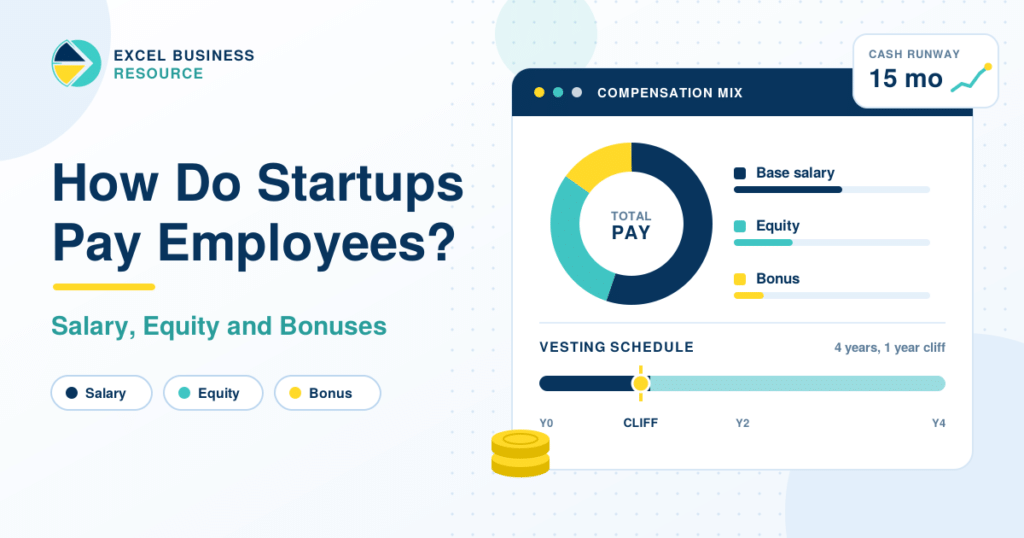
Startups pay employees with three things: a base salary, equity (a small share of the company), and sometimes bonuses. In the early stage, a startup usually offers a lower salary than a large company and adds equity to make up the difference. When the company earns more money or raises funding, salaries rise toward market levels.
Every founder faces this question in the first year. You need good people, but you have little cash. At Excel Business Resource, we have worked with more than 100 startups on financial modeling, FP&A and data analysis. In that work we see one pattern clearly. Founders who plan employee pay early keep their cash for a longer time than founders who decide pay one hire at a time.
This guide explains what startups pay, why they pay it that way, and how to calculate the cost before you make an offer. First, let us look at the basic parts of a pay package.
How Startups Pay Their Employees: The Three Main Parts
Every startup pay package is built from the same three parts. Once you know these parts, the rest of this guide is easy to follow.
- Base salary: a fixed amount paid every month or every two weeks.
- Equity: a share of ownership in the company. Startups usually give equity as employee stock options (ESOPs).
- Variable pay: extra money paid for results, such as a bonus, profit sharing or milestone pay.
| Pay Type | Does It Use Cash Today? | Why Employees Like It | Main Risk |
|---|---|---|---|
Base salary |
Yes |
Income is stable |
Shortens the startup’s runway |
Equity |
No |
Can be worth a lot if the company grows |
May be worth nothing |
Variable Pay |
Only when the goal is met |
Rewards good results |
Needs clear targets |
Look at the equity row. Equity costs the company no cash today, so startups with little cash use it often. To see why cash is so limited, we need to look at how quickly a startup spends it.
Why Startups Cannot Pay Like Big Companies
A startup spends money every month but earns little revenue in the early stage. Two numbers explain the problem:
- Monthly cash burn: the amount of cash the company spends each month.
- Runway: the number of months the company can operate before cash runs out.
Here is an example. A startup has $600,000 in the bank and spends $40,000 per month.
- Runway now: $600,000 ÷ $40,000 = 15 months
- The startup hires two people. Each costs $7,500 per month in total. Monthly spending rises to $55,000.
- Runway after hiring: $600,000 ÷ $55,000 = about 10.9 months
Two new hires removed more than four months of runway. Before you hire, check this effect in a model. Our free cash runway template shows how each new salary changes your runway. Next, we will see how pay changes as the startup moves through different stages.
Read this article: Why Tracking Cash Runway is Crucial for Startups and VCs, for detail understanding for making rational decision making.
Free Cash Runway Template that shows you, how each new salary changes your months of runway.
Startup Team Payment Models by Stage
A new company and a funded company have different amounts of cash, so they pay in different ways. These are the three common stages.
Bootstrapped and Pre Revenue Stage
A bootstrapped startup has no outside investors. The founders use their own money or early sales to pay costs. Cash is very limited, so early employees may accept:
- A low salary with a larger equity grant
- Part time or fractional work (a few days per week or month)
- Deferred salary, which means pay delayed until the company earns revenue. Put the terms in writing.
Guide to bootstrapped financial modeling shows how to plan spending at this stage.
Seed Stage Funding
Seed stage funding is the first outside investment. It gives the startup enough cash to pay regular salaries, but the salaries are usually still below market. A typical seed package includes a moderate salary, an option grant and basic benefits. Investors often ask how you plan to use their money on hiring. Our guide on fundraising strategy for bootstrapped startups helps you prepare that answer.
Series A and Later
A Series A funding round is the first large round, and it usually follows proof that customers want the product. With more cash and lower risk, the company pays salaries closer to market rates. The company is also worth more, so each new hire receives a smaller percentage of equity than the first hires did. Our explainer on startup funding rounds shows how each round changes hiring and ownership.
At every stage, equity is part of the package. Many new employees do not fully understand it, so the next section explains it step by step.
How Startup Equity Works for Employees
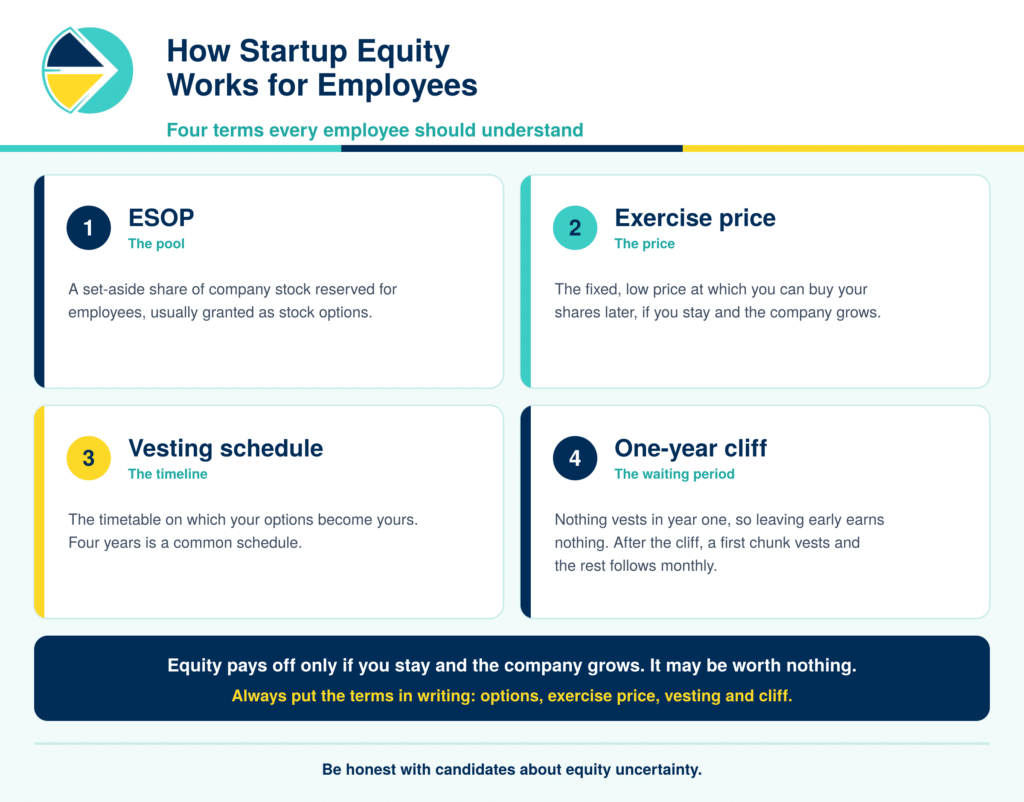
New employees often ask about equity, but many founders explain it poorly. Founders should say it plainly: if you stay with the company and the company grows, you may buy shares at a low, fixed price. That is the full idea. The details below explain how it works.
Here is an example. Maya joins a startup. Her offer includes 20,000 stock options, a four year vesting schedule and a one year cliff. Her exercise price (the fixed price she pays for each share) is $1.
- Months 1 to 12: none of her options are earned yet. If she leaves in month 11, she receives nothing.
- Month 12: the one year cliff ends. She now earns 25% of her options, which is 5,000 options.
- Months 13 to 48: she earns the remaining 15,000 options in equal monthly parts, about 417 each month.
- If the company is sold for $5 per share: her first 5,000 options are worth 5,000 × ($5 − $1) = $20,000 before taxes.
| Term | What It Means |
|---|---|
ESOP |
A group of shares the company sets aside for employees |
Exercise Price |
The fixed price an employee pays for each share |
Vesting Schedule |
The timeline that decides when an employee earns the options |
One Year Cliff |
The employee earns nothing until month 12 |
A startup must set aside shares for these grants before it hires. Carta data shows that option pools usually start near 10% before the seed round and grow by about 1 to 1.5 percentage points in each funding round. Record every grant in a cap table template, and use our guide on startup equity management to plan your pool.
Now a fair question arises, can equity replace a higher salary? The next example answers it with numbers.
Equity vs. Salary: A Worked Example
Suppose a developer earns $120,000 at a large company. Your startup can pay only $90,000, and you add a grant of 0.25% of the company. The developer accepts a lower salary now in exchange for a possible gain later.
- Salary gap per year: $120,000 − $90,000 = $30,000
- Salary gap over four years: $30,000 × 4 = $120,000
- Company sale price needed to cover the gap: $120,000 ÷ 0.25% = $48 million
This result ignores taxes, the exercise price and dilution (the drop in ownership percentage when new shares are issued), so the real sale price must be higher. The lesson is direct. A large pay cut needs a large equity grant, and the founder should tell the candidate honestly how uncertain equity is. Honest offers build trust, and trust helps keep employees.
Real companies also have to balance cash and equity. Let us look at three well known examples.
How Famous Companies Paid Their Employees
Airbnb, OYO and Amazon each used a different mix of cash and equity. Each choice solved a specific problem for that company.
| Company | What They Did | Lesson For Founders |
|---|---|---|
Airbnb |
Before going public, it created a cash bonus program for 2018 and 2019, and removed the one year vesting cliff for employees who held equity. Its CEO now has a base salary of $1. |
Equity can take years to pay. A cash bonus rewards employees while they wait. |
OYO |
An estimated 80% of employees held ESOPs. In 2018, it offered a Rs 50 crore buyback of employee shares. Later, more than 500 current and former employees exercised options before the IPO. |
Giving ESOPs to many employees builds ownership. A buyback gives them real cash before the company is sold. |
Amazon |
Jeff Bezos earned $64,333 in 1996, $79,197 in 1997, and $81,840 from 1998 onward. A 2014 report said no employee received more than $160K in cash pay, and any extra pay came as stock. |
A company can keep cash pay low and use stock to reward long term growth. |
What These Examples Teach
- Salary and equity do different jobs. Salary pays for daily life. Equity rewards long term growth.
- Employees need a way to turn equity into cash. OYO’s buyback let employees sell some shares before an exit.
- Rules can change. Airbnb removed its cliff for existing equity holders to keep them motivated.
- Copy the idea, not the numbers. These are large, well funded companies, and your budget is different.
Salary and equity are the two main tools, but other rewards can help when cash is short.
Other Ways Startups Reward Employees
When a startup cannot raise salaries, it can offer other rewards that cost little cash. Many candidates value these rewards, especially flexibility and learning.
| Reward | How It Works | Cash Cost |
|---|---|---|
Profit Sharing |
Employees receive a share of profit after the company earns it |
None until the company is profitable |
Milestone Pay |
A bonus is paid when the team reaches a clear goal, such as a product launch |
Paid only when the goal is met |
Flexible Work |
Remote work or flexible hours |
Low |
Learning Budget |
The company pays for courses or certifications |
Small and predictable |
Cost Of Living Adjustment (COLA) |
Pay is set by the employee’s city |
Matches local pay levels |
Write the target for any bonus before the work begins. A clear target makes a lower base salary easier to accept. After you choose the rewards, you must decide whether each person is an employee or a contractor.
Employees or Contractors? Choose the Right Classification
An employee works under your direction. A contractor runs their own work and can serve other clients. Many founders hire contractors first because it looks simpler. The law, however, looks at how the work is done, and not at the word in your contract. In the US, the IRS checks three areas: behavioral control (who directs the work), financial control (who pays for tools and carries the risk), and the type of relationship (how long and how closely they work with you).
| Factor | W2 Employee | Independent Contractor |
|---|---|---|
Who sets hours and methods |
The company |
The Contractor |
Employer Payroll Taxes |
Yes |
No |
Benefits such as health insurance |
Usually |
No |
Risk of misclassification |
Low |
High if you treat them like staff |
Misclassification means calling an employee a contractor. It can lead to back taxes and penalties, so check your local rules before you hire. If you hire in another country, a global employer of record (EOR), such as Deel, can legally employ and pay that person for you. For short projects, fractional and remote workers let you add skills without a full time salary.
If you hire employees, remember that salary is only part of the cost. The next section shows the full amount.
Calculate the Fully Loaded Cost of Each Hire
A $75,000 salary does not cost $75,000. The fully loaded employee cost adds taxes, benefits and tools to the salary. In the US, employers pay 7.65% of wages for Social Security and Medicare. They also pay federal unemployment tax of 6.0% on the first $7,000 of wages, usually reduced to 0.6% with state credits. One worked example shows total employer payroll taxes of $5,779.50 on a $75,000 salary, which is 7.71%.
| Cost Item | Annual Amount |
|---|---|
Base Salary |
$75,000 |
Employer payroll taxes |
$5,780 |
Health insurance (assumed) |
$6,000 |
Laptop and software (assumed) |
$2,500 |
Recruiting and onboarding (assumed) |
$3,000 |
Fully loaded cost |
$92,280 |
In this example, one employee costs about 1.23 times the base salary. Your numbers will differ by country and benefits plan, so replace the assumed rows with real quotes. Add the totals to your operating expenses (OpEx) and track them in a profit and loss statement template. Our free financial projection template for startups converts your hiring plan into monthly burn and shows your breakeven point. For a complete plan, use our free financial plan template.
What Should Founders Pay Themselves?
Investors and employees both watch founder pay. A founder who takes a high salary from limited cash may worry investors. A founder who takes no pay for a long time may run out of personal savings and leave the business.
Most early stage founders pay themselves enough to cover basic living costs, then raise their pay after funding or revenue arrives. To set a fair level, compare your plan with Carta compensation data, Y Combinator guidance on founder pay, and the Pilot founder salary report. These sources show how pay changes by stage, role and funding level. Treat them as references, because every company has a different budget and location.
You now have all the parts. The next section puts them into a simple order.
A Simple Process for Paying Startup Employees Well
Follow these steps in order. Each step uses the result of the step before it.
- Set a runway target. Decide how many months of cash you must keep.
- Build a headcount plan. List every role you need over the next 12 to 18 months.
- Check market pay. Find typical pay for each role in each location.
- Design the package. Combine salary, equity and variable pay.
- Calculate the full cost. Include taxes, benefits and tools.
- Set up startup payroll management. Use software that handles tax filings.
- Review every quarter. Update the plan when revenue or funding changes.
Many startups skip some of these steps, and that causes the mistakes below.
Common Mistakes to Avoid
- Promising equity without explaining it. Tell the employee the number of options, the exercise price, the vesting schedule and the cliff, in writing.
- Forgetting employer taxes. In the US example above, they add about 7.7% to the salary.
- Treating employees as contractors. This creates tax and legal risk.
- Raising pay without checking runway. Test each raise in your model before you approve it.
Final Thoughts
Startups pay employees with salary, equity and incentives. The right mix depends on how much cash the company has, which stage it is in, and how much risk the employee accepts. A good mix attracts strong people, helps you keep them, and protects your runway. Investors also read your payroll plan as a sign of financial discipline, and our guide on unit economics and scalable growth shows how pay connects to company value.
Start with a clear model, test each hire before you make an offer, and review the plan as you grow. If you want help turning these ideas into numbers, Excel Business Resource offers startup financial model templates and custom financial modeling and FP&A support.
Frequently Asked Questions (FAQs)
How do startups pay employees with no money?
They offer equity, deferred salary, or part time and fractional roles, and they write every term down. When cash becomes available, most add a small base salary.
Do startups pay less than established companies?
Early stage startups often do, especially for base salary. They offer equity to make up the difference. As the company raises money and earns revenue, pay moves closer to market levels.
What is a vesting schedule?
A vesting schedule is the timeline that decides when an employee earns their stock options. A common schedule is four years with a one year cliff.
Should startup employees get equity or higher salary?
It depends on the person’s finances and comfort with risk. Salary is certain. Equity may be worth a lot or nothing. Many people choose a balance of both.
How much equity should a startup give an employee?
There is no fixed number. The amount depends on the role, the seniority, the company stage and the company value. Earlier and more senior hires receive larger grants. A cap table model shows how each grant changes ownership.