
The EV industry is no longer a bet on the future it’s the present. Global electric vehicle sales crossed 17 million units in 2024 and the first quarter of 2025 alone saw over 4 million EVs sold worldwide 35% more than the same period in 2024. The global EV market, currently valued at nearly $900 billion, is on a trajectory to surpass $2 trillion by 2032. For startup founders, engineers, and visionary entrepreneurs, this is one of the rare windows where early movers can carve out a lasting market position.
But here’s the honest truth most blogs won’t tell you: having a brilliant EV idea is just the starting point. What separates the startups that raise capital and scale from those that burn through savings and stall is a business plan built on real numbers, credible strategy, and investor-grade financial modeling.
That’s exactly where the right guidance and the right tools make all the difference.
At Excel Business Resource, we’ve worked with 100+ startups and SMEs across business plan writing, financial modeling, FP&A, and data analysis. We understand how time-consuming and overwhelming it is to build these documents from scratch especially in a capital-intensive sector like EV manufacturing. Our ready-made business plan templates and financial models, available for 30+ industries including EV manufacturing, can save you literally hundreds of hours. They’re built by industry experts, investor-ready, and fully customizable to your unique vision and market. So you can stop worrying about spreadsheets and focus on what matters building your business.
Now let’s get into what your EV manufacturing business plan actually needs to look like.
What Is an EV Manufacturing Business Plan and Why Does It Matter So Much?
An electric vehicle manufacturing business plan is a structured document that explains your business model, market opportunity, manufacturing approach, team, and financial projections to investors, banks, partners, and regulators. Think of it as your company’s complete story told with data, strategy, and clarity.
For an EV startup, this document carries even more weight than in most industries. Why? Because EV manufacturing is capital-heavy. Facility costs, battery technology, R&D, regulatory compliance, tooling, and workforce training all require significant upfront investment. Investors know this, and they will scrutinize your plan carefully.
A well-structured business plan for an electric vehicle manufacturing startup does three things:
First, it forces you to think through every aspect of your business market fit, production costs, break-even timelines, competitive positioning. Second, it demonstrates to investors that you understand the EV industry deeply not just the technology, but the economics. Third, it becomes your operational roadmap for the first three to five years of your journey.
Let’s break down every essential section.
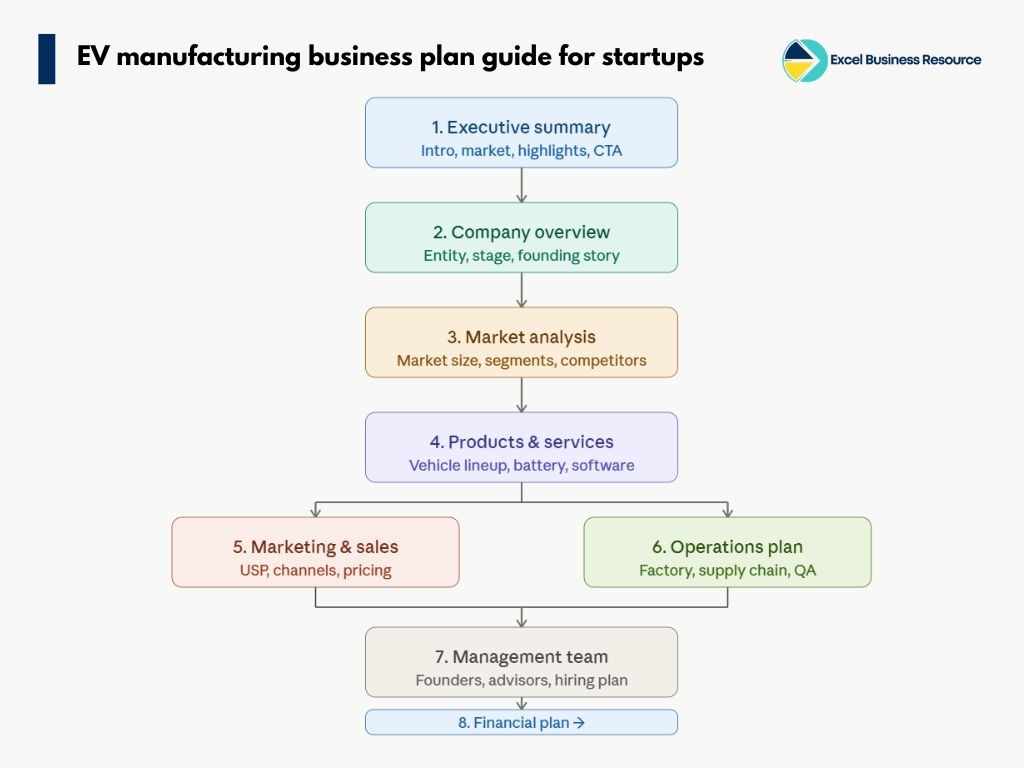
Section 1: Executive Summary Your 60-Second Pitch on Paper
The executive summary comes first in your document but should be written last. It’s the most read section of any business plan investors often decide whether to continue reading based on this alone. Keep it sharp, compelling, and data-backed.
Introduction to Your Business
Start with who you are. What is your company called, where is it based, and what type of EVs will you manufacture passenger cars, two-wheelers, electric buses, three-wheelers, or commercial fleet vehicles? Be specific. We manufacture affordable urban electric two-wheelers targeting emerging markets in South Asia is far more compelling than We make electric vehicles.
The Market Opportunity
Briefly state the market size and growth potential. The global EV market is projected to grow at a CAGR of roughly 13–25% depending on the segment through 2030–2032. Asia Pacific dominates with over 50% market share, but North America and Europe are growing fast. Mention the regulatory tailwinds emission mandates, government subsidies, zero-emission targets that are pushing consumers and fleet operators toward electric mobility.
Products and Services Overview
Summarize what you’re building and what makes it different your unique value proposition. Is it affordability? Range? Modular battery design? Vertical integration? Fleet customization?
Financial Highlights
Mention your total funding requirement, projected revenue for years 1–3, expected break-even timeline, and gross margin target. Investors want to see you have a clear grasp of the numbers not vague aspirations.
Call to Action
Close with what you’re looking for equity investment, debt funding, a strategic partnership and what you’re offering in return. Be direct.
Section 2: Company Overview
This section gives context about your business structure and founding story. Include your legal entity type (LLC, private limited, corporation), founding date, headquarters, and a brief founding story. Why did you start this company? What problem in the EV ecosystem are you solving?
Also clarify the stage you’re at: idea stage, prototype, pre-revenue, or early-stage production. Investors need this context to calibrate their expectations.
Section 3: Market Analysis Know Your Playing Field
This is where many startup founders underdeliver. A surface-level market analysis with generic statistics won’t impress a serious investor. You need to dig deeper.
Industry Overview and EV Market Size
Ground your analysis in credible data. As of 2025, the global electric vehicle market is valued at approximately $900 billion and expected to grow at a CAGR of over 13% through 2032. Battery Electric Vehicles (BEVs) lead the segment with over 52% market share. Over 785 EV models were available globally in 2024, and that number is expected to cross 1,000 by 2026.
Key growth drivers include declining lithium-ion battery costs, expanding charging infrastructure, rising fuel prices, stricter carbon emission regulations, and growing consumer awareness around sustainable mobility.
Target Market Segmentation
Who is your customer? Be specific. Are you targeting individual consumers, corporate fleet operators, logistics companies, ride-hailing platforms, or government agencies? Each segment has very different purchasing behavior, price sensitivity, and decision-making timelines.
A B2B fleet operator evaluates total cost of ownership (TCO) over 5–7 years. An individual consumer prioritizes upfront price and range. Your marketing, pricing, and distribution strategy should reflect this distinction.
Competitive Landscape
Identify direct competitors (EV OEMs in your category and region) and indirect competitors (ICE vehicle manufacturers, second-hand EV markets). Analyze their pricing, model range, distribution network, after-sales service, and technology roadmap. Then clearly articulate your differentiation what gives you an edge that a competitor cannot easily replicate?
Section 4: Products and Services What You're Actually Building
This section is your chance to explain your EV lineup in detail. Describe each vehicle model its specifications, target use case, price point, range, charging time, and key technology differentiators.
Beyond the vehicle itself, discuss your broader product and service ecosystem:
Battery Technology Strategy: Will you develop proprietary battery packs, license technology, or source from established suppliers like CATL or BYD? This is a critical decision that affects both cost structure and competitive positioning.
Software and Connectivity: Modern EVs are increasingly software-defined. Over-the-air (OTA) updates, telematics, fleet management dashboards, and app-based user experiences are becoming standard and high-margin revenue streams.
After-Sales Services: Maintenance programs, warranty packages, charging solutions, and battery swap networks are increasingly important especially for fleet buyers. The global EV software market alone is projected to reach $159 billion by 2028.
Manufacturing Approach: Will you build a fully integrated in-house factory, adopt a contract manufacturing model, or pursue a hybrid approach? Explain your production capacity roadmap from initial units to full-scale manufacturing.
Section 5: Marketing and Sales Strategy
Even the best EV product will fail without a smart go-to-market strategy. This section answers: How will you reach your customers, convert them, and retain them?
Defining Your Unique Selling Proposition (USP)
Your USP should be specific and defensible. “The most affordable long-range electric cargo three-wheeler for last-mile delivery in Southeast Asia” is a USP. “Quality electric vehicles at competitive prices” is not.
Sales Channels
Outline your primary and secondary sales channels. Direct-to-consumer models (like Tesla’s approach) eliminate dealer markups and allow better customer data collection. Dealer networks offer faster geographic reach but reduce control. Fleet sales require a dedicated B2B sales team with longer sales cycles but larger deal sizes.
Digital Marketing and Brand Building
In today’s landscape, your online presence is your first impression. SEO-optimized content, LinkedIn thought leadership, YouTube technical content, targeted advertising, and PR in automotive and sustainability publications all play a role. For fleet buyers, trade shows, industry associations, and direct outreach matter more.
Pricing Strategy
Your pricing must balance market competitiveness with unit economics. Be transparent in your plan about how you’ve calculated your cost-per-unit and your gross margin at different production volumes. Show investors that you understand the relationship between scale and profitability.
Section 6: Operations Plan How You'll Actually Make This Work
This is where the rubber meets the road (pun intended). Your operations plan needs to be realistic and detailed especially for a business as operationally complex as EV manufacturing.
Manufacturing Facility
Setting up a dedicated EV manufacturing plant requires significant capital. A 500,000 sq ft facility with robotics integration, battery production lines, cleanroom environments for quality control, and specialized HVAC systems easily runs into tens of millions of dollars. If you’re a startup, consider phased facility development, contract manufacturing partnerships, or government-supported industrial zones that offer subsidized space.
Supply Chain Management
Your supply chain is one of your biggest risk factors. Lithium, cobalt, nickel, and other critical minerals have volatile pricing and geopolitical supply risks. Map out your top-tier suppliers for batteries, motors, inverters, chassis components, and electronics. Have backup supplier relationships and build buffer inventory strategies into your plan.
Regulatory Compliance and Certifications
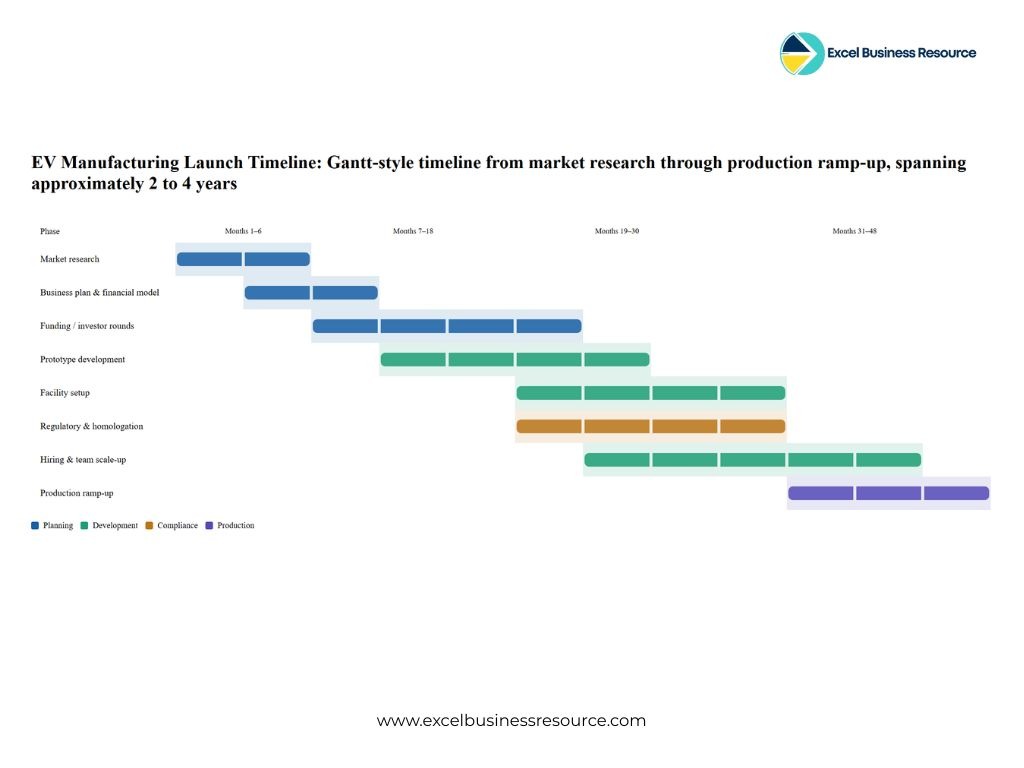
EV manufacturers must navigate a complex regulatory landscape vehicle safety standards, homologation requirements, environmental permits, type approvals, and country-specific emission certifications. These processes take 6–18 months in most markets and should be built into your launch timeline.
Quality Assurance
Describe your quality management system. How will you ensure consistent build quality at scale? What testing protocols will you follow for battery safety, crash standards, electrical systems, and software? Quality failures in EVs can be catastrophic for brand reputation.
Section 7: Management Team The People Behind the Plan
Investors frequently say they invest in teams, not just ideas. This section matters enormously.
Highlight your founding team’s relevant experience automotive engineering, battery technology, supply chain management, regulatory affairs, operations, and finance. If you have advisors or board members with EV industry credibility, name them here.
If your team has gaps a common situation for early-stage startups acknowledge them honestly and outline your hiring plan. Show that you know what talent you need and have a strategy to attract it.
Section 8: Financial Plan The Heart of Your EV Business Plan
This is the section that separates a serious business plan from a wishful document. For an EV manufacturing startup, your financial model needs to cover at minimum five years and address several critical areas.
Startup Costs and Capital Expenditure (CapEx)
EV manufacturing startup costs are substantial. Initial CAPEX for plant construction and assembly robotics can exceed $90 million for a full-scale facility. Robotics per assembly cell can run $5–15 million. High-precision welding equipment, battery testing rigs, and cleanroom setups add tens of millions more. If you’re pursuing a leaner model — contract manufacturing, phased production, or a focused niche your startup cost profile will look different, but must still be realistic and fully detailed.
Operating Costs (OpEx)
Monthly fixed operating expenses plant rent or debt service, R&D licensing, administrative overhead, insurance can easily run $250,000–$500,000 even before production begins. Variable costs include raw materials, labor, quality testing, logistics, and marketing.
Revenue Projections and Sales Forecast
Model your revenue based on realistic unit sales projections, broken down by model and market. What’s your production capacity in Year 1, Year 2, and Year 3? What’s your average selling price? What’s the revenue impact of after-sales services, software subscriptions, and fleet contracts?
Profitability Analysis
Show your gross margin trajectory. Early-stage EV manufacturers typically have thin or negative gross margins due to low production volumes. Your model should demonstrate how margins improve as you scale through economies of scale in procurement, manufacturing efficiency, and fixed cost leverage.
Cash Flow Statement and Break-Even Analysis
Cash flow is the lifeblood of any manufacturing business. Map out your monthly cash burn rate, your peak working capital requirement, and the timeline to cash flow positivity. Investors want to understand your minimum cash runway the total capital you need to survive to profitability.
Funding Requirements and Use of Funds
Be explicit about how much you’re raising, what you’ll use it for (CapEx, OpEx, R&D, marketing, working capital), and the funding milestones that will trigger follow-on rounds.
Is Electric Vehicle Manufacturing Profitable?
This is the question every founder and every investor wants answered honestly. The short answer: yes, but not quickly, and not without scale.
Early-stage EV startups typically operate at a loss for the first 3–5 years as they invest in tooling, certification, production ramp-up, and brand building. Legacy OEMs like Tesla took over a decade to reach consistent profitability. However, the revenue streams available to EV manufacturers today vehicle sales, software subscriptions, fleet services, energy management, after-sales maintenance, and partnerships create multiple paths to long-term profitability.
Profit margins improve dramatically with scale. Sourcing components at volume, optimizing the assembly line, and spreading fixed costs over more units changes the economics substantially.
Government incentives tax credits, production subsidies, R&D grants, and green financing can meaningfully reduce your capital requirements and improve unit economics, especially in markets actively promoting domestic EV manufacturing.
Key Challenges in EV Manufacturing You Must Address in Your Plan
A credible EV manufacturing business plan doesn’t hide the challenges it addresses them head-on. Investors respect founders who understand the risks.
- Capital intensity is the most immediate challenge. EV manufacturing requires large upfront investment before a single vehicle is sold, creating significant cash burn risk in the early years.
- Battery technology and supply chain remain key vulnerabilities. Battery costs represent 30–40% of total vehicle cost, and the supply of critical minerals is subject to geopolitical disruption.
- Regulatory complexity is significant and market-specific. Meeting safety standards, environmental permits, and homologation requirements in multiple markets requires dedicated regulatory expertise and adds time to your launch timeline.
- Competition from established OEMs is intensifying. Companies like BYD, Volkswagen, Hyundai, and Tesla are investing tens of billions into EV platforms and supply chains, creating pricing pressure and brand headwinds for startups.
- Talent acquisition in an industry that blends automotive engineering, software development, battery science, and manufacturing operations is genuinely difficult. Your business plan should acknowledge this and outline your talent strategy.
Conclusion: A Business Plan Is Only as Strong as the Thinking Behind It
Writing an electric vehicle manufacturing business plan is not about filling in a template. It’s about doing the hard intellectual work of thinking through your business model, your market, your operations, and your finances with honesty and rigor.
The EV sector is entering a phase of industrial rationalization. The speculative era of pre-revenue EV startups commanding billion-dollar valuations is over. Today’s investors want to see realistic financial projections, defensible market positioning, a credible team, and a clear path to unit economics that work at scale. Founders who understand this and build their plans accordingly are the ones who secure funding and build lasting businesses.
A well-structured EV manufacturing business plan, backed by a professional-grade financial model, is your most powerful tool in this journey.