

A revenue drivers of laundromat business mainly are wash and dry cycles, charged per load through coins, cards, or an app, and then layers on income through wash and fold, pickup and delivery, and vending. A store with 20 to 30 machines can generate $100,000 to $300,000 a year in gross revenue, and the businesses that hit the higher end of that range are almost always the ones that manage a handful of specific revenue drivers well.
Machine count alone does not decide how much a laundromat earns. Two stores with the same number of washers can post very different numbers depending on utilization, pricing, and service mix. This article focuses purely on where that revenue comes from and which levers actually grow it, so you can look past the machines and understand the business model itself. If you also want the startup budget side of the equation, our earlier guide on the Cost To start A Laundromat Business covers that in full detail.
How Does a Laundromat Business Make Money?
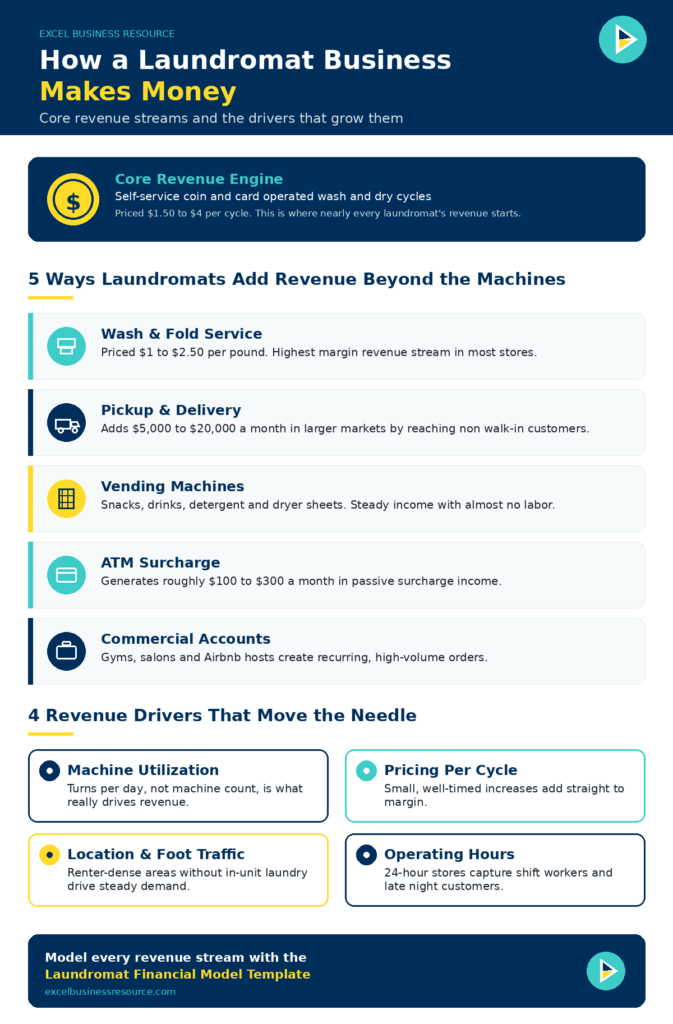
At its core, a laundromat earns money by charging customers per wash and dry cycle. Pricing typically runs $1.50 to $4 per wash, depending on machine size and local market rates. Every cycle a customer runs adds directly to your top line, which is why laundromats are often described as a cash based, low inventory business. There is nothing to manufacture and nothing to restock beyond basic supplies, so almost every dollar collected flows straight into revenue.
This is also why the business rewards volume over headcount. A machine sitting idle earns nothing, but a machine running back to back cycles all day can generate several times its purchase cost in a single year. That single fact, machine utilization, is the real engine behind how laundromat business generate revenue, more than the total number of machines on the floor.
What Are the Main Revenue Drivers of a Laundromat Business?
A handful of specific factors explain most of the gap between an average store and a strong one:
Machine count and mix:
More machines mean more potential cycles, but only if demand supports them. Too many idle machines simply sit as unused capital.
Utilization rate, or turns per day:
This measures how many times each machine runs in a day. Higher turns mean higher revenue without buying a single new machine.
Pricing per cycle:
Even a small price increase, where the local market can support it, adds directly to margin since fixed costs stay the same.
Location and foot traffic:
Areas with a high density of renters, students, or apartment dwellers without in-unit laundry produce the most consistent demand.
Operating hours:
Roughly 20% of U.S. coin laundries run 24 hours a day, which raises utility costs but also captures shift workers and late night customers who would otherwise go elsewhere.
How Do Laundromats Generate Revenue Beyond Coin Machines?
Coin and card cycles are the foundation, but they rarely tell the whole story. Here is how laundromats build revenue on top of that base:
- Wash and Fold Service:
Customers drop off dirty laundry and pick it up washed, dried, and folded, usually priced at $1 to $2.50 per pound. This service carries a noticeably higher margin than self-service because customers are paying for convenience and time, not just machine access.
- Pickup and Delivery:
Especially popular in urban markets, pickup and delivery can add $5,000 to $20,000 a month in larger markets by reaching customers who never plan to walk into the store at all.
- Vending Machines:
Snack, drink, detergent, and dryer sheet vending adds a steady secondary income stream with almost no additional labor required.
- ATM Machines:
An on-site ATM can generate $100 to $300 a month in surcharge revenue, a small but essentially passive addition to the till.
- Commercial Accounts:
Contracts with gyms, salons, Airbnb hosts, or small hotels create recurring, high-volume orders that smooth out the unpredictability of daily walk-in traffic.
Stacking two or three of these on top of core coin revenue is usually what pushes a laundromat from average earnings into a genuinely strong income stream.
How Much Money Can a Laundromat Business Make?
Annual gross revenue for a moderately sized laundromat, with 20 to 30 machines, typically falls between $100,000 and $300,000, according to The Laundry Boss. Owner take home income varies widely across the industry, from roughly $40,000 to over $200,000 a year, based on data from UpFlip and The Laundry Boss, depending heavily on size, location, and how many ancillary services are running alongside the core machines. Some well run stores with a strong wash and fold and delivery mix report margins closer to 30% to 40%, based on figures cited by Cents, which is above the typical range most operators see.
How to Increase Revenue in a Laundromat Business
A few practical moves consistently grow the top line, separate from cost control:
- Introduce cycle upgrades. Extra rinse options or hot versus cold pricing tiers let customers pay more for a better wash without adding equipment.
- Sell commercial contracts before you need them. A single Airbnb host or salon account can replace dozens of unpredictable walk-ins with steady, recurring volume.
- Adopt digital and card payments. Cashless systems make it easier to raise prices incrementally and give you cleaner data on which machines and hours actually perform.
- Run promotions during off-peak hours. Filling slow afternoon slots with discounted cycles raises overall utilization without cutting into peak hour pricing.
- Layer in vending and ATM income early. These require almost no extra labor and add revenue from day one.
Building these assumptions into a real forecast, rather than a flat monthly guess, is where Driver-Based Forecasting earns its keep. It ties your revenue projection to actual machine level activity instead of an arbitrary growth percentage.
Download Ready To Use Laundromat Financial Model
Knowing where the money comes from is only half the job. Turning wash and fold pricing, delivery income, and machine utilization into a month by month forecast is where most founders get stuck. Excel Business Resource has built financial models for startups across more than 30 industries, and our Laundromat Financial Model Template is structured around exactly these revenue drivers rather than a generic one line revenue estimate.
The template breaks revenue down by service line, coin cycles, wash and fold, delivery, and vending, so you can see which one actually moves your bottom line. It also includes a break even calculator and a full expense build, so you are not modeling revenue in isolation from cost.

If you want to build a similar structure yourself from the ground up, our guide on the Startup Financial Forecasting Model From Scratch walks through the process, and our broader Startup Financial Model Template works well as a starting structure for founders comparing formats. Tracking Unit Economics per machine alongside this model will tell you exactly which revenue stream deserves more investment.
For founders who plan to raise money or eventually sell, it also helps to understand Startup Valuation methods and how EBITDA Multiple valuation applies to a cash generating business like this one. Pairing your revenue model with a free revenue forecasting template is a good way to sanity check your assumptions before committing to a full build, and a burn rate and cash runway template helps you see how long your capital lasts while revenue ramps up. Founders comparing formats with other storefront concepts may also find our financial model template for retail businesses useful as a reference point, and an FP&A consultant can help scale your startup once the revenue engine is running and you need tighter forecasting discipline.
Frequently Asked Questions By Founders
What is the main source of income for a laundromat?
The primary income source is per-load payments from self-service coin or card operated washers and dryers, which typically make up the majority of total revenue.
Which revenue stream carries the highest margin in a laundromat?
Wash and fold service generally carries the highest margin among laundromat revenue streams, since customers pay a per-pound rate for convenience rather than just machine time.
How much revenue does wash and fold add to a laundromat?
Wash and fold typically adds 20% to 30% or more to total revenue once it is established, since it is priced by the pound and commands a premium over standard self-service cycles.
What is the biggest factor in laundromat revenue?
Machine utilization, meaning how many times each machine runs per day, has the biggest single impact on revenue, even more than the total number of machines installed.
Understanding how a laundromat business makes money is the easy part. Turning that understanding into an accurate, defensible forecast is where most owners struggle. If you are ready to model your own revenue drivers, our Laundromat Financial Model Template is built to get you there faster.